
Yamauba (山姥, Yamanba): The Mountain Woman Who Came for Her Sandal
Japan's mountain crone — thief-catcher, fire-borrower, dish-lender, and worse
山姥(やまうば) Yamauba ASCII: Yamauba
Also known as: Yamanba, 山婆, やまんば
Pronunciation: yah-mah-oo-bah
Yamauba (山姥, “mountain old woman”; also yamanba) is the woman of the Japanese mountains. In Tsuruoka, a man finds a newly woven straw thing on the hillside, takes it home and hangs it by his back door; that night a voice outside says, give back my ashinaka — it was the yamauba’s sandal. Elsewhere she borrows fire, lends dishes without showing her face, helps with the farm work, sends rice cakes down the stream, or kills anyone who smiles at her.
Quick Facts
- Habitat
- Mountain, Forest, House
- Region
- Tsuruoka (Yamagata), Tokushima, Miyazaki, Kōchi, Kyoto, Kagawa
- Recorded period
- 1943 folklore record, postwar folklore records, modern folklore collections
- Nature
- Mixed
- Danger rating
- If you meet one
- Give the sandal back. What you took for a basket on the mountain was hers. In the article
The danger rating is an editorial summary made for readability. It is not an objective measure found in folklore sources.
Watch the Short
What is Yamauba?
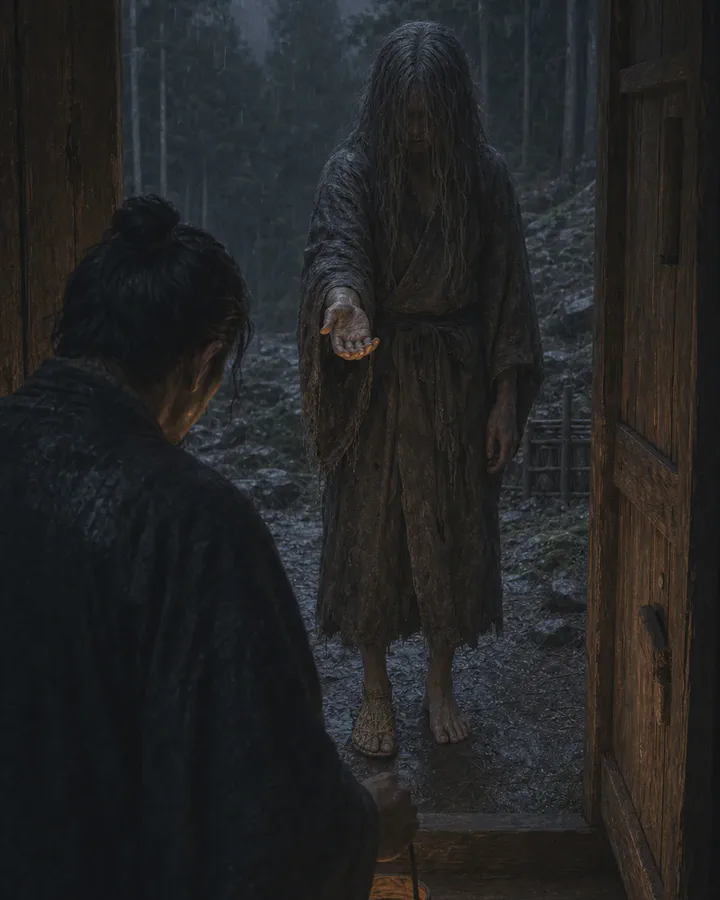
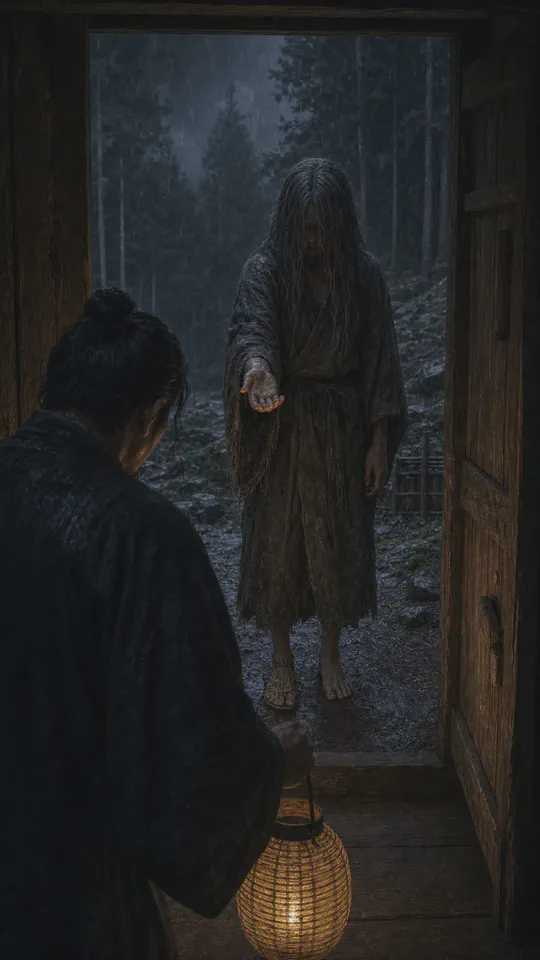
A man went up the mountain one day near Tsuruoka, in Yamagata, and found a brand-new thing woven from bamboo lying on the ground. He took it for a mekke, a kind of basket-work, carried it home and hung it up by the back door. That night someone came to the house. A woman’s voice, outside, in the dark: Give back my ashinaka.
An ashinaka is a short straw sandal that covers only the front half of the foot. What the man had hung by his door was the yamauba’s shoe, and she had walked down the mountain on the other one to collect it.
That was told in 1943, and it is the yamauba at her quietest. No door is broken. Nobody is eaten. The mountain simply knows what was taken from it, and sends someone to ask.
What does yamauba mean?
The name is written 山姥: yama, mountain, and uba, an old woman, a nurse, a crone. The mountain’s old woman. In many regions she is yamanba, the same word worn smooth, and in Kyushu and Shikoku she may be yamahaha, the mountain mother. The name says where she lives and roughly how old she is, and nothing at all about what she will do when you meet her.
Appearance
The Tsuruoka record gives a voice and a missing sandal, and no face. Our illustration gives the voice a body with care: an older woman standing in the rain outside the back door, grey hair soaked flat, worn clothes, one foot in a short woven sandal and the other bare. The face stays in shadow. No fangs, no second mouth in the back of the head, no claws.
The Miyazaki yamauba went further and refused to be seen at all.
Behavior and abilities
- She reclaims. Tsuruoka: what was taken from the mountain is asked for back, that same night.
- She borrows. In Naka, in Tokushima, as told in 1962, a yamauba lived in a great katsura tree and came down to the village to borrow fire, and carried the live coal away on the palm of her hand.
- She lends. At Kotozuka near Nobeoka, in Miyazaki, she lived in a cave in the hill and would lend out trays and bowls to anyone who asked — but never showed her face, and spoke with her back turned. A village tough grabbed her to make her turn round; she roared like thunder and vanished, and afterwards the sound of a koto came out of the cave, which is why the hill is called Koto Mound.
- She helps, at a price. In Ōkawa, in Kōchi (1975), a house the yamauba attached herself to prospered — she did the work — but the family that leaned on her saw its fortune shrink, and when she left, they were poor.
- She feeds. In Miyama, in Kyoto (1982), she pounds rice cakes on the fourteenth of the first month in a mortar of pine, and on the fifteenth she sets them floating down the mountain stream. They smell of pine, and eating one makes you strong.
Never smile at her
The one piece of survival advice comes from Mannō, in Kagawa, told in 1984. If you meet a yamauba in the mountains, keep a straight face and act as though you have seen nothing. Smile at her, and she will have you.
The man with the voice at his door had a different problem, and the Kagawa rule would have been no use to him. There is no single yamauba to have a single rule for. There are mountains, and in each range a woman who deals with the village on her own terms.
Weaknesses and countermeasures
In Tsuruoka, give the sandal back. In Tokushima, when a man did the yamauba an injury, she fled, saying she would return when the katsura’s branches numbered a thousand — and the villagers cut the branches before they could. In Kagawa, do not smile. In Kōchi, do not lean on her. None of these transfers. The recurring lesson is more modest than a charm: nothing found on the mountain is free to take, and the mountain’s woman is not someone to grin at.
Documented tradition and later imagery
Documented tradition. A yamauba who came by night for her stolen ashinaka (Tsuruoka, Yamagata, 1943); one who borrowed fire and carried the coal in her palm (Naka, Tokushima, 1962); one who lent dishes from a cave but never showed her face (Nobeoka, Miyazaki, 1992); one who brought prosperity through her labour and poverty when she left (Ōkawa, Kōchi, 1975); one who sends pine-scented rice cakes down the stream at New Year (Miyama, Kyoto, 1982); and the Kagawa rule to keep a straight face (Mannō, 1984).
Later imagery. Popular pictures fuse the yamauba with cannibalism, fangs, a mouth in the back of the head, and a single tragic origin. Some of those have literary histories of their own. None of them is needed for the rain at the back door, a voice asking for one small shoe, and the discovery that the mountain had noticed.
Sources and further reading
- Fieldwork collection Yamauba and the ashinaka from Tsuruoka, Yamagata, record 1231301 (external link) International Research Center for Japanese Studies The adopted 1943 account: a man takes a newly woven object from the hills, and a woman's voice comes to his back door demanding the return of her ashinaka.
- Fieldwork collection Yamauba seeking a source of fire in Tokushima, record 0730051 (external link) International Research Center for Japanese Studies A 1962 regional account in which a Yamauba comes to a village for fire.
- Fieldwork collection Yamauba lending household dishes in Miyazaki, record C4510115-000 (external link) International Research Center for Japanese Studies A regional account in which Yamauba lends dishes but does not show her face.
- Fieldwork collection Yamauba helping with household work in Kōchi, record 1480100 (external link) International Research Center for Japanese Studies A 1975 regional account showing a helpful mountain-woman tradition.
- Fieldwork collection Mochi offered to Yamauba in Kyoto, record 0700257 (external link) International Research Center for Japanese Studies A 1982 regional account involving mochi sent down a mountain stream.
- Fieldwork collection Advice for a Yamauba encounter in Kagawa, record 0470087 (external link) International Research Center for Japanese Studies A regional account advising a person to act as though nothing unusual was seen.
Where it was recorded
- 1943
Tsuruoka, Yamagata
Folklore record
Voice at the back door: 'give back my ashinaka'
- 1962
Naka, Tokushima
Folklore record
Yamauba of the katsura tree who borrowed fire
- 1992
Kotozuka, Nobeoka, Miyazaki
Folklore record
Lent dishes from a cave but never showed her face
- 1975
Ōkawa, Tosa District, Kōchi
Folklore record
Prosperity while she worked, poverty when she left
- 1982
Miyama, Nantan, Kyoto
Folklore record
Pine-scented rice cakes floated down the stream at New Year
- 1984
Mannō, Kagawa
Folklore record
Keep a straight face; smile and she has you
Places named in the records behind this article. Coordinates are approximate. View on the map
Records behind this article
- 1943 The yamauba comes for her ashinaka sandal
- 1962 The yamauba of the katsura tree who came to borrow fire
- 1975 The yamauba who brings wealth and takes it away
- 1982 The yamauba floats rice cakes down the stream at New Year
- 1984 Meet a yamauba and keep a straight face
- 1992 The yamauba of Kotozuka who lent dishes but never showed her face
On the timeline
- 15th century The Noh stage takes up the monsters
- 1910 Tōno Monogatari
- 1926 Yama no Jinsei: the lore of the mountains
In the glossary
In manga
- Kiitarō Shōnen no Yōkai Enikki 奇異太郎少年の妖怪絵日記 Keeps the traditional forms, invents the stories
- Mokke もっけ Keeps the traditional forms, invents the stories
- Tono Monogatari 水木しげるの遠野物語 Keeps to the recorded tales
Where to see it
- Tōno Municipal Museum 遠野市立博物館 Museum
- Tōno Folktale Museum とおの物語の館 Museum
- Kinasa Folk Museum and the Demon Woman Momiji 鬼無里ふるさと資料館と鬼女紅葉の里 Museum
- Yokai Yashiki at Ōboke 妖怪屋敷と石の博物館(道の駅大歩危) Museum
Related yokai
Yuki-onna
雪女(ゆきおんな)
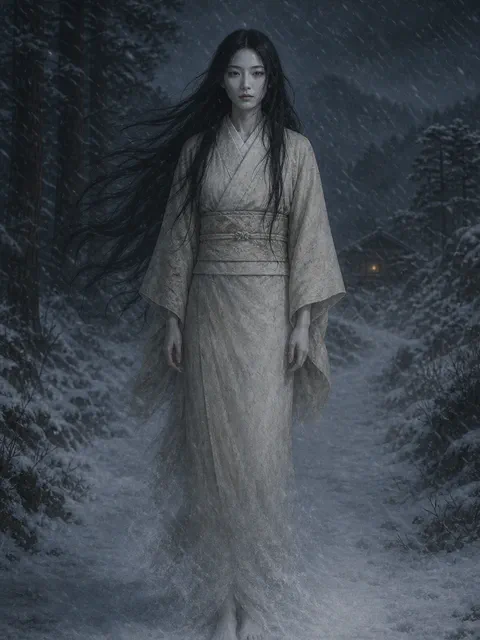
A pale woman seen on winter roads, sometimes deadly, sometimes harmless, and never described the same way everywhere.
Satori
覚(さとり)
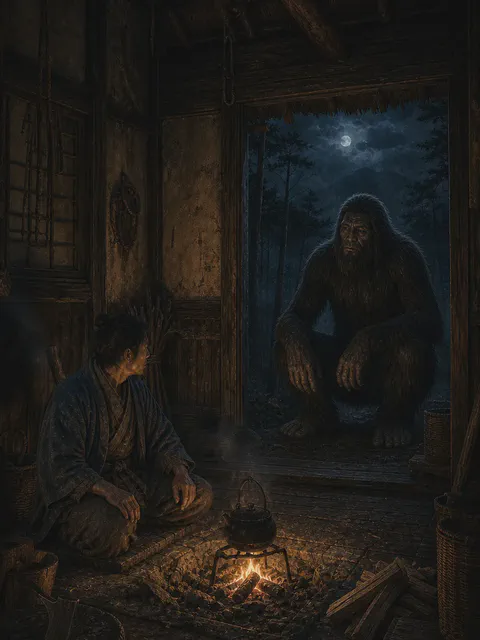
Sekien's 1779 entry describes a black, long-haired creature of the deep mountains that understands speech, reads what you are thinking, and leaves the moment you decide to kill it — and a later tale defeats it with something nobody thought at all.
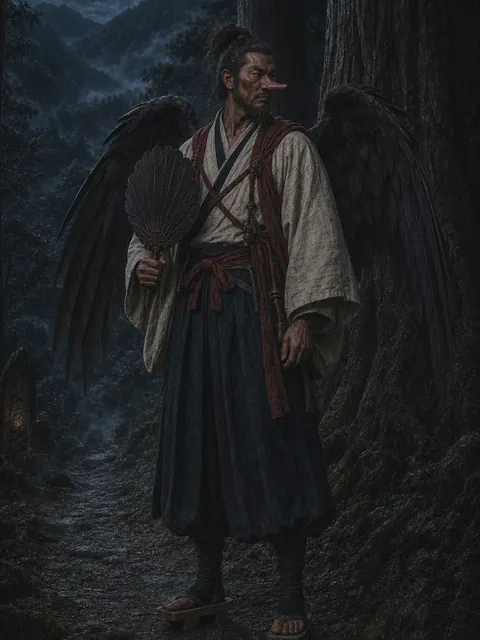
Tengu
天狗(てんぐ)
A mountain being associated with flight, impossible voices, disappearances, and more than one familiar face.