Ushi-oni (牛鬼, Gyūki): The Horned Thing Among the Rocks
Japan's ox demon — a silent print, a festival giant, and a beast on the Iwami shore
牛鬼(うしおに) Ushi-oni ASCII: Ushi-oni
Also known as: Gyūki, Ushioni
Pronunciation: oo-shee oh-nee
Ushi-oni (牛鬼, “ox demon”; also read gyūki) is the horned, bull-headed yokai of the Japanese shore. In Toriyama Sekien’s 1776 print it crouches among wet rocks at the waterline — two curved horns, a bovine muzzle, long hair, and a low body ringed with thick clawed limbs — with no caption but the name. On the Iwami coast it is the beast that comes out of the dark after a fisherman who has been handed a baby by a wet-haired woman. In Uwajima it is a festival giant carried through the streets.
Quick Facts
- Habitat
- Coast, Sea
- Region
- Japan, Nanyo (southern Ehime)
- Recorded period
- Gazu Hyakki Yagyō (1776), Edo-period festival record (1784)
- Nature
- Unknown
- Danger rating
- If you meet one
- Get inside the nearest house. The fisherman reached a farmhouse, and the door was what saved him. In the article
The danger rating is an editorial summary made for readability. It is not an objective measure found in folklore sources.
Watch the Short
What is Ushi-oni?
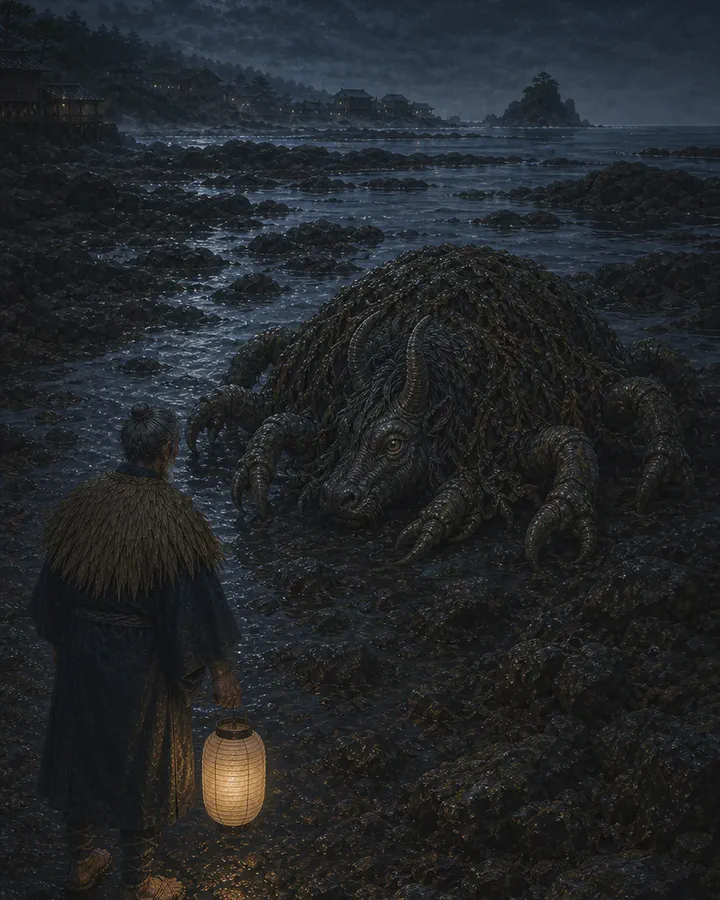
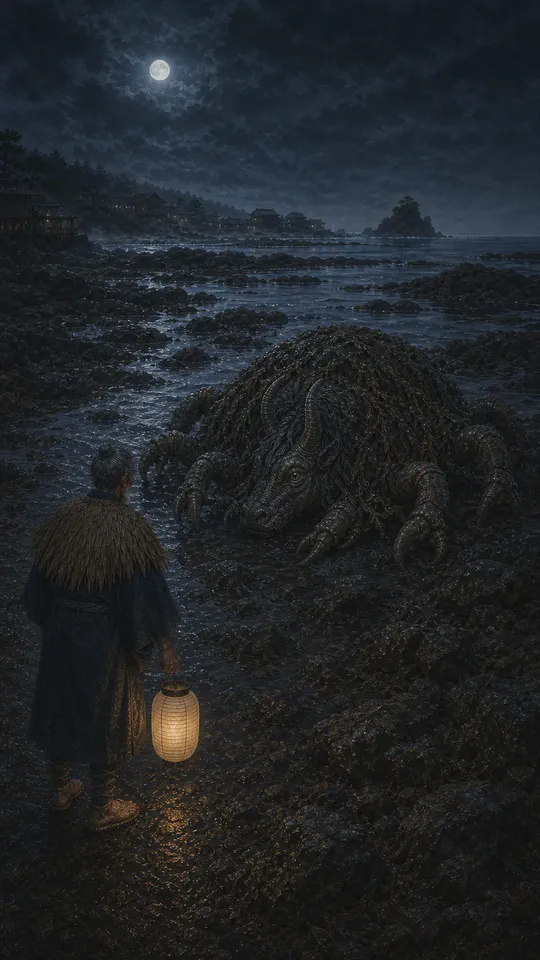
In Gazu Hyakki Yagyō, the “Illustrated Night Parade of a Hundred Demons” that Toriyama Sekien published in 1776, there is a page with the sea on it. Among the rocks at the waterline something is crouched that could be a rock itself until you look again: two curved horns over a bull’s muzzle, round eyes, long unkempt hair, and under the head not a bull’s body at all but a low, rounded mass with thick jointed limbs coming out all round it, each one ending in a hook.
The caption reads ushi-oni, and nothing else. No place, no victim, no warning, no way out. It is one of the most striking images in the yokai books and one of the least explained, and the explanation has been supplied ever since by other coasts.
What does ushi-oni mean?
The name is written 牛鬼: ushi, an ox or bull, and oni, the horned demon of Japanese Buddhism and folklore. The ox-demon. Read in the Chinese manner the same characters give gyūki. The word says a horned head and something monstrous under it, and it has been applied to things that share little else.
Appearance
Sekien’s anatomy is restrained and worth keeping: a compact shoreline creature, nearly readable as terrain, not a towering sea monster. Our illustration holds those proportions — the horns, the hair, the low body pressed to the rock, the hooked limbs reaching round it — and lets the horror be the moment the rock moves.
Behavior and abilities
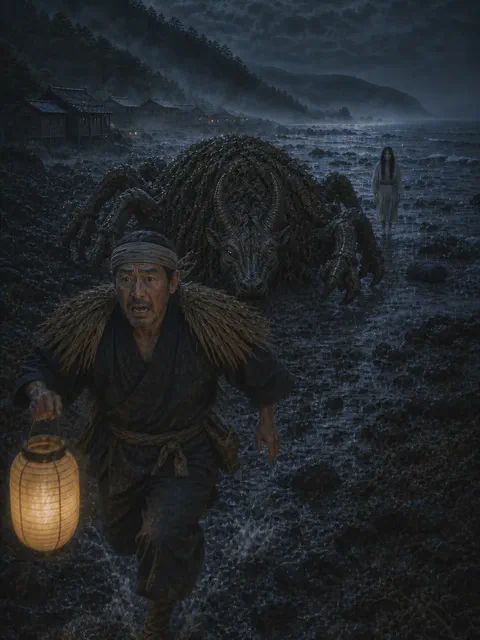
The print gives a posture, not a behaviour: it lies among the rocks at the tideline, partly hidden. On the Iwami coast of Shimane, the behaviour is supplied. A fisherman walking home at night, in a story told in 1933, meets a woman with wet hair who puts a baby in his arms and vanishes — the nure-onna. He throws the bundle down and runs, and out of the dark behind him comes an ushi-oni, and chases him to a farmhouse door.
- It waits at the water’s edge. Sekien.
- It pursues. Iwami, after the woman has done her part.
- It is stopped by a door. The farmhouse is where the Iwami story ends.
One name, several creatures
The word ushi-oni belongs to more than one tradition, and running them together is the usual mistake.
In Uwajima, in southern Ehime, the ushi-oni is a festival giant — a huge cloth-and-bamboo body on a long neck, carried through the streets by a crew ahead of the shrine’s portable shrine to clear and purify the route. The city dates its first written mention to 1784. It is civic ritual with a schedule, not a monster on the rocks.
An eighteenth-century picture scroll of the Rashōmon tale has an ushi-oni behind the illness of Minamoto no Yorimitsu, destroyed by his retainers — a warrior legend in the same family as the tsuchigumo.
A picture with no story, a beast that chases fishermen, a festival with a job to do, and a hero’s tale: one horned word, four things.
Weaknesses and countermeasures
Sekien gives none. Iwami gives one, and it is not a technique: the fisherman got inside. No blade, charm or phrase appears anywhere in the coastal records; the only thing that worked was a door between the man and the thing behind him.
Documented tradition and later imagery
Documented tradition. Sekien’s 1776 print of a horned, long-haired head on a squat clawed body among shoreline rocks, captioned only with the name; the Iwami record of 1933 in which an ushi-oni pursues a fisherman after the nure-onna hands him a child; the Uwajima festival ushi-oni, first attested in 1784; and the Rashōmon scroll’s ushi-oni slain by Yorimitsu’s men.
Later imagery. Games and encyclopedias merge all of this into a single giant sea monster with a spider’s legs, poison breath and tidal waves, hunting as a pair with the nure-onna. Those are inventions built on a picture that stayed silent. The print is more unsettling for what it withholds: a face in the rocks, and no instructions.
Sources and further reading
- Primary text Ushi-oni, from Gazu Hyakki Yagyō (1776) (external link) Toriyama Sekien; Wikimedia Commons scan Sekien's print of a horned head on a squat clawed body among shoreline rocks. It carries no caption beyond the name, so it records no attack, victim, weakness or location.
- Library Gazu Hyakki Yagyō bibliographic record (画図百鬼夜行) (external link) National Diet Library Search Bibliographic record for Sekien's 1776 picture book.
- Library Hyakki Yagyō holding record (external link) Tokyo University of the Arts Library Library catalogue record for a copy of the picture book.
- Reliable secondary Autumn festival of Uwatsuhiko Shrine (external link) Uwajima City, Ehime Describes the Ushi-oni festival float that clears the way ahead of a shrine procession, first attested in 1784. A separate tradition from Sekien's shoreline creature.
- Museum Rashōmon Emaki cultural property record (external link) Agency for Cultural Affairs heritage database An eighteenth-century scroll with a different Ushi-oni narrative involving Minamoto no Yorimitsu.
Where it was recorded
- 1784
Uwajima, Ehime
Living rite
Festival ushi-oni carried ahead of the portable shrine
- 1933
Iwami coast (Ōda), Shimane
Folklore record
Chases the fisherman after the nure-onna hands him a baby
Places named in the records behind this article. Coordinates are approximate. View on the map
Records behind this article
On the timeline
In the glossary
In manga
- GeGeGe no Kitarō ゲゲゲの鬼太郎 Keeps the traditional forms, invents the stories
- Kiitarō Shōnen no Yōkai Enikki 奇異太郎少年の妖怪絵日記 Keeps the traditional forms, invents the stories
- Nura: Rise of the Yokai Clan ぬらりひょんの孫 Uses the names, reinvents the rest
- Yokai Doctor 妖怪のお医者さん Uses the names, reinvents the rest
Where to see it
- Warei Shrine 和霊神社 Shrine or temple
- Uwajima Ushi-oni Festival うわじま牛鬼まつり Festival
Related yokai
Nure-onna
濡女(ぬれおんな)
In Iwami in 1933, a fisherman walking home at night was handed an infant by a wet-haired woman — and when he threw the bundle down and ran, something else came out of the dark after him.
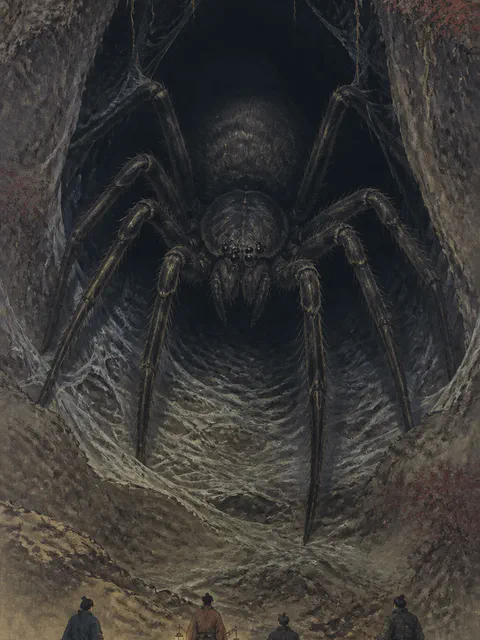
Tsuchigumo
土蜘蛛(つちぐも)
A monk appears at a sick warlord's bedside and throws spider silk at him. That is the tale. But the same word, centuries earlier, was what the court called people it wanted to treat as outsiders.
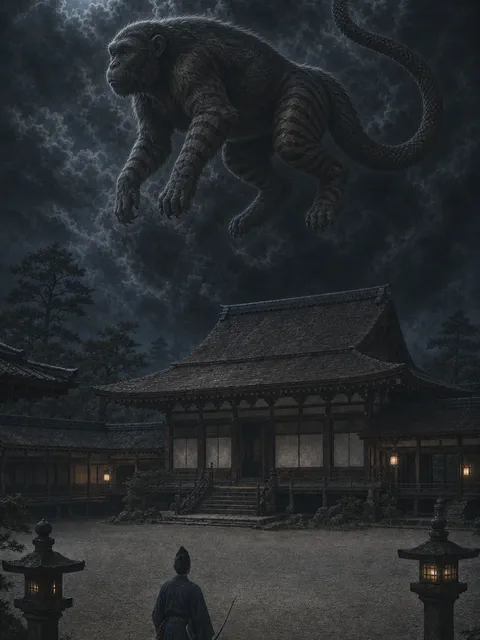

Nue
鵺(ぬえ)
In The Tale of the Heike, a black cloud and a bird's cry sicken the emperor until an archer shoots the creature down — and the versions disagree on what fell.