
Tsurube-otoshi (釣瓶落とし, Tsurube-oroshi): The Bucket That Drops From the Treetops
The thing that falls from tall trees in Aichi, the oni in the cedar with a golden bucket, and the voice in the zelkova that asks whether your night work is done
釣瓶落とし(つるべおとし) Tsurube-otoshi ASCII: Tsurube-otoshi
Also known as: Tsurube-oroshi
Pronunciation: tsoo-roo-beh oh-toh-shee
Tsurube-otoshi (釣瓶落とし, “the dropping well-bucket”) is the thing that falls without warning from the top of a tall tree onto the road beneath. A note printed in 1938 gives two stories from Aichi: in one it simply drops from the crown of a great tree; in the other an oni lives in a huge cedar and scoops up the people passing below in a golden bucket. In Kyoto, Fukui, Gifu and Shiga the same name, or its twin tsurube-oroshi, “the lowering bucket”, belongs to a bucket let down from a pine or a zelkova at night, sometimes with laughter, sometimes with a question.
Quick Facts
- Habitat
- Forest, Road
- Region
- Japan, Aichi, Kyoto (Kameoka, Nantan), Fukui (Ōi), Gifu (Ibigawa), Shiga (Hikone), Wakayama (Kainan), Hyōgo (Tamba-Sasayama)
- Recorded period
- Edo ghost-story books (1686), Taishō and Shōwa folklore records (1938, 1992)
- Nature
- Harmful
- Danger rating
The danger rating is an editorial summary made for readability. It is not an objective measure found in folklore sources.
Watch the Short
What is Tsurube-otoshi?
Somewhere in Aichi there was a road that ran under tall trees, and something came down out of them. A note printed in August 1938 in a folklore journal, in a running glossary of yokai names, took the entry from a collection of Aichi legends and gave it in two sentences. The tsurube-otoshi comes down all at once from the crown of a great tree. And there is another story: an oni lived in an enormous cedar, and it scooped up the people who walked beneath it with a golden bucket.
Those are two different things, and the note keeps them apart. The first has no body at all; it is a fall, a weight arriving from above. The second has an oni, a tree with a name, and a bucket on a rope, the ordinary gear of a village well, hauling a person up into the dark instead of water. The note gives no face to either, no village, no year of any encounter, and no word on what became of the people in the bucket.
What does tsurube-otoshi mean?
A tsurube is a well-bucket: the wooden pail on a rope that was let down a well and hauled up full. Otoshi is dropping, and oroshi is lowering, so the name is either “the bucket that drops” or “the bucket that is let down”, and both forms were in use, often for the same story. The Aichi note lists it under three headings at once, tsurube-otoshi, tsurube-oroshi and oni. The picture in the name is of someone at the top of a tree working a well-rope, with the road for a well.
The name is only found in the central and western parts of Honshu, in the Tōkai and Kinki regions. Elsewhere things fall from trees too, but they are not called buckets.
The voice in the tree
In the Kuchi-Tanba district of Kyoto, at Hōki in the village of Sogabe, now part of Kameoka, the tsurube-oroshi dropped suddenly from a kaya tree, a Japanese nutmeg-yew, and burst out laughing. Then it spoke. “Is the night work finished? Shall I lower the bucket? Gii, gii.” And it went back up the tree. The lines were written down in a Taishō-era collection of the district’s oral lore. Yonabe, night work, was the spinning, weaving and mending done by lamplight after the day’s labour; the voice in the tree is asking a question that only someone out late on the road could be asked.
Across the mountains in Fukui, at Natashō in the town of Ōi, the same question was being asked from a zelkova. Late at night, when the hour was far gone, a voice came down from the top of the tree, “Shall I lower the bucket? Have you finished your night work?”, and a bucket came down. This was the tsurube-oroshi of the village, written into the settlement’s chronicle and discussed in a 1992 paper on the Hokuriku examples. Two regions, one tree-top catechism, and in neither of them is there any word about what the bucket was for.
Heads, buckets, and a coin
The rest of Sogabe did not keep to buckets. At Tera, another hamlet of the same village, what came down from an old pine was a severed head, and it ate people; then, as if it had eaten its fill, it stayed away for two or three days before appearing again. In the village of Tomimoto, now in Nantan, an eerie old pine wound round with vines was feared as the place the tsurube-oroshi came out, and at Tsuchida in the village of Ōi, now also in Kameoka, the tsurube-oroshi ate people too.
In Gifu, at Tsukumi in the village of Kuze, now Ibigawa, it lived at the top of a great tree in a place that was dim even by day, and it dropped its bucket. In Hikone, in Shiga, it sat on a branch and dropped the bucket at whoever passed. In the town of Kuroe, now part of Kainan in Wakayama, a tale set in the Genroku years at the end of the seventeenth century has a bucket standing at the foot of an old pine with something glinting inside it. A passer-by takes the glint for a gold coin and reaches in, and is pulled into the bucket and hauled up into the tree, where the thing that lives there frightens them, or eats them, or throws them down to the ground to die.
And in the castle town of Sasayama, in Hyōgo, “the kaya tree at Tsuboi” was one of the seven wonders of the town. The tree stood at a samurai house near the eastern gate and gave off a ghostly air, and anyone passing under it at night had a severed head fall on them. In time the trick came out: a sake bottle with a hairpiece stuck to it had been hung up on a rope and let drop at the right moment. Until then it was told as a tsurube-otoshi.
Appearance
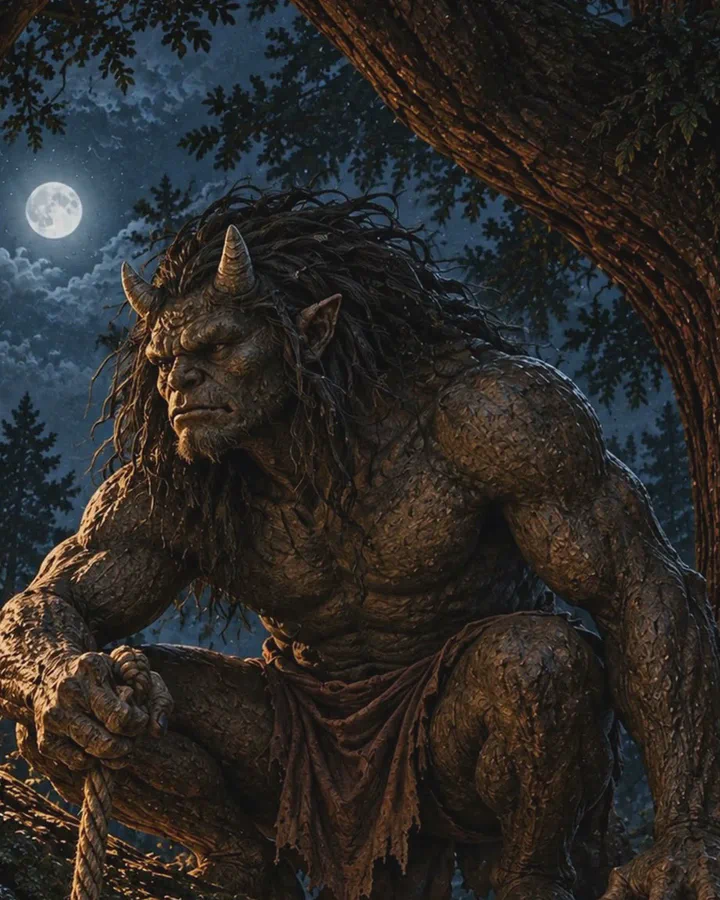
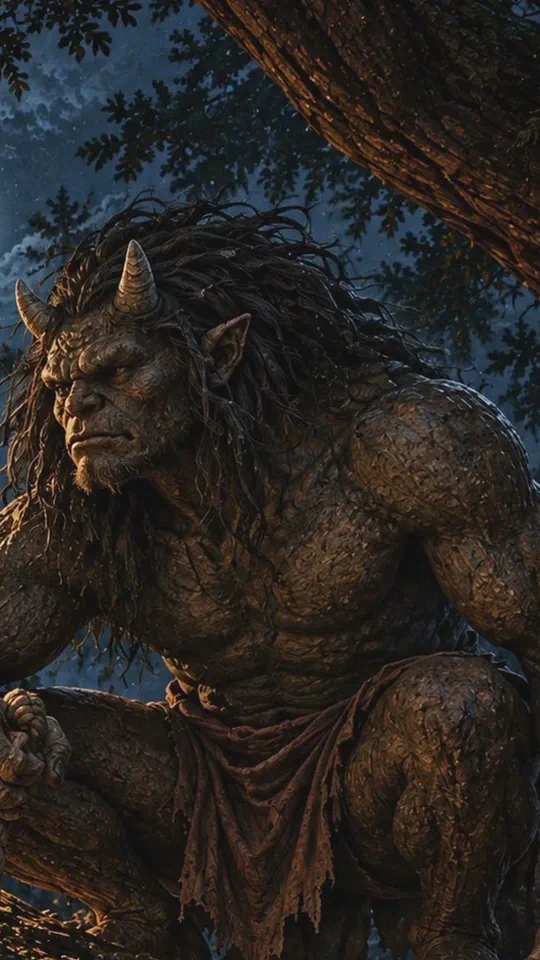
The Aichi note gives nothing. The falling thing has no shape; the oni in the cedar has no colour, no horns, no size. The Kyoto tellings give a laugh and a head; the Fukui telling gives a voice; Kuroe gives a glint in a bucket. Our illustration keeps the parts that every version shares: an enormous cedar on a night road, a rope coming down out of its branches, and an empty wooden bucket hanging at the end of it. The oni in the branches is a figure the colour of bark, drawn to fit the story and not to copy any picture.
Behavior and abilities
- It drops. From the crown of a great tree, all at once, onto the road.
- It scoops. In the Aichi story the oni lifts passers-by in its golden bucket; at Kuroe the bucket pulls in whoever reaches for the coin.
- It asks. “Is the night work done? Shall I lower the bucket?” in Kameoka and in Natashō.
- It laughs. At Hōki, before it speaks.
- It eats. At Tera and Tsuchida, and in Kuroe, and then rests for two or three days.
Weaknesses and countermeasures
None are recorded. No charm, no word to say back, no way to cut the rope. The only countermeasure in any of the stories is the one that uncovered the Sasayama head: looking closely enough, often enough, to find the man with the rope. Everywhere else the records take it for granted that you know which tree it is, and that you are not under it after dark.
Documented tradition and later imagery
Documented tradition. The two Aichi stories in the 1938 note, the fall from the treetop and the oni with the golden bucket; the laughing, questioning tsurube-oroshi of Hōki and the head-dropping pine of Tera in the Taishō-era Kuchi-Tanba collection, with Tomimoto and Tsuchida; the Natashō zelkova in Fukui; the bucket-droppers of Tsukumi in Gifu and Hikone in Shiga; the coin in the bucket at Kuroe; and the kaya tree at Tsuboi in Sasayama, which turned out to be a bottle on a string.
Later imagery. The oldest tsurube-oroshi in print is not a bucket at all. A ghost-story book of 1686 describes “the tsurube-oroshi of Nishioka” as the spirit of a great old tree coming down as a ball of fire, and its author explains it by the five phases: on a rainy day, water gives rise to wood, and wood to fire. Sekien drew that fireball in 1776 and called it the tsurube-bi, the bucket fire, and modern yokai books have kept the two apart ever since, the fire on one page and the falling head or bucket on another; in Yamagata the thing that comes down out of a cedar at dusk is a red-hot cooking pot that carries off the children still out playing. The bronze on the yokai street in Sakaiminato wears the Hōki address and says the tsurube-otoshi pulled people up and ate them. The 1938 note is barer than any of it: a tree, a drop, and no face at all.
Sources and further reading
- Fieldwork collection Tsurube-otoshi, tsurube-oroshi and oni, record 2180761 (Aichi) (external link) International Research Center for Japanese Studies Yanagita Kunio, "Yōkai Meii (3)", Minkan Denshō 3(12), 20 August 1938, p. 12, from a collection of Aichi legends: it falls suddenly from the crown of a great tree, and in another story an oni living in a huge cedar scoops up passers-by with a golden bucket.
- Fieldwork collection Tsurube-oroshi, record 0540093 (Ōi, Fukui) (external link) International Research Center for Japanese Studies Matsumoto Kōzō, "The tsurube-otoshi apparition in Hokuriku", Kanō Minzoku Kenkyū 23, 1992, p. 47, citing the chronicle of a Natashō settlement: late at night a voice from the top of a zelkova asks whether to lower the bucket and whether the night work is done, and a bucket comes down.
- Database Tsurube-otoshi (釣瓶落とし) (external link) Wikipedia (Japanese) The Kuchi-Tanba tellings from Sogabe, Tomimoto and Ōi, the Gifu and Shiga bucket-droppers, the Kuroe coin tale, the 1686 fireball and Sekien's tsurube-bi, and the Yamagata red-hot pot, with the printed sources for each.
- Reliable secondary The seven ghostly wonders of Sasayama (Folk tales and legends of Sasayama) (external link) Tamba-Sasayama City The kaya tree at Tsuboi near the castle's eastern gate: a severed head fell on night passers-by, later found to be a sake bottle with a hairpiece let down on a rope; told as a tsurube-otoshi until then.
- Museum The tsurube-oroshi of Nishioka, from Kokon Hyakumonogatari Hyōban (File:Genrin Tsurube-oroshi.jpg) (external link) Wikimedia Commons The woodblock illustration of the 1686 ghost-story book by Yamaoka Genrin, which treats the tsurube-oroshi as the spirit of an old tree descending as fire. Consulted for research only.
- Reliable secondary Yokai of the forest: the bronze statues of Mizuki Shigeru Road (external link) Mizuki Shigeru Museum, Sakaiminato Statue 52, tsurube-otoshi, labelled with Hōki in Sogabe, Kameoka: it hangs down suddenly from the treetops, and in some tellings pulls people up and eats them. Consulted for the later image only.
Where it was recorded
- 1938
Aichi (village unnamed), Aichi
Folklore record
Falls suddenly from the crown of a great tree; in another telling an oni living in a huge cedar scoops up passers-by with a golden bucket
- undated
Hōki, Sogabe (now Kameoka), Kyoto
Legend or tale
Drops from a kaya tree, laughs, asks whether the night work is done and whether it may lower the bucket, then climbs back up
- undated
Tera, Sogabe (now Kameoka), Kyoto
Legend or tale
A severed head comes down from an old pine and eats people; sated, it stays away for two or three days
- 1992
Natashō, Ōi town, Fukui
Folklore record
Late at night a voice from the top of a zelkova asks whether to lower the bucket and whether the night work is finished, and a bucket comes down
- undated
Tsukumi, Kuze (now Ibigawa), Gifu
Legend or tale
Lives in a great tree where it is dim even by day and drops a bucket on people
- undated
Hikone, Shiga
Legend or tale
From a branch it drops its bucket at passers-by
- undated
Kuroe, Kainan, Wakayama
Legend or tale
A bucket at the foot of an old pine with something shining inside; whoever reaches for the coin is pulled into the bucket and hauled up into the tree
- undated
Tsuboi, Sasayama castle town (now Tamba-Sasayama), Hyōgo
Legend or tale
A severed head fell from a kaya tree at night; it proved to be a sake bottle with a hairpiece let down on a rope
Places named in the records behind this article. Coordinates are approximate. View on the map
Records behind this article
Related yokai
Tenjō-sagari
天井下り(てんじょうさがり)
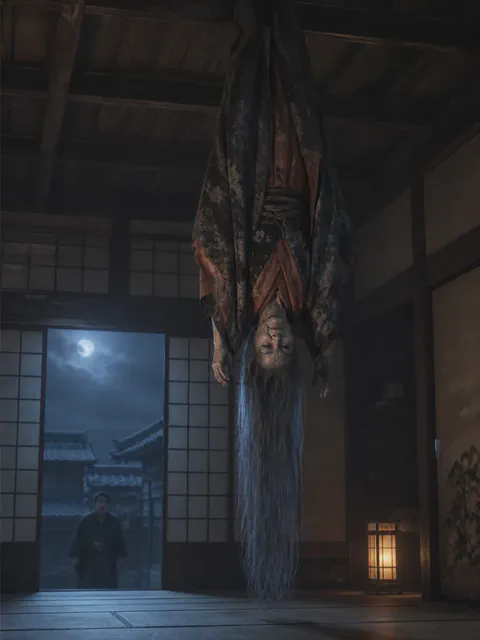
In 1779 Sekien drew an old woman hanging upside down from the ceiling, and wrote a caption that is mostly a joke — about a demon who once escaped through a roof, and a phrase for knocking someone flat.
Chabukuro
茶袋(ちゃぶくろ)
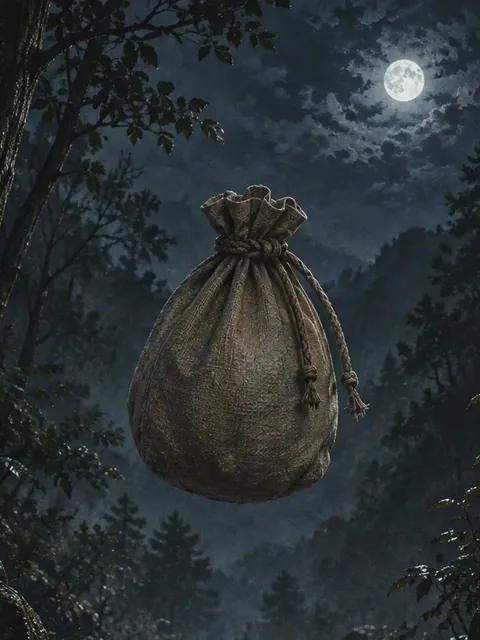
A tea-steeping bag that hangs in the air on eerie stretches of road in the Hata district of Kōchi, recorded in 1938, with illness blamed on anyone it strikes; related bags hang from trees in Kagawa and float on rivers in Wakayama.
Ōkubi
大首(おおくび)
In the Inō Mononoke-roku, set in Miyoshi in 1749, sixteen-year-old Heitarō faces a month of nightly visitations. One night an old woman's face, teeth blackened, fills his doorway. He takes the fire tongs to it.

Mikoshi-nyūdō
見越入道(みこしにゅうどう)
A 1938 Nagasaki record warns of bamboo rustling over a night road and a looming figure that must be recognized aloud.