
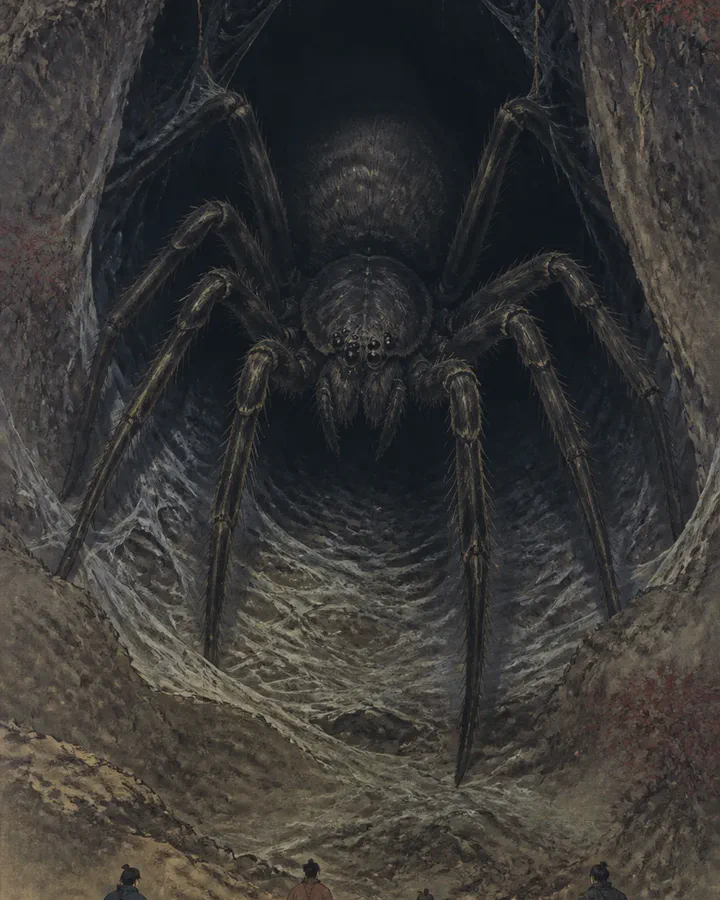
Tsuchigumo (土蜘蛛): The Earth Spider at Yorimitsu's Bedside
Japan's giant spider yokai — and the older, uglier meaning of the same word
土蜘蛛(つちぐも) Tsuchigumo ASCII: Tsuchigumo
Also known as: Earth spider
Pronunciation: tsoo-chee-GOO-moh
Tsuchigumo (土蜘蛛, “earth spider”) is the giant spider of medieval Japanese legend. The warrior Minamoto no Yorimitsu lies sick in bed; a monk nobody recognises comes to his room at a strange hour and throws threads of spider silk over him; Yorimitsu cuts at him and drives him off, and in the morning his retainers follow the trail to a lair and kill the thing inside. Centuries earlier, the same word was what the Yamato court called people it refused to count as its own.
Quick Facts
- Habitat
- House, Mountain
- Region
- the capital, in the Yorimitsu tales
- Recorded period
- ancient chronicles for the older meaning, medieval tales and nō for the spider
- Nature
- Harmful
- Danger rating
- If you meet one
- Strike, then follow the trail of blood. It leads to the mound where the spider waits. In the article
The danger rating is an editorial summary made for readability. It is not an objective measure found in folklore sources.
Watch the Short
What is Tsuchigumo?
Minamoto no Yorimitsu — Raikō, the great demon-slayer of the Heian court — is ill, and has been for days, and nobody can say why. One night a monk comes to his room. He is not a monk anyone in the household knows, and the hour is wrong. He stands by the bed, and then he is not a visitor any more: he throws threads of spider silk over the sick man, loop after loop.
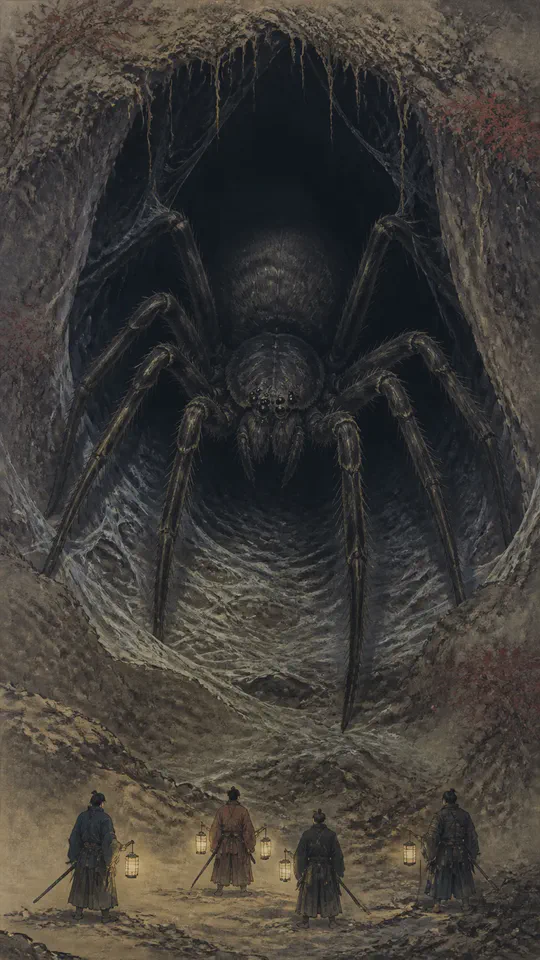
Yorimitsu gets a hand to his sword and cuts. The monk is gone. In the morning the retainers find what he left — silk, blood, a trail — and follow it out of the city into the hills, to a mound, and to the thing inside the mound, which is a spider the size of a room. They kill it, and the fever lifts.
That is the tsuchigumo of the Tsuchigumo Zōshi picture scroll, of the Sword Chapter of The Tale of the Heike, and of the nō play. The three differ on names, places and the size of the body count. What they share is the shape: sickbed, monk, silk, pursuit.
What does tsuchigumo mean?
The name is written 土蜘蛛: tsuchi, earth, and kumo, spider. The earth spider — a spider that lives in the ground, in a mound or a pit, rather than in a web. It is pronounced tsoo-chee-GOO-moh.
The real spider of that name, the purse-web spider, digs a burrow and lines it with silk. The legend’s spider does the same at a scale that needs a hill.
Appearance
Our illustration takes the moment before the disguise fails: the room, the man on the bed, and something behind him that the room is not big enough for. The spider is an original design. The tale is centuries older than any one painting of it, and the Edo print-makers who drew the sickroom over and over never agreed on a body either.
Behavior and abilities
- It disguises itself. The monk is the whole first act, and the disguise is good enough to get through the door of a warrior’s house.
- It sickens from a distance. Yorimitsu is already ill when the monk arrives. In most tellings, the spider is the illness.
- It throws silk. The weapon is entanglement, not force.
- It bleeds and it leaves a trail. Which is what ends it.
The older word
In the Nihon Shoki and the provincial gazetteers of the eighth century, tsuchigumo is not a spider. It is a name the Yamato court gave to groups in the provinces who did not submit to it — people living in pits and caves, the chronicles say, short of body and long of limb, described entirely from the outside by the side that was winning and writing.
That is a political vocabulary, not a bestiary. Nothing in those passages describes a monster, and reading them as if they did gets the history backwards: the only thing inhuman in them is the point of view. The word sat in the old books for several hundred years, and when a medieval storyteller needed a name for the thing in the mound outside Kyoto, it was there to be taken. The spider inherited the insult.
Weaknesses and countermeasures
The disguise is the creature’s only real advantage, and it is spent in the first scene. After that the tale is a manhunt. The retainers need no charm, no blessed blade and no secret knowledge; they need a trail, and there is one. For a thing that reached a sleeping warrior’s bedside unseen, it is remarkably easy to find once it stops pretending to be a monk.
Documented tales and later imagery
Documented tales. The Tsuchigumo Zōshi scroll, the Sword Chapter of The Tale of the Heike, and the nō play Tsuchigumo: a monk at the bedside of the ailing Minamoto no Yorimitsu, threads of silk, a wound, a trail, a mound, a giant spider. Separately and much earlier, tsuchigumo in the Nihon Shoki and the gazetteers as the court’s name for provincial groups it cast as outsiders.
Later imagery. Edo print-makers made the sickroom a favourite subject, and the giant spider looming over Yorimitsu’s pillow is now the fixed image of the story; games add venom and a web-filled dungeon. What goes missing beside the picture is the word’s second history, in which nobody was a spider and the monsters were a matter of who held the brush.
Sources and further reading
- Museum Nishiki-e: Minamoto no Yorimitsu's mansion and the earth spider National Museum of Japanese History Later imagery of the sickbed, the spider disguised as a monk, and the cords of silk.
- Museum Fukutomi Zōshi and otogi-zōshi picture scrolls Kyoto National Museum Exhibition context for Tsuchigumo Zōshi as a tale of Yorimitsu and his four retainers.
- Database What does 'Tsuchigumo' refer to? Collaborative Reference Database, National Diet Library Establishes that in the ancient sources the word names regional groups the Yamato court treated as outsiders, not a giant spider.
Where it was recorded
- undated
Kyoto (Yorimitsu's residence), Kyoto
Legend or tale
Monk at the sickbed throws silk; the mound of the earth spider
Places named in the records behind this article. Coordinates are approximate. View on the map
Records behind this article
On the timeline
- 712–720 The first chronicles are compiled
- c. 1000 The court of Emperor Ichijō, where the demon-slaying tales are set
- 14th century The first monster-slaying scrolls
- 15th century The Noh stage takes up the monsters
In the glossary
In manga
- Kakuriyo: Bed & Breakfast for Spirits かくりよの宿飯 Uses the names, reinvents the rest
- Nura: Rise of the Yokai Clan ぬらりひょんの孫 Uses the names, reinvents the rest
- Toilet-bound Hanako-kun 地縛少年花子くん Yokai-adjacent: urban legends and mixed lore
- Yōkai Hunter 妖怪ハンター Uses the names, reinvents the rest
Related yokai
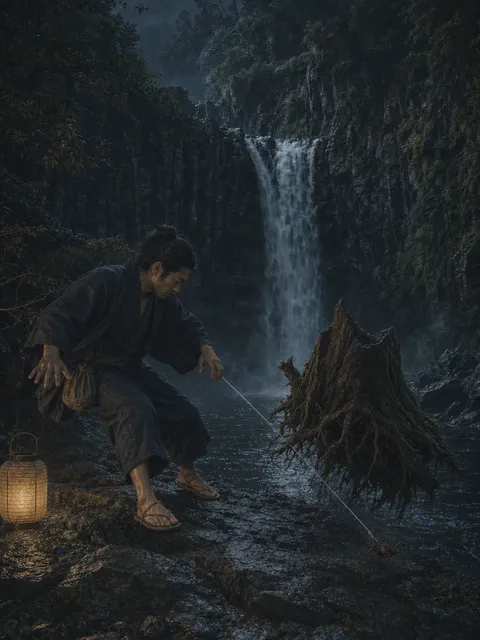
Jorōgumo
絡新婦(じょろうぐも)
At a waterfall in Shizuoka, a spider winds one fine thread around a man's foot—and reveals enough strength to tear a mulberry stump from the earth.
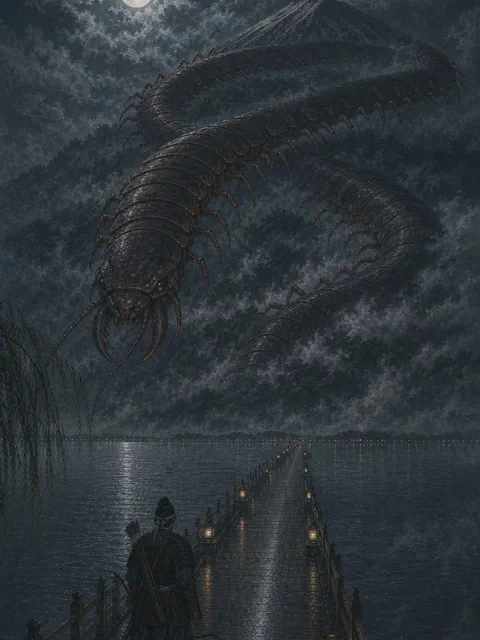
Ōmukade
大百足(おおむかで)
A warrior who walked over a serpent lying across the Long Bridge of Seta was asked by the dragon clan for help — because a centipede large enough to wrap a mountain was killing them, and they could not stop it themselves.
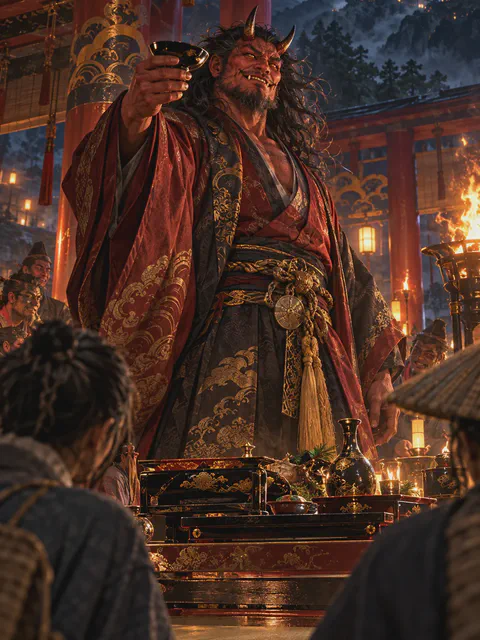
Shuten-dōji
酒呑童子(しゅてんどうじ)
The tale of Shuten-dōji appeared in the fourteenth century: an oni lord on Mt. Ōe who carried off the daughters of the capital, and the warriors who got in disguised as monks and defeated him with sake.