
Tenjō-sagari (天井下り, Tenjō-kudari): The Old Woman Who Hangs From the Ceiling
Sekien's upside-down yokai, and the two-step joke in its caption
天井下り(てんじょうさがり) Tenjō-sagari ASCII: Tenjo-sagari
Also known as: Tenjō-kudari, Tenjo kudari
Pronunciation: ten-JOH sah-GAH-ree
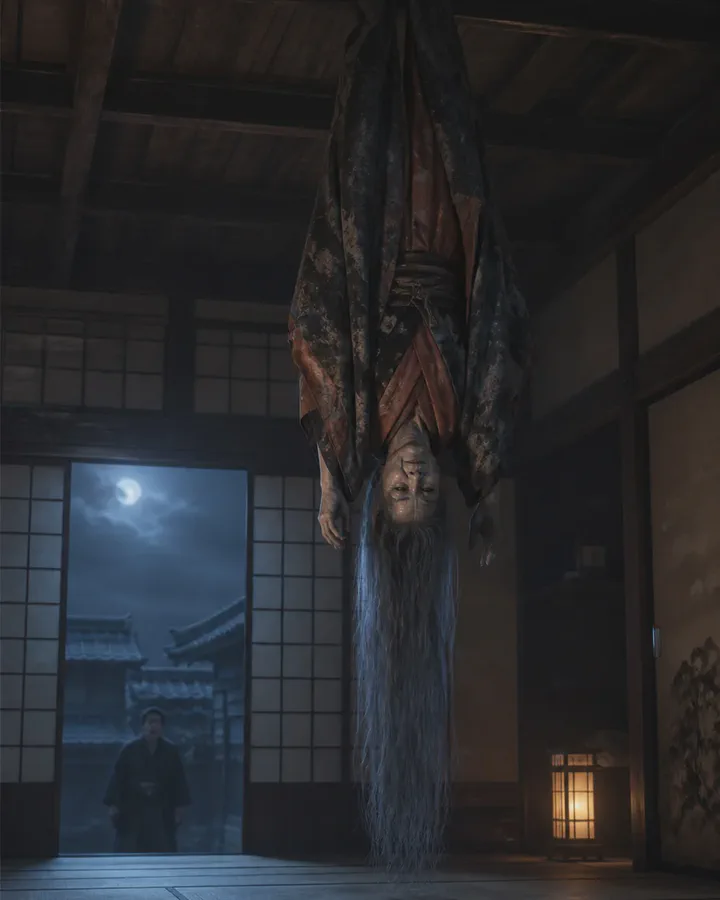
Tenjō-sagari (天井下り, “ceiling-hanger”; also read tenjō-kudari) is an old woman with wild hair who hangs head-down from the rafters of a house, her hair spilling into the room below. Toriyama Sekien drew her in 1779 with a caption that is mostly a joke: the demon Ibaraki-dōji once disguised itself as a beautiful woman and escaped up through a roof — this one is no beauty, and she comes down — and perhaps this is where the phrase “to show someone the ceiling,” meaning to knock them flat, comes from.
Quick Facts
- Habitat
- House
- Region
- unspecified
- Recorded period
- Toriyama Sekien's Konjaku Gazu Zoku Hyakki (1779)
- Nature
- Unknown
- Danger rating
The danger rating is an editorial summary made for readability. It is not an objective measure found in folklore sources.
Watch the Short
What is Tenjō-sagari?
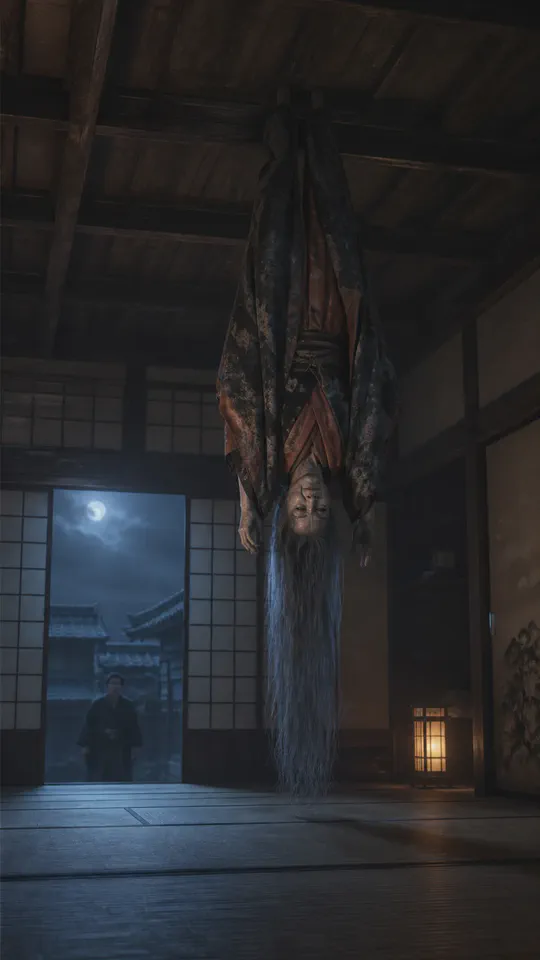
You are lying on your back in an old house at night, looking up into the dark between the rafters, and the dark moves. Hair comes down first — long, disordered, grey — and then the face it belongs to, an old woman’s, upside down, a foot above yours.
That is the plate Toriyama Sekien published in 1779 in Konjaku Gazu Zoku Hyakki: an old woman hanging head-down from the ceiling of a house, her hair spilling into the room. Unlike many of Sekien’s figures, this one comes with a caption. It is not an explanation. It is a joke, and it takes two steps to get.
What does tenjō-sagari mean?
The name is written 天井下り: tenjō, the ceiling, and sagari — or kudari, the same characters read another way — hanging down, coming down. The thing that comes down from the ceiling. It is pronounced ten-JOH sah-GAH-ree, and both readings are in use.
The joke in the caption
The first step is a story. Sekien’s readers knew the tale of Ibaraki-dōji, the demon whose arm the warrior Watanabe no Tsuna cut off at the Rashōmon gate. To get the arm back, Ibaraki-dōji disguised itself as Tsuna’s old aunt, came into the house, seized the arm, and escaped by breaking out through the gable of the roof. Sekien recalls this and turns it over: that demon came in looking like a respectable woman and went up through the roof; this one is no beauty, and she comes down from the ceiling.
The second step is a phrase. In Edo Japanese, tenjō o miseru — “to show someone the ceiling” — meant to knock them flat, to put them through something dreadful. Sekien wonders aloud whether the saying comes from a visit like this one. If you are on your back looking at the ceiling, something has already gone badly wrong.
Appearance
An old woman, upside down, hanging from the beams, hair falling loose toward the floor. That is the whole figure. Our illustration sets her in an old farmhouse at night, where the beams are high enough to hide something, and lets her hang in the dark above a single lantern.
Behavior and abilities
- She comes down from the ceiling. The name and the image.
- She is old and not beautiful. The caption makes a point of it, as the punchline to the Ibaraki-dōji story.
- She puts people on their backs. Or so the pun suggests; the caption poses it as a question.
Weaknesses and countermeasures
None are recorded. The caption never says what she does once she is down, whether she keeps to a particular kind of house, or how to keep her away. It ends on the pun.
Documented plate and later imagery
Documented plate. Toriyama Sekien, Konjaku Gazu Zoku Hyakki (1779): an old woman with loose hair hanging from a ceiling, with a caption contrasting her with Ibaraki-dōji’s escape through a roof and playing on the phrase tenjō o miseru.
Later imagery. Modern yokai books give the tenjō-sagari a habitat and habits — a creature of old, dark houses with neglected attics, dropping down to startle the people below and retreating. None of that is in Sekien, who is concerned with a demon story and a figure of speech. The plate, left to itself, is enough. Some night the dust overhead will shift. Before you look up, it is worth remembering what the phrase meant.
Sources and further reading
- Library Konjaku Gazu Zoku Hyakki bibliographic record (今昔畫圖續百鬼) (external link) National Diet Library Search Bibliographic record for Sekien's 1779 picture book.
- Museum Toriyama Sekien, Konjaku Gazu Zoku Hyakki (今昔画図続百鬼), 1779 (external link) Tokyo Museum Collection The 1779 sequel to Sekien's illustrated demon catalogue, containing both Kawa-akago and Suiko.
- Library Konjaku zoku hyakki digitized copy (external link) Smithsonian Libraries Digitized copy of the picture book containing the Wanyūdō print.
Records behind this article
On the timeline
In the glossary
In manga
- Kiitarō Shōnen no Yōkai Enikki 奇異太郎少年の妖怪絵日記 Keeps the traditional forms, invents the stories
Related yokai
Akaname
垢嘗(あかなめ)
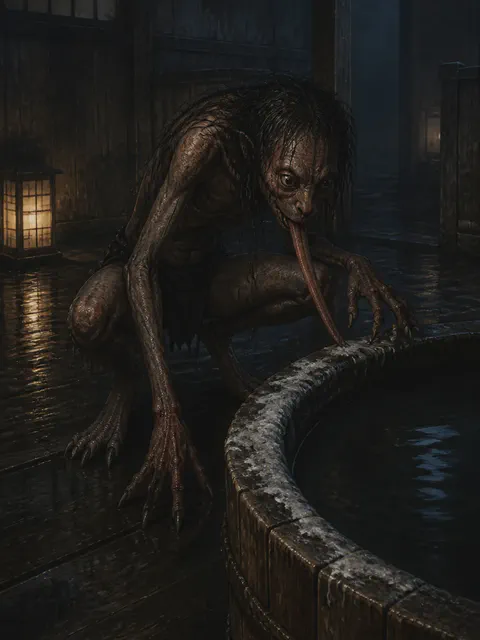
Sekien drew a crouching figure with a long tongue in a bathhouse in 1776 and called it the grime-licker. He wrote nothing else about it — and everything you have been told about dirty bathrooms was added afterwards.
Yanari
鳴屋(やなり)
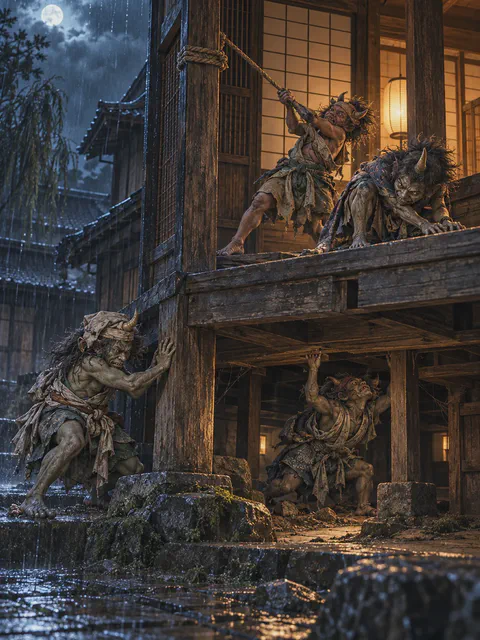
Sekien's 1776 plate shows a crew of small oni at the posts and under the veranda of a wooden house, pushing at the timbers. He named them for the sound a house makes at night and wrote nothing else.
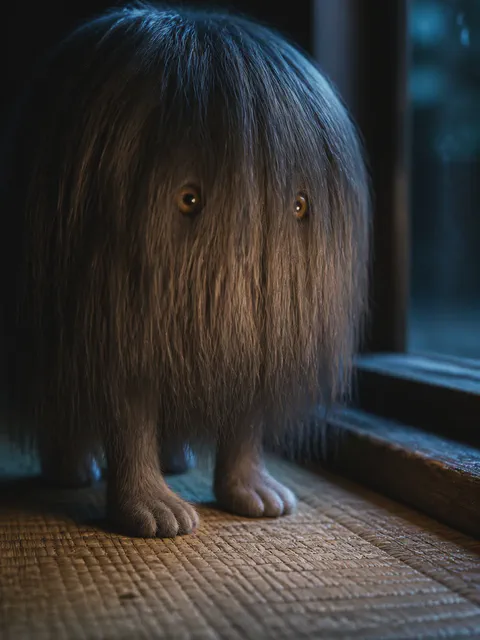
Keukegen
毛羽毛現(けうけげん)
Sekien drew Keukegen in 1781 as a small creature covered in long hair, and spent his caption on its name — which, written another way, means rarely there and rarely seen. The damp houses and disease came later.