Shuten-dōji (酒呑童子): The Oni King Undone by His Own Banquet
The most famous oni in Japan, and the sake that killed him
酒呑童子(しゅてんどうじ) Shuten-dōji ASCII: Shuten-doji
Also known as: Shutendōji, Shuten Doji
Pronunciation: SHOO-ten DOH-jee
Shuten-dōji (酒呑童子, “the sake-drinking youth”) is the oni king of Mt. Ōe in Japanese legend. From his mountain fortress he carried off the young women of the capital, until the emperor sent Minamoto no Raikō and his retainers after him. They came disguised as mountain monks, carrying a sake the gods had given them — medicine to humans, poison to oni. Shuten-dōji welcomed them to his banquet, drank, slept, and was beheaded; his severed head flew up and bit at Raikō’s helmet.
Quick Facts
- Habitat
- Mountain
- Region
- Mt. Ōe (Ōeyama tradition), Mt. Ibuki (Ibuki tradition)
- Recorded period
- 14th-century legend, Muromachi and Edo picture scrolls
- Nature
- Harmful
- Danger rating
- If you meet one
- Bring the gods' sake, poison only to oni, a disguise good enough for the gate, and a helmet for the last bite. In the article
The danger rating is an editorial summary made for readability. It is not an objective measure found in folklore sources.
Watch the Short
Who is Shuten-dōji?
In the reign of Emperor Ichijō, around the year 1000, young women were vanishing from the capital. Divination found the cause: an oni lord in a fortress on Mt. Ōe, north-west of Kyoto. The emperor ordered Minamoto no Yorimitsu — Raikō — to deal with him, and Raikō went with his famous retainers, Watanabe no Tsuna and Sakata no Kintoki among them.
On the way the gods gave them two things: a helmet, and a sake that was medicine to men and poison to oni. They climbed to the fortress dressed as mountain monks. Shuten-dōji took them in and held a banquet — and the tale does not soften what was served at it; the oni’s feast was his captives. Raikō waited, and poured his own sake. The oni king drank, grew merry, grew drunk, and went to sleep in an inner room.
They cut off his head. It rose into the air and sank its teeth into Raikō’s head, and the helmet from the gods held. The rest of the oni were killed, the women freed, and the band went home.
What does Shuten-dōji mean?
The name is written 酒呑童子. Shuten, 酒呑, is “sake-drinking.” Dōji, 童子, is a child or a youth — and also the word for the attendants of gods and temples who wear their hair long and loose like children. Shuten-dōji is the drinking youth: an oni who looks, by day, like a big handsome boy with unbound hair, and whose name is the thing that kills him. It is pronounced SHOO-ten DOH-jee.
The tale and its scrolls
The story appeared in the fourteenth century and was painted and told again for four hundred years — in picture scrolls, illustrated books, Noh and kabuki. The oldest surviving version is the Ōeyama Ekotoba scroll. Tradition is divided over where the fortress stood: one line puts it on Mt. Ōe, another on Mt. Ibuki, and both were painted — three sets of Shuten-dōji scrolls in Tokyo all follow the Ibuki line. This page follows Ōeyama.
The dates inside the story belong to the story. It was written three centuries after the reign it is set in, and it is a legend about famous warriors, not a record of a campaign.
Appearance
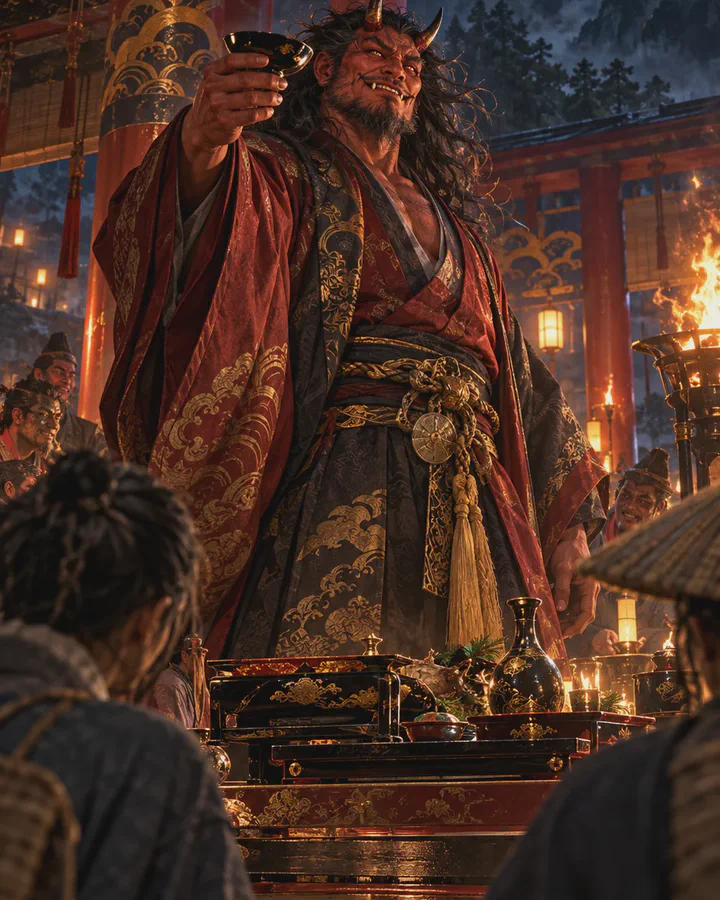
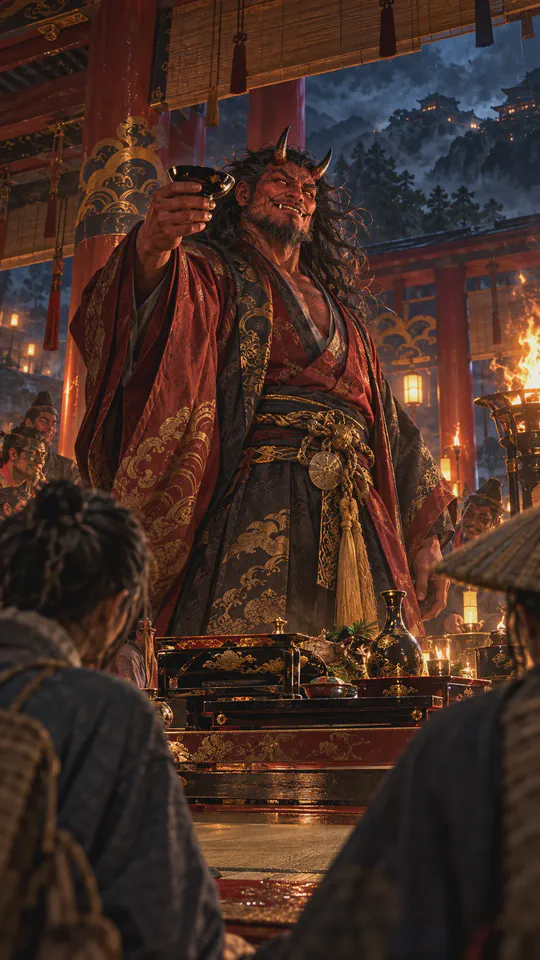
The scrolls make him a giant: red-faced, horned in his true form, and by day often a large youth in fine robes entertaining his guests. Our illustration takes the banquet — cup raised, seen from among the disguised guests.
Behavior and abilities
- He takes people from the capital. The reason warriors are sent.
- He rules a fortress of oni. A household, with retainers and a hall.
- He drinks. It is in his name, and it is how he is beaten.
- His head fights on. Severed, it still attacks.
Weaknesses and countermeasures
The sake of the gods, poison only to oni; a disguise good enough to get through the gate; and a helmet strong enough to stop the last bite. Every one of the three is a gift or a trick. Raikō’s band does not overpower Shuten-dōji. It waits for him to be a host.
Documented legend and later imagery
Documented legend. From the fourteenth century: an oni lord on Mt. Ōe (or Mt. Ibuki) abducts women from the capital; Raikō and his retainers, disguised as mountain monks and carrying divine sake and a helmet, are welcomed to his banquet, make him drunk and behead him; the severed head bites at Raikō and the helmet saves him. Oldest scroll: the Ōeyama Ekotoba.
Later imagery. Later versions give him an origin — a beautiful temple boy, a youth turned oni by drink or by the masks he wore — and disagree about where he was born. Modern games and manga often make him tragic, even sympathetic, and rank him with Tamamo-no-Mae and Ōtakemaru as the three great yokai of Japan, a modern grouping. The fourteenth-century tale needs none of it. Its oni lord is a generous host, and that is what kills him.
Sources and further reading
- Museum A Tale of Expelling the Demon: The Shutendōji Picture Scroll (external link) Nezu Museum The tale appeared in the fourteenth century and spread through picture scrolls and Nara ehon; tradition divides over Mt. Ōe and Mt. Ibuki.
- Academic paper The Shuten-dōji legend (external link) Art Research Center, Ritsumeikan University Names the Ōeyama Ekotoba in the Itsuō Art Museum as the oldest surviving work; summarises the divine sake, the star helmet, and the flying head.
- Museum The Tale of Shuten Dōji, F1998.26.2 (external link) Smithsonian National Museum of Asian Art Handscroll of 1700 by Kano Shōun, calligraphy by Nakayama Atsuchika: Raikō's band disguised as monks, the wine potion, the sleeping giant.
- Library How the otherworld and its beings were drawn (external link) National Diet Library The Ōeyama mansion, the banquet, and the drunken oni killed by Raikō's band.
Where it was recorded
- undated
Mt. Ōe, Kyoto
Legend or tale
Oni king's fortress in the Ōeyama tradition
- undated
Mt. Ibuki, Shiga
Legend or tale
Ibuki tradition of the same tale
Places named in the records behind this article. Coordinates are approximate. View on the map
Records behind this article
On the timeline
In the glossary
In manga
- Hozuki's Coolheadedness 鬼灯の冷徹 Uses the names, reinvents the rest
- Kemono Jihen 怪物事変 Uses the names, reinvents the rest
- Yokai Rental Shop 妖飼兄さん Uses the names, reinvents the rest
Where to see it
- Japan Oni Exchange Museum 日本の鬼の交流博物館 Museum
- Kubizuka Daimyōjin 首塚大明神 Shrine or temple
- Onitake Inari Shrine on Mount Ōe 鬼嶽稲荷神社 Shrine or temple
Related yokai
Ōtakemaru
大嶽丸(おおたけまる)
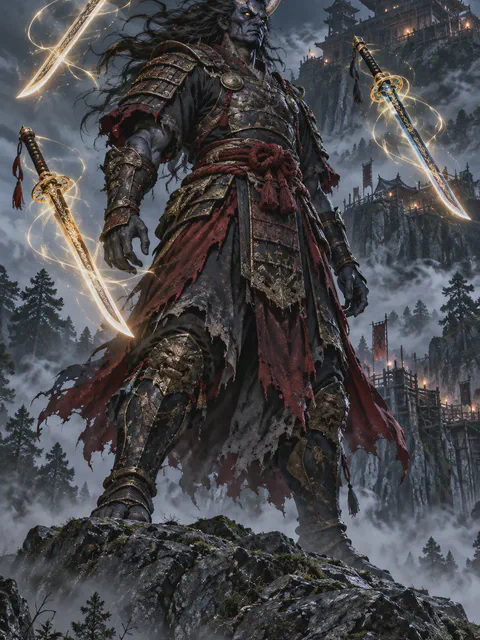
In the Muromachi tale Tamura no Sōshi, the demon god Ōtakemaru of Mt. Suzuka cannot be found or beaten by force. The hero Tamura-maru wins only because Suzuka Gozen deceives the demon and takes his swords.
Tengu
天狗(てんぐ)
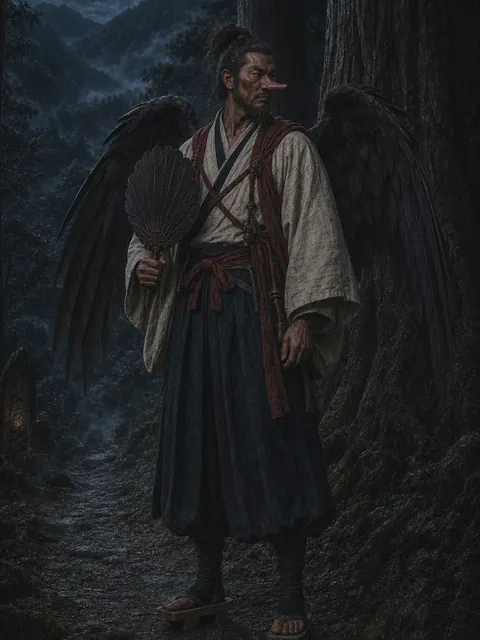
A mountain being associated with flight, impossible voices, disappearances, and more than one familiar face.
Ushi-oni
牛鬼(うしおに)
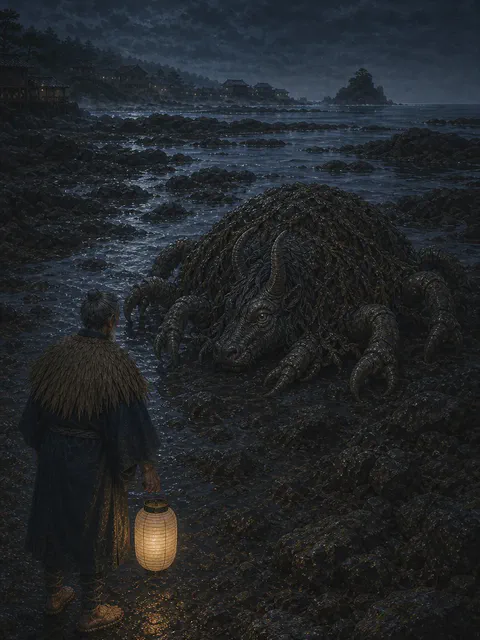
Toriyama Sekien's 1776 print shows a bull-like head on a squat clawed body at the water's edge — and tells us nothing else about it.