Oni (鬼): Japan's Demons, and How They Got Their Horns
From an invisible spirit of the dead to the red-faced giant with the iron club
鬼(おに) Oni ASCII: Oni
Also known as: Japanese demon
Pronunciation: OH-nee
Oni (鬼) are the demons of Japan — in the familiar image, huge horned figures with fangs, red or blue skin, a tiger-skin loincloth and an iron club. That image is a composite built over a thousand years. The word first named an invisible spirit of the dead; Buddhist hell paintings gave it a body as the wardens who torture the damned; medieval tales put it on mountains and at city gates; and at the year-end rite the masked exorcist who drove the oni out ended up being chased out as the oni himself.
Quick Facts
- Habitat
- Mountain, Other
- Region
- Japan
- Recorded period
- Heian period, medieval tales and performance, Edo period, modern imagery
- Nature
- Mixed
- Danger rating
- If you meet one
- Throw peaches. Izanagi drove them off with three. In the article
The danger rating is an editorial summary made for readability. It is not an objective measure found in folklore sources.
Watch the Short
What are oni?
Ask anyone in Japan to draw an oni and you will get the same thing: a huge figure with horns and fangs, red or blue skin, wild hair, a loincloth of tiger skin and an iron club. It is one of the most familiar images in the country — on Setsubun masks, on temple gates, in every children’s book.
It is also a composite, assembled over more than a thousand years from things that were not originally the same. The word oni has meant several different kinds of being, and the red giant is what remained when they were laid on top of one another.
What does oni mean?
The character 鬼 came from China, where it means the spirit of a dead person, a ghost. In Japanese it was read oni, a word that may come from on, “hidden” — the thing that does not show itself. The Wamyō Ruijushō, a dictionary of the 930s, explains oni as something that hides behind things and does not wish to appear: a spirit of the dead. The earliest oni had no body to draw. It is pronounced OH-nee.
A spirit that does not appear
Early Japanese ideas of oni fall into three types: evil spirits and malign gods that bring disease and death; strangers and foreigners, people from outside; and, more rarely, beneficent gods. The first kind, the bringers of plague, was originally invisible, and only later acquired a form.
How oni got a body
The visible oni came largely from Buddhism. As teaching about the six realms and the torments of hell spread in the late Heian period, paintings such as the twelfth-century Jigoku Zōshi, the hell scrolls, showed the wardens of hell at work: muscular, fanged, sometimes with the heads of oxen or horses, beating and boiling the dead. Those wardens gave the invisible oni muscles and a face. The horns and the tiger skin are usually explained by the ushitora, the north-east — the direction of the ox and the tiger on the old compass, the “demon gate” from which misfortune was said to come. The club is a weapon for a body that size.
Mountains, gates and outsiders
In medieval tales and theatre the oni came out of hell and into the world. They lived on mountains and at the gates of the capital, carried off women and ate travellers, and were hunted down by heroes: Shuten-dōji on Mt. Ōe, Ōtakemaru on Mt. Suzuka, the demon of the Rashōmon gate whose arm Watanabe no Tsuna cut off.
The same word was used of people — outsiders, those who would not submit to the court, anyone placed beyond the edge of the ordered world. That usage is part of the history of the word, and it is one reason the oni of the tales so often live just past a border.
The exorcist who became the demon
The year-end rite of tsuina, adopted from China and recorded at court by 706, drove out the invisible oni of disease. The one who did the driving was the hōsōshi, an officer in a golden four-eyed mask who stamped through the palace with a spear and a shield. By the end of the Heian period the roles had reversed: the hōsōshi himself was treated as the oni and chased out by the courtiers with bows. The masked exorcist had become the demon. Later still the rite merged with Setsubun and the throwing of roasted beans — oni wa soto, fuku wa uchi, demons out, fortune in.
Appearance
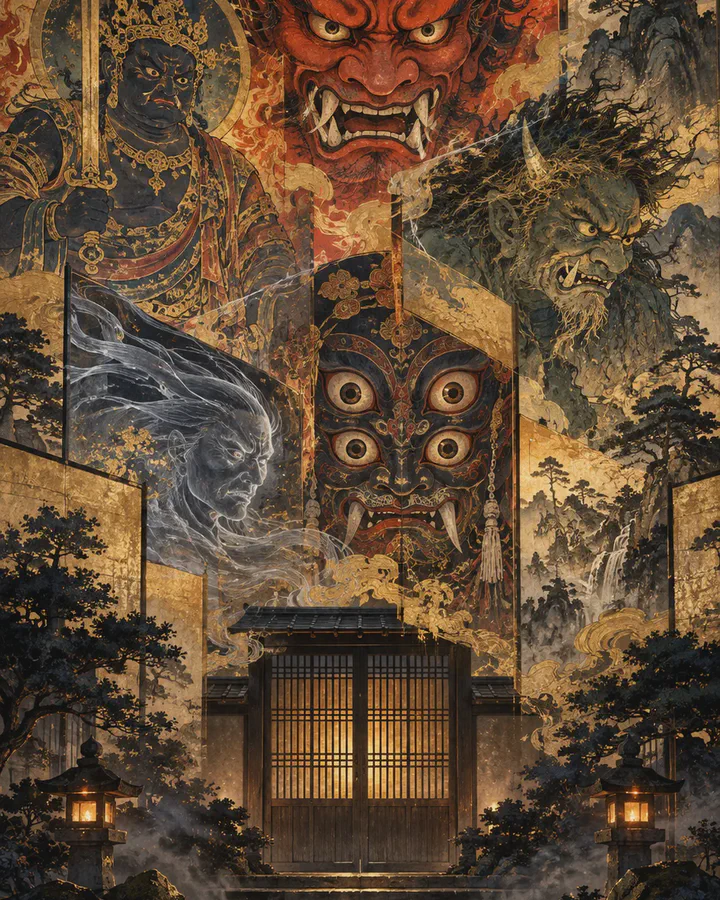
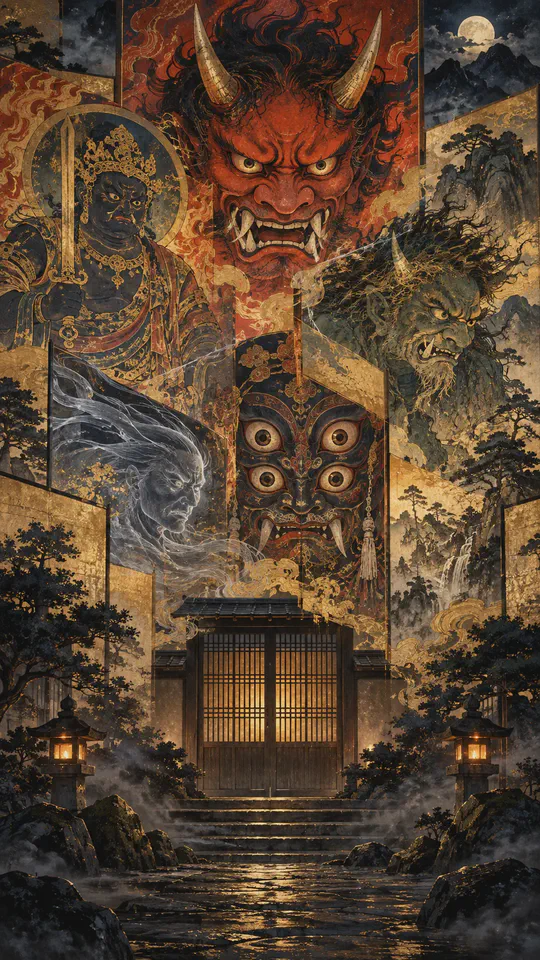
Horns, fangs, wild hair, red or blue skin, a tiger-skin loincloth, an iron club. Every element was added somewhere along the way. Our illustration stacks the layers: the familiar red mask, the four-eyed mask of the rite, the shadows, and a gate.
Behavior and abilities
That depends on which oni. Invisible bringers of plague; punishers in hell; mountain bandits and kidnappers; sometimes protectors and bringers of blessing.
Weaknesses and countermeasures
Peaches, in the oldest chronicles, where Izanagi drives off the hags of the underworld by throwing them; the masked exorcist of the year-end rite; roasted beans at Setsubun; holly and sardine heads at the door; heroes with divine help and poisoned sake. Each answers a different oni.
Documented history and later imagery
Documented history. An invisible spirit of the dead in the Wamyō Ruijushō (930s); evil spirits, outsiders and beneficent gods in early belief; the wardens of hell in twelfth-century Buddhist painting; monsters of mountain and gate in medieval tales; and the tsuina rite, whose exorcist had become the oni by the late Heian period.
Later imagery. The modern oni is cheerful as often as frightening — a Setsubun mask, a mascot, a cartoon with a club — and is usually presented as a single species of Japanese demon. It was never one thing. Its shape was built across centuries by people trying to give a body to whatever they feared was just outside.
Sources and further reading
- Academic book Oni (external link) Kokugakuin University, Encyclopedia of Shinto Three types of oni — evil spirits, foreigners or strangers, and good kami — the first initially invisible and only later given visible form.
- Academic paper Transformation of the Oni: From the Frightening and Diabolical to the Cute and Sexy (external link) Noriko T. Reider; Asian Folklore Studies 62 (2003) Quotes the Wamyō Ruijushō (c. 930s) defining oni as a hidden spirit of the dead that does not wish to appear.
- Library Chapter 1: Setsubun and bean-throwing (external link) National Diet Library Tsuina by 706; the hōsōshi drove out invisible plague oni, but by the late Heian period was himself treated as the oni and chased out; bean-throwing with "oni out, fortune in" recorded in 1447.
- Museum Hell Scroll (Jigoku Zōshi) (external link) National Institutes for Cultural Heritage, e-Museum Twelfth-century hell paintings with their wardens.
- Database Database of Folklore and Yokai Phenomena (怪異・妖怪伝承データベース) (external link) International Research Center for Japanese Studies Use individual records; do not generalize one local account nationwide.
On the timeline
In the glossary
In manga
- Demon Slayer: Kimetsu no Yaiba 鬼滅の刃 Yokai-adjacent: urban legends and mixed lore
- The Great Yokai War: Guardians 妖怪大戦争 ガーディアンズ Uses the names, reinvents the rest
- Hozuki's Coolheadedness 鬼灯の冷徹 Uses the names, reinvents the rest
- Inuyasha 犬夜叉 Uses the names, reinvents the rest
- Kakuriyo: Bed & Breakfast for Spirits かくりよの宿飯 Uses the names, reinvents the rest
- Kamisama Kiss 神様はじめました Uses the names, reinvents the rest
- Kekkaishi 結界師 Uses the names, reinvents the rest
- Kemono Jihen 怪物事変 Uses the names, reinvents the rest
- Nura: Rise of the Yokai Clan ぬらりひょんの孫 Uses the names, reinvents the rest
- Ōedo Yōkai Kawaraban 大江戸妖怪かわら版 Uses the names, reinvents the rest
- Otome Yōkai Zakuro おとめ妖怪 ざくろ Uses the names, reinvents the rest
- Ushio and Tora うしおととら Uses the names, reinvents the rest
- Yo-kai Watch 妖怪ウォッチ Uses the names, reinvents the rest
- Yokai Doctor 妖怪のお医者さん Uses the names, reinvents the rest
Where to see it
- Mitsuishi Shrine and the Oni's Handprints 三ツ石神社(鬼の手形) Shrine or temple
- Namahage Museum and Shinzan Folklore Museum なまはげ館・男鹿真山伝承館 Museum
- Kijin Shrine 鬼鎮神社 Shrine or temple
- Kinasa Folk Museum and the Demon Woman Momiji 鬼無里ふるさと資料館と鬼女紅葉の里 Museum
- Seimei Shrine and Ichijō Modoribashi 晴明神社・一条戻橋 Shrine or temple
- Japan Oni Exchange Museum 日本の鬼の交流博物館 Museum
- Kubizuka Daimyōjin 首塚大明神 Shrine or temple
- Onitake Inari Shrine on Mount Ōe 鬼嶽稲荷神社 Shrine or temple
- Gangōji 元興寺 Shrine or temple
- Kibitsu Shrine 吉備津神社 Shrine or temple
- Kinojō, the Oni's Castle 鬼ノ城 Site
Related yokai
Shuten-dōji
酒呑童子(しゅてんどうじ)
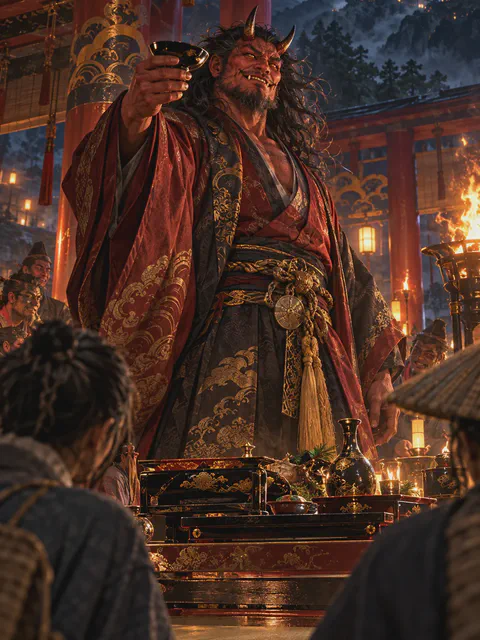
The tale of Shuten-dōji appeared in the fourteenth century: an oni lord on Mt. Ōe who carried off the daughters of the capital, and the warriors who got in disguised as monks and defeated him with sake.
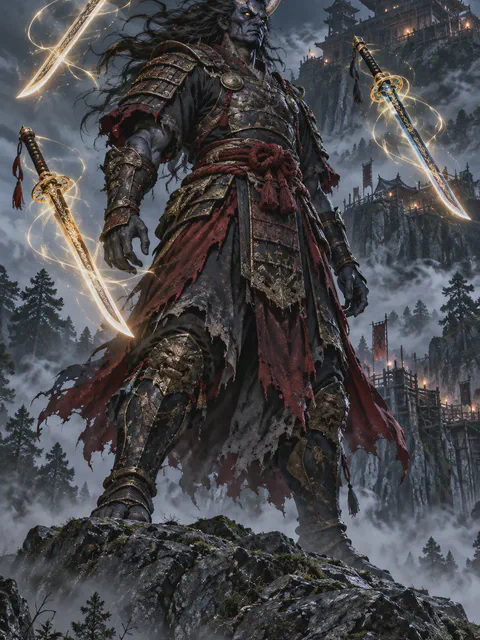
Ōtakemaru
大嶽丸(おおたけまる)
In the Muromachi tale Tamura no Sōshi, the demon god Ōtakemaru of Mt. Suzuka cannot be found or beaten by force. The hero Tamura-maru wins only because Suzuka Gozen deceives the demon and takes his swords.
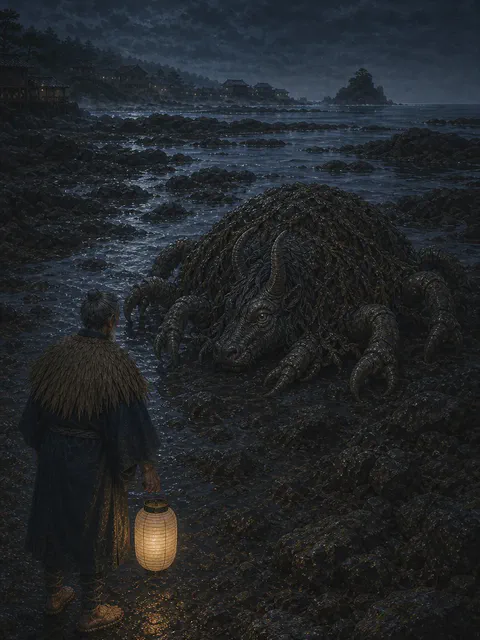
Ushi-oni
牛鬼(うしおに)
Toriyama Sekien's 1776 print shows a bull-like head on a squat clawed body at the water's edge — and tells us nothing else about it.