Ōmukade (大百足): The Giant Centipede of Mount Mikami
The monster the dragon clan could not kill, and the arrow that did
大百足(おおむかで) Ōmukade ASCII: Omukade
Also known as: Omukade, Oomukade
Pronunciation: oh-moo-KAH-deh
Ōmukade (大百足, “great centipede”) is the giant centipede of Japanese legend, long enough to wrap itself seven times around Mount Mikami above Lake Biwa. The dragons of the lake could not kill it, so they lay across the Seta Bridge as a serpent to find a man who would not flinch — the warrior Fujiwara no Hidesato, Tawara Tōda. Two of his arrows bounced off. The third, wetted with his own saliva, went through its skull.
Quick Facts
- Habitat
- Mountain, River
- Region
- Mount Mikami and the Long Bridge of Seta, in Ōmi
- Recorded period
- the Taiheiki, and the otogizōshi that developed from it
- Nature
- Harmful
- Danger rating
- If you meet one
- Wet the arrowhead with saliva. Two ordinary arrows failed; the third, touched by the archer's mouth, killed it. In the article
The danger rating is an editorial summary made for readability. It is not an objective measure found in folklore sources.
Watch the Short
What is Ōmukade?
The story opens with a test the hero does not know he is taking. A huge serpent lies across the Long Bridge of Seta, where the Seta river leaves Lake Biwa, and nobody will cross. Fujiwara no Hidesato — Tawara Tōda, “Tōda of the rice bale,” as the tale remembers him — walks up and steps over it. He does not fight it or go round. He declines to be impressed.
That night a woman comes to him. The serpent was her: she is of the dragon clan that lives in the lake, and the bridge was a way of finding someone who would do what he had just done. Her people have an enemy they cannot kill. On Mount Mikami, across the water, there is a centipede, and it is large enough to wind itself around the mountain.
What does ōmukade mean?
The name is written 大百足. Ō is great; mukade is the centipede, written with characters meaning “a hundred legs.” The great hundred-legs. It is pronounced oh-moo-KAH-deh, with the first syllable held long.
Ordinary mukade — the large, venomous centipedes of the Japanese countryside — were feared enough on their own. The legend keeps the animal and changes only the unit of measurement.
Appearance
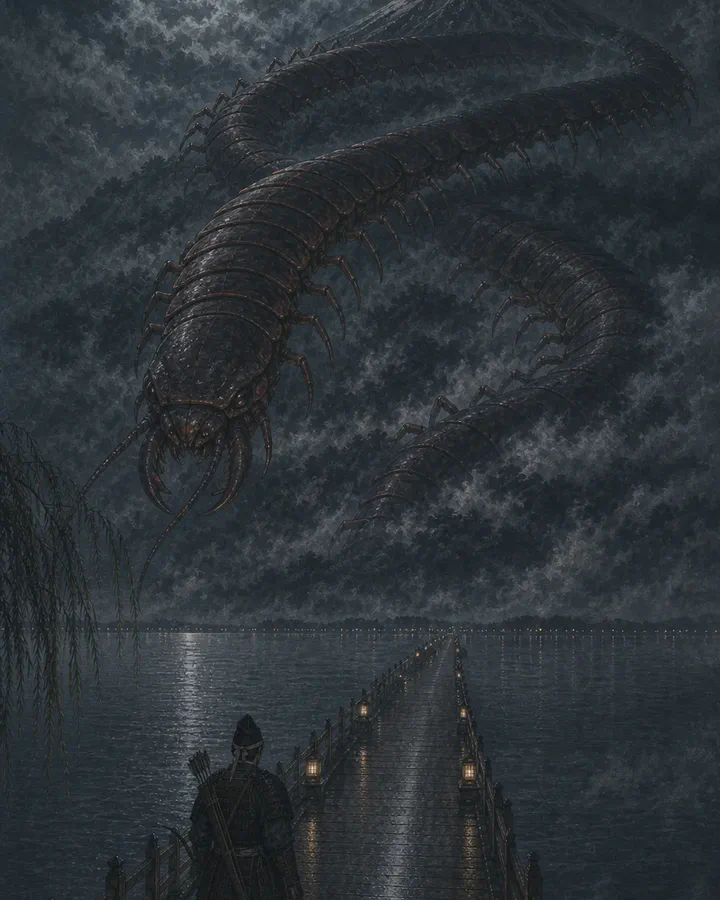
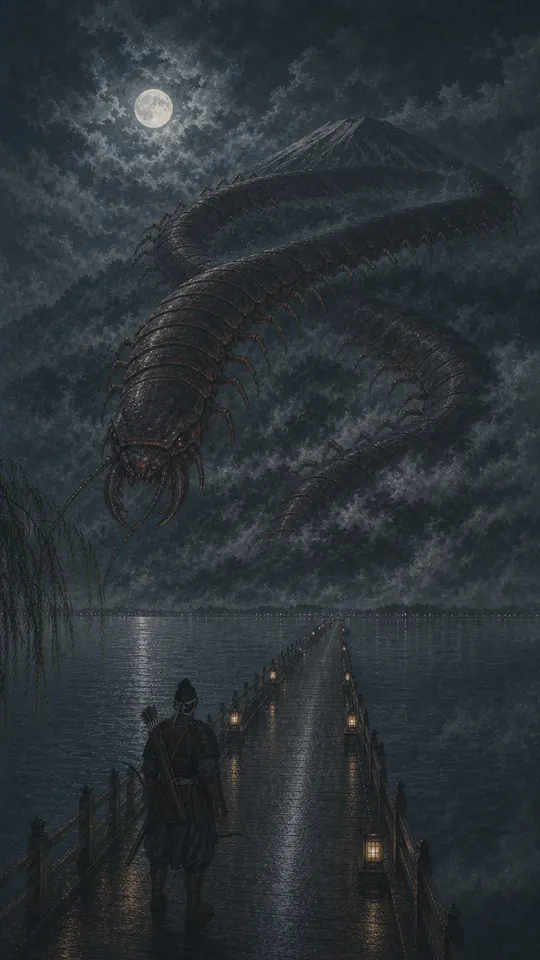
A segmented body coiling round an entire forested mountain, legs braced along its length, two eyes burning on the summit like a pair of torches. That is the scale the tale asks for, and our illustration gives it, seen from across the lake with an archer on the near shore for size. No particular old painting is being copied; the tale is older than any image of it.
Behavior and abilities
- It is enormous. The mountain is the ruler it is measured against.
- It is beyond the dragons. A supernatural clan with a palace under the lake cannot handle it and goes looking for a human being.
- It shrugs off arrows. Hidesato is the finest archer of his age, and the first two shots do nothing.
- It devours the dragon clan. That is the whole of its stated motive.
The third arrow
Hidesato waits on the shore of the lake. The centipede comes down the mountain in the dark, its lights ahead of it. He draws and shoots at the space between the eyes. The arrow strikes and falls away. He shoots again; the same. One arrow left.
He puts the point of it in his mouth and wets it with his saliva, says a prayer to Hachiman, and shoots. The third arrow goes in where the other two bounced, and the centipede dies.
That is the hinge of the story. The archer’s aim was never the problem, and neither was his strength; both had already been enough and both had already failed. What changed was that something of the man himself went into the shot. Human spit, in the old belief, was poison to a centipede. It is a remedy nobody can copy from a safe distance.
What came after
The dragon clan took him down to the palace under the lake and sent him home with gifts, and the versions do not agree on the list: a bolt of silk that never ran out, a cooking pot that needed no fire, a temple bell, and the one everyone remembers — a bale of rice that was never empty however much was taken from it. That bale is the tawara in Tawara Tōda.
The tale is in the Taiheiki, the fourteenth-century war chronicle, and was spun out further in the otogizōshi picture-books that followed. Fujiwara no Hidesato was a real tenth-century warrior who helped put down the rebellion of Taira no Masakado. The centipede is a legend. The story carries both in the same sentence, and only one of them left records anywhere else.
Weaknesses and countermeasures
Saliva on the arrowhead, and nothing else is recorded. No charm, no blessed weapon, no advice on where to strike. Two ordinary arrows fail; the third differs only in having been touched by the mouth of the man who shot it. For a creature the dragons themselves could not defeat, the answer is startlingly small, and useless to anyone who is not already standing there with a bow.
Documented tale and later imagery
Documented tale. From the Taiheiki and the later otogizōshi: a serpent across the Seta Bridge, crossed without fear by Tawara Tōda; the dragon clan’s plea; a centipede coiled round Mount Mikami; two arrows that fail and a third, wetted with saliva, that kills; and treasures from the dragon palace, among them a bottomless bale of rice.
Later imagery. The centipede has been drawn many times since and tends to acquire teeth, malice and a grudge. The tale gives it none. It gives a creature so far beyond its enemies that a clan of dragons went looking for a man — and a man who beat it by spitting on an arrowhead.
Sources and further reading
- Museum Fujiwara no Hidesato and the giant centipede Art Research Center, Ritsumeikan University The sequence of the tale: the serpent lying across Seta bridge, the giant centipede of Mount Mikami, and the treasures from the dragon palace.
- Database On the tale of Tawara Tōda and the centipede Collaborative Reference Database, National Diet Library Traces the story from the Taiheiki into later otogizōshi, including the arrow wetted with saliva and the variation in what the rewards were.
Where it was recorded
- undated
Mt. Mikami and the Seta Bridge, Shiga
Legend or tale
Tawara Tōda's third arrow, wetted with saliva
Places named in the records behind this article. Coordinates are approximate. View on the map
On the timeline
In the glossary
In manga
- Inuyasha 犬夜叉 Uses the names, reinvents the rest
- Nura: Rise of the Yokai Clan ぬらりひょんの孫 Uses the names, reinvents the rest
- Ushio and Tora うしおととら Uses the names, reinvents the rest
Where to see it
- Seta no Karahashi 瀬田の唐橋 Site
- Mount Mikami 三上山 Site
Related yokai
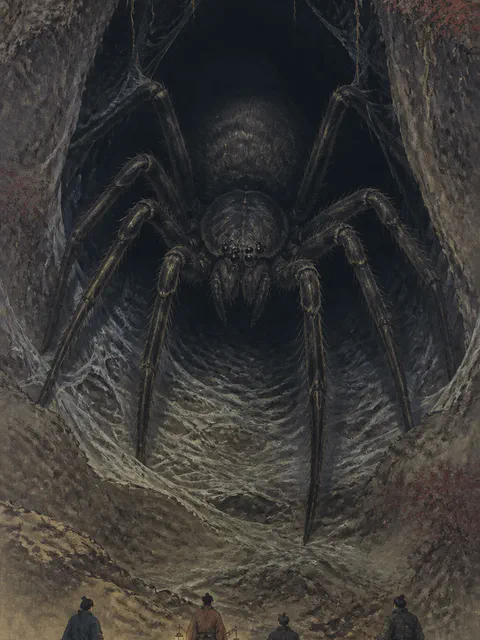
Tsuchigumo
土蜘蛛(つちぐも)
A monk appears at a sick warlord's bedside and throws spider silk at him. That is the tale. But the same word, centuries earlier, was what the court called people it wanted to treat as outsiders.
Shuten-dōji
酒呑童子(しゅてんどうじ)
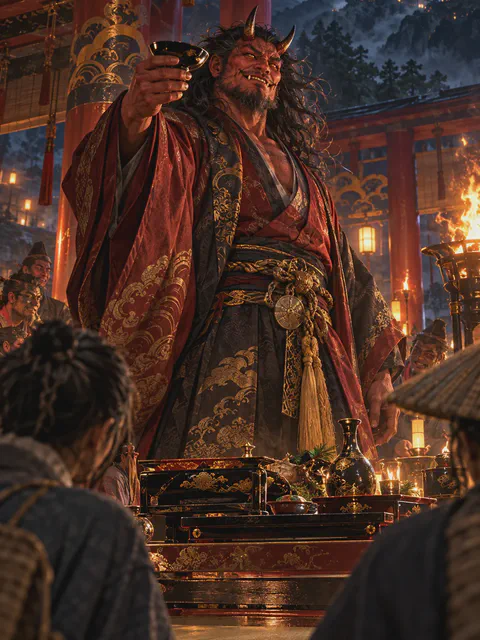
The tale of Shuten-dōji appeared in the fourteenth century: an oni lord on Mt. Ōe who carried off the daughters of the capital, and the warriors who got in disguised as monks and defeated him with sake.
Samebito
鮫人(さめびと)
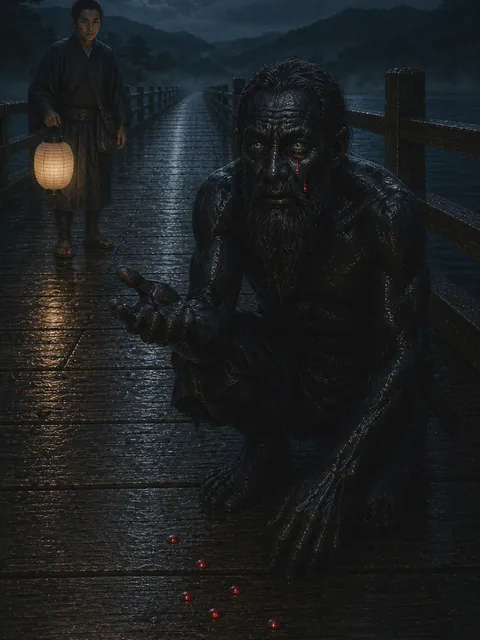
In a story Lafcadio Hearn published in English in 1900, a man on the Long Bridge of Seta shelters a creature banished from the Dragon Palace — and is repaid in tears that harden into jewels, which only come when the grief behind them is real.