
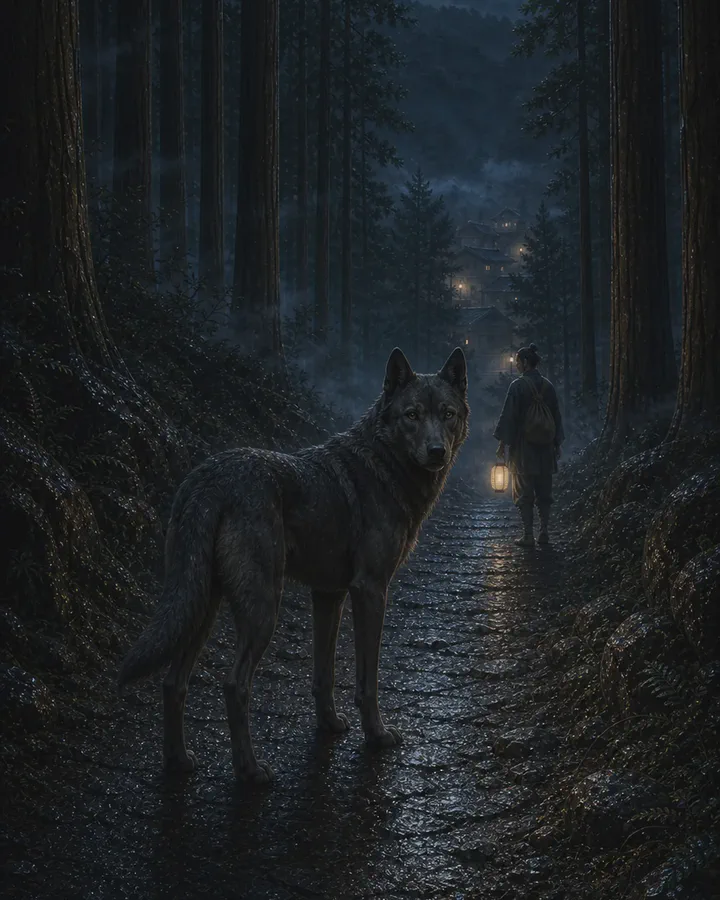
Okuri-inu (送り犬, Okuri-ōkami): The Dog That Sees You Home
The escorting dog — or wolf — of Japanese mountain roads
送り犬(おくりいぬ) Okuri-inu ASCII: Okuri-inu
Also known as: Okuri-ōkami, O-inu-sama
Pronunciation: oh-koo-ree ee-noo
Okuri-inu (送り犬, “the sending dog”; also okuri-ōkami, “the sending wolf”) is a Japanese yokai that follows a traveler along a night road all the way to their door. For as long as you stay on your feet it is an escort. If you fall, the same animal may attack. In Gifu the walk ended with a handful of salt at the doorway and a word of thanks.
Quick Facts
- Habitat
- Mountain, Road, Forest
- Region
- Takayama (Gifu), Miyagi, Ōtsuki (Yamanashi)
- Recorded period
- 1936 folklore record, 20th-century folklore collections
- Nature
- Mixed
- Danger rating
- If you meet one
- At your door, set down a handful of salt and say, 'Thank you for your trouble; take this and go home.' In the article
The danger rating is an editorial summary made for readability. It is not an objective measure found in folklore sources.
Watch the Short
What is Okuri-inu?
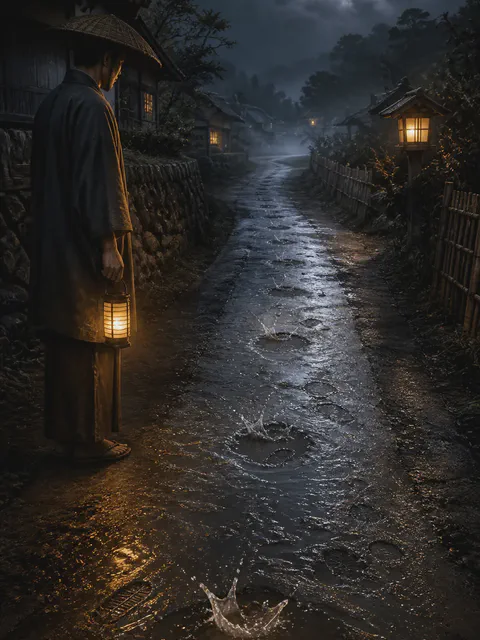
A man was walking home at night on a mountain road above Kamigahora, in the Asahi district of Takayama in Gifu. A mountain dog was following him. He did not like it, and when he came to a sake shop he went in. After a while he decided the dog must have gone, and came out. It was there. It followed him the rest of the way home.
At his door he put down a handful of salt and said to it: Gokurō datta ga, kore de kaere — “You have taken trouble on my account, but now go home.” And the dog went.
That is how it was told in 1936, and it comes with one more sentence: while you are being sent home by the mountain dog, if you fall, the dog will harm you. The whole creature is in those two facts. It walks you to your door. It is waiting for you to fall.
What does okuri-inu mean?
Okuru is to send someone off, to see them home. Inu is a dog. Okuri-inu is the dog that sees you home — the same verb a host uses for walking a guest to the gate.
The other name is okuri-ōkami, the sending wolf. In Miyagi it was said that wolves came in two kinds: the ones that run in packs and attack people, and the sending dog, which protects them. In Yamanashi the animal was addressed as o-inu-sama, the honoured dog, which is also what people called the wolf they worshipped as the guardian of mountain travelers and crops. Dog and wolf, and guardian and threat, are the same word here.
Appearance
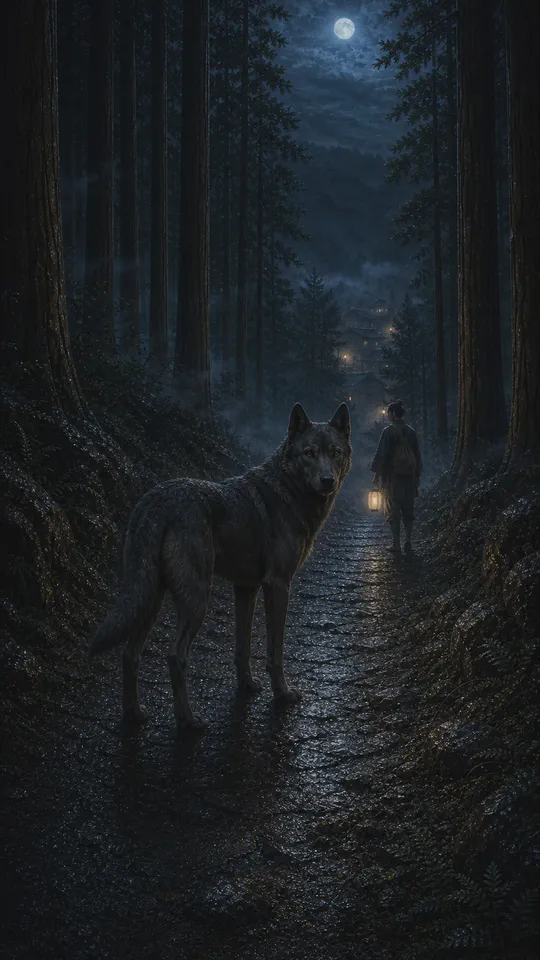
The Gifu telling says only yamainu, a mountain dog, and leaves its colour, size, eyes, and teeth unsaid.
Our illustration keeps it real: a large, lean, grey-black dog with small triangular ears, a long muzzle, a low tail, and a coat soaked with rain — a Japanese native dog, or the Japanese wolf that is now extinct. No glowing eyes, no oversized fangs, no spectral glow. The whole tension of the story depends on the animal being entirely ordinary.
Behavior and abilities
- It follows at a distance. In Yamanashi you noticed it by the rustling behind you.
- It waits. The sake shop did not end anything. It was still there.
- It goes to the door. Not to the edge of the mountain — to the threshold of your house.
- It turns if you fall. In Miyagi it was said to come stumbling after a fallen person to bite; in Yamanashi, to spring on them.
For as long as you are upright, you are being escorted. The moment you are down, the escort is something else.
What to do if you fall
Each place had its own answer, and the answers are small acts of theatre.
In Miyagi (1956), if you fell you were to call out “mazu ippuku” — “time for a smoke” — as though you had sat down on purpose to rest, and the dog would not attack. In Ōtsuki, Yamanashi (1977), you pretended to be picking something up off the ground. A fall is an invitation; a deliberate stop is not. The dog, in both tellings, can be fooled by a person who acts as if nothing has gone wrong.
Weaknesses and countermeasures
The endings are not defences. They are thanks.
In Gifu, salt at the doorway and a word of dismissal. In Miyagi, once you were safely home you threw it one straw sandal and one rice ball; it ate the rice ball and carried the sandal home in its mouth. In Yamanashi you said, “O-inu- sama, dōmo gokurō-san deshita” — “Honoured dog, thank you for your trouble” — and it went quietly away.
The salt is not a weapon and the rice ball is not a bribe. They are what you give someone who has walked you home through the dark, even when you were not sure, the whole way, which kind of walk it was.
Documented tradition and later imagery
Documented tradition. A mountain dog that follows a night traveler at a distance, outwaits his detours, accompanies him to his door, is feared if he falls, and leaves after salt and thanks (Gifu, 1936); the same animal as the sending wolf, the protecting kind of wolf, and the honoured dog (Miyagi, 1956; Yamanashi, 1977), with regional advice on what to say if you stumble and what to give it when you are home.
Later imagery. Modern usage has pulled the figure in two directions: the reassuring guardian dog of illustrated collections, and the okuri-ōkami of the modern idiom — a man who offers to “walk a woman home” with bad intent. Both settle a question the 1936 telling leaves open.
The man in Gifu put salt at his door and thanked the dog. He did not know, and the story does not tell us, whether he was thanking a guardian or paying off something that had been waiting for him to trip.
Sources and further reading
- Fieldwork collection Okuri-inu account from Takayama, Gifu (1936), record 2290005 (external link) International Research Center for Japanese Studies The adopted account, published in Minzokugaku Kenkyū in 1936: a mountain dog escorts a traveler home, leaves after salt and thanks at the doorway, and is feared if the traveler falls on the way.
- Fieldwork collection Okuri-inu and okuri-ōkami account, record C0410965-000 (external link) International Research Center for Japanese Studies Shows that the sending-dog and sending-wolf names cover varied local traditions.
- Fieldwork collection Okuri-inu and o-inu-sama account, record 1310058 (external link) International Research Center for Japanese Studies A regional example connecting the escorting dog to protective wolf veneration.
- Reliable secondary Lecture material on okuri-ōkami traditions (external link) Fukuoka City Archaeology Center Public lecture material surveying escorting-animal traditions.
Where it was recorded
- 1936
Takayama, Gifu
Folklore record
Dog that follows at night and guards you if you do not fall
- undated
Ōtsuki, Yamanashi
Folklore record
Sending-off wolf of the Kōshū road
- undated
Miyagi, Miyagi
Folklore record
Okuri-inu traditions
Places named in the records behind this article. Coordinates are approximate. View on the map
Records behind this article
In the glossary
In manga
- Kiitarō Shōnen no Yōkai Enikki 奇異太郎少年の妖怪絵日記 Keeps the traditional forms, invents the stories
- Mokke もっけ Keeps the traditional forms, invents the stories
- Yokai Rental Shop 妖飼兄さん Uses the names, reinvents the rest
Related yokai
Inugami
犬神(いぬがみ)
A possessing spirit of western Japan with no agreed-upon body — and a label that excluded entire households from marriage and community life.
Kamaitachi
鎌鼬(かまいたち)
In Nagano in 1955 the kamaitachi was a weasel so fast that no one had ever seen it — known only by the clean cut it leaves on a stumbling traveler's shin.
Betobeto-san
べとべとさん(べとべとさん)
On a night road in Uda you hear a bita-bita footfall coming along behind you. There is nobody there. Step aside, say the words, and it stops — which is the entire record.