Nue (鵺): The Cry Above the Palace
The chimera of The Tale of the Heike — and the bird whose voice it borrowed
鵺(ぬえ) Nue ASCII: Nue
Also known as: Nue-dori
Pronunciation: noo-eh
Nue (鵺) is the chimera of The Tale of the Heike. In the reign of Emperor Konoe, a black cloud settled nightly over the palace hall and something inside it cried; the emperor sickened; the archer Minamoto no Yorimasa shot into the cloud and brought down a creature with a monkey’s head, a tanuki’s body, a tiger’s limbs and a snake for a tail. The word nue was first the name of a bird — the White’s thrush, whose thin night whistle was thought ill-omened — and the monster took its voice.
Quick Facts
- Habitat
- Sky, Temple or shrine
- Region
- Kyoto
- Recorded period
- The Tale of the Heike (Kamakura period onward), reign of Emperor Konoe (1141-1155)
- Nature
- Harmful
- Danger rating
- If you meet one
- Shoot it with an arrow. Yorimasa brought it down with the arrow his mother sent him. In the article
The danger rating is an editorial summary made for readability. It is not an objective measure found in folklore sources.
Watch the Short
What is Nue?
In the reign of Emperor Konoe, in the middle of the twelfth century, a black cloud began to gather every night above the Shishinden, the ceremonial hall of the imperial palace in Kyoto. Something inside it cried out. The emperor fell ill, and prayers and medicine did nothing. The court sent for Minamoto no Yorimasa, a warrior known for his bow. He stood in the courtyard in the dark, waited for the cloud, and shot into it. Something fell.
That is the nue, and it belongs to a book, not a village. The Tale of the Heike took shape from the thirteenth century onward and survives in dozens of variant texts, and the nue episode is one of its set pieces: a court, a sickness, and a marksman who could hit what he could not see.
What does nue mean?
Before it was a monster, nue (鵺) was a bird. It is the old name for the White’s thrush, a mottled brown bird of the mountain forests whose call — a thin, drawn-out whistle in the middle of the night — was heard as an omen of misfortune. The creature over the palace cried with that voice, and so the tale called it by the bird’s name. It is pronounced noo-eh, two syllables.
The voice came first. The body was assembled around it.
Appearance
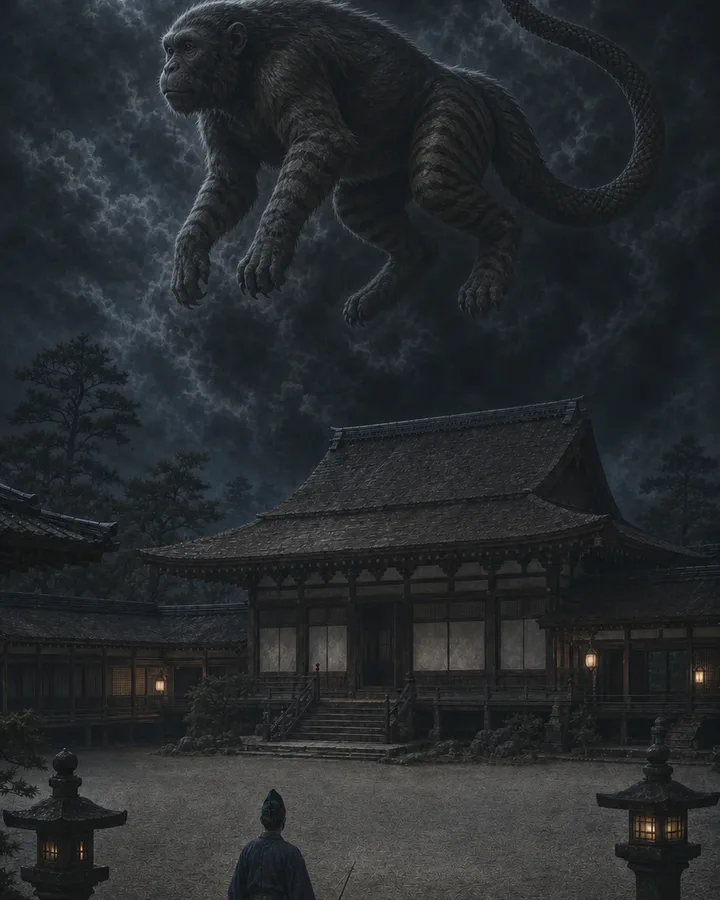
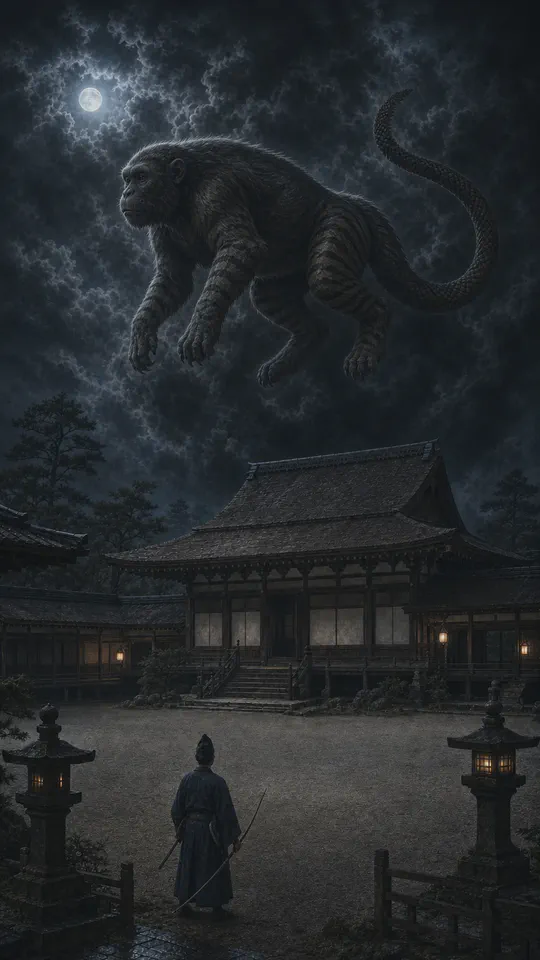
Here the texts openly disagree, and that is the most interesting thing about the nue. One illustrated edition describes what Yorimasa brought down as having the head of a monkey, the body of a tanuki, the limbs of a tiger, and a snake for a tail — the form our short adopts. Other versions hand out the parts differently. There is no single canonical body.
Our illustration treats the creature as one animal rather than a collage: a single dark-brown coat, one skeleton, tiger striping with the colour taken down, and a snake tail that continues from the spine. No wings, no horns, no second head.
Behavior and abilities
- It comes in black cloud. Never seen plainly; it arrives as weather over the roofline.
- It cries in the night. The court experiences a voice, not a body.
- The emperor sickens. The illness is laid to its presence.
- An arrow ends it. Yorimasa shoots into the cloud and the thing falls.
Our short stops at the moment before the shot: the archer in the courtyard, the thing still circling above the hall, nothing yet decided.
The bird, the book, and the pond
Was the nue a monster, or a name that grew out of a sound in the dark? The tale gives it a body and an arrow; the older word gives it only a cry. Kyoto keeps a stone at the Nue Pond, Nue-ike, where Yorimasa is said to have washed the blood from his arrowhead, and illustrated Heike editions in archives and museums show how differently artists imagined what came down over the centuries.
The bird is still out there. On summer nights in the hills it still whistles. It is a thrush. A twelfth-century court heard it above the palace roof and built a monster around the sound.
Weaknesses and countermeasures
Within the story, Yorimasa’s bow — and, in the fuller tellings, his retainer Ii no Hayata, who finished the fallen creature with a blade. That is a plot resolution, not a rule about a species. There is no charm or sutra against the nue, because the nue is an episode rather than a hazard anyone expected to meet.
Documented tradition and later imagery
Documented tradition. A narrative episode in The Tale of the Heike: a black cloud over the palace, a bird-like cry, Emperor Konoe’s illness, Minamoto no Yorimasa’s arrow, and a creature whose parts differ between versions. The name is that of a real bird with an ill-omened night call, and Kyoto preserves a monument at the Nue Pond.
Later imagery. Games and illustration have hardened the nue into a fixed design — always the same monkey-tiger-snake composite, often winged, often breathing fire or lightning. Fixing the body is exactly what the older material refuses to do. Something was up there, everyone heard it, and no two accounts agree on what fell.
Sources and further reading
- Primary text The Tale of the Heike, digital exhibition (external link) National Archives of Japan The Nue episode: a creature in black cloud over the palace, the emperor's illness, and Minamoto no Yorimasa's arrow. A medieval war tale, not a record of a living animal.
- Museum Exhibition on monster-slaying tales (妖怪退治伝) (external link) National Archives of Japan Exhibition material on illustrated versions of monster-slaying narratives.
- Museum About The Tale of the Heike (external link) Hyogo Prefectural Museum of History Explains the textual history and the existence of many variant versions.
- Reliable secondary Nue Pond monument (鵺池碑) (external link) City of Kyoto A Kyoto monument attached to the Nue narrative.
Where it was recorded
- 1153
Nue Pond, Kyoto, Kyoto
Legend or tale
Black cloud over the palace; Yorimasa's arrow (Tale of the Heike)
Places named in the records behind this article. Coordinates are approximate. View on the map
Records behind this article
On the timeline
In the glossary
In manga
- Dororo どろろ Uses the names, reinvents the rest
- Jujutsu Kaisen 呪術廻戦 Yokai-adjacent: urban legends and mixed lore
- Mononoke モノノ怪 Uses the names, reinvents the rest
- Nura: Rise of the Yokai Clan ぬらりひょんの孫 Uses the names, reinvents the rest
Where to see it
- Nue Pond and Nue Daimyōjin 鵺池・鵺大明神 Site
- Nuezuka, the Nue Mound 鵺塚(都島) Site
- Fukusaki: Yanagita Kunio's Birthplace and the Yokai Benches 福崎町(柳田國男・松岡家記念館と妖怪ベンチ) Site
Related yokai
Tamamo-no-Mae
玉藻前(たまものまえ)
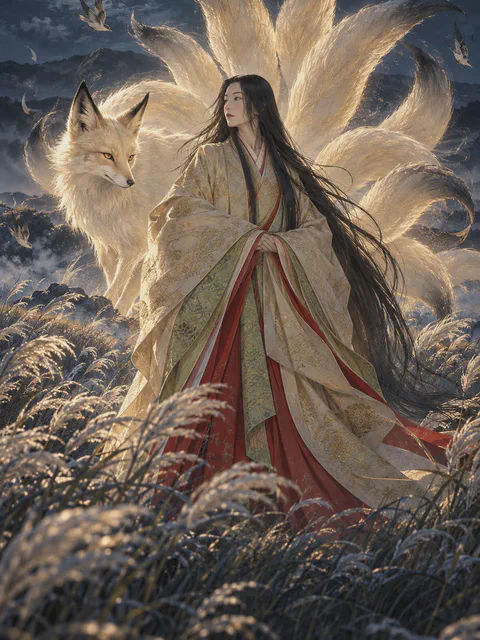
In the fifteenth-century tale, Tamamo-no-Mae is the most learned woman at the court of Retired Emperor Toba. He falls ill, divination names her as the cause, and she flees to Nasu as a fox. The killing stone came later.
Shuten-dōji
酒呑童子(しゅてんどうじ)
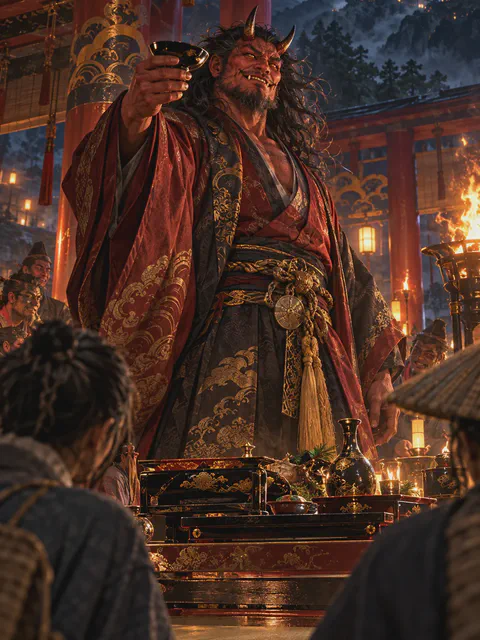
The tale of Shuten-dōji appeared in the fourteenth century: an oni lord on Mt. Ōe who carried off the daughters of the capital, and the warriors who got in disguised as monks and defeated him with sake.
Raijū
雷獣(らいじゅう)
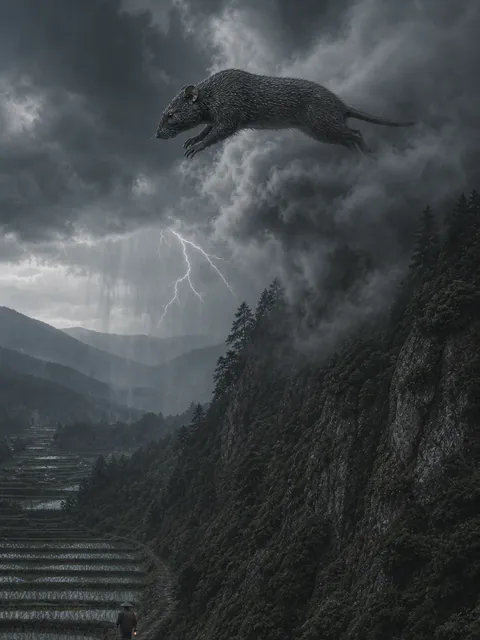
An Edo-period account from Shimotsuke describes a mouse-like animal that waited in a mountain hole each summer until its own thundercloud came to collect it.