
Nekomata (猫又): The Cat With Two Tails
Japan's forked-tail cat yokai, from a mountain rumour to the family hearth
猫又(ねこまた) Nekomata ASCII: Nekomata
Also known as: 猫股, Neko-mata
Pronunciation: neh-koh-MAH-tah
Nekomata (猫又, “forked cat”) is the Japanese cat yokai with a tail split in two. In Marugame, in Kagawa, an old household cat becomes a nekomata: its tail divides, and it stands up on its hind legs and dances. In Miyazaki a cat that grows past a certain weight goes off into the mountains to train, and comes home years later as a nekomata with designs on the family. The name is seven centuries old, and the two tails came later.
Quick Facts
- Habitat
- House, Mountain
- Region
- Marugame (Kagawa), Shintomi (Miyazaki)
- Recorded period
- Tsurezuregusa (14th century), Gazu Hyakki Yagyō (1776), 1931 folklore record
- Nature
- Mixed
- Danger rating
- If you meet one
- Feed it red-bean rice with a fish on it and put a red hand-towel over its head. It leaves the house without doing harm. In the article
The danger rating is an editorial summary made for readability. It is not an objective measure found in folklore sources.
Watch the Short
What is Nekomata?
In Marugame, in Kagawa, this is what happens to a cat that lives long enough. It becomes a nekomata. Its tail splits into two, and it gets up on its hind legs and dances. When a household’s cat reaches that point, as it was told in 1931, you feed it red-bean rice with a fish laid on top, put a red hand-towel over its head, and it leaves the house without doing the family any harm.
That is a nekomata at its most domestic: not a monster from the hills but the animal asleep by the hearth, one day older than it ought to be.
What does nekomata mean?
The name is written 猫又. Neko is a cat. Mata means a fork — the place where one thing divides into two, as in a branch or the crotch of a tree — and it is also written 猫股 with the character for the thigh. The forked cat, the cat whose tail goes two ways. It is pronounced neh-koh-MAH-tah.
The name is far older than the forked tail. In the fourteenth century, Tsurezuregusa mentions a rumour that a nekomata lives deep in the mountains and eats people. A priest walking home alone at night, sure the creature has leapt on him, discovers at the end that it is his own dog, overjoyed to see him. The passage proves that people already feared something called a nekomata; it says nothing about a house cat, old age, or two tails.
Appearance
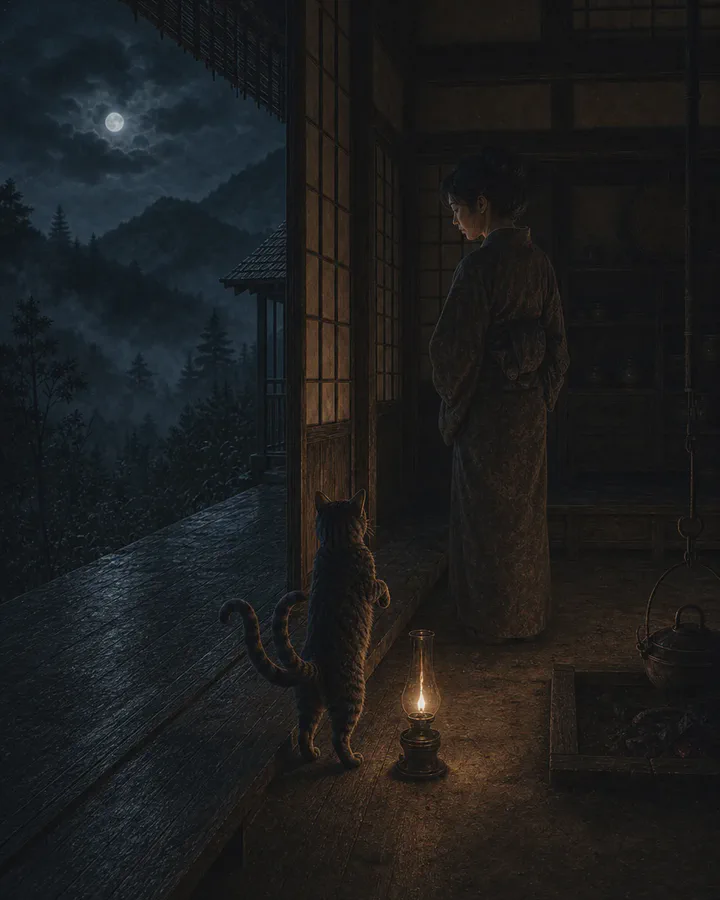
The Kagawa record gives two marks: a tail divided in two, and an upright posture. Toriyama Sekien’s picture of 1776, in Gazu Hyakki Yagyō, fixed the image most people carry — a two-tailed cat standing on its hind legs.
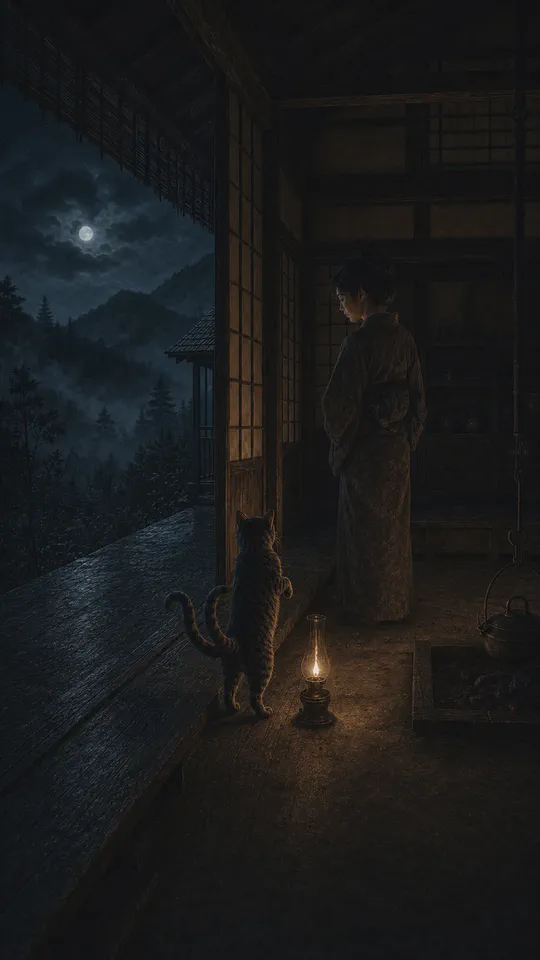
Our illustration keeps the animal the size of a house cat: an old dark tabby, two tails that part naturally from one root, no clothing and no human face. Not the giant monster cat, not the cat-eared woman.
Behavior and abilities
- It grows old and changes. In Kagawa, age alone is enough.
- It stands and dances. On its hind legs, in the lamplight.
- It trains. In Shintomi, in Miyazaki, as told in 1992, a cat that passes one kan in weight — nearly four kilograms — leaves home to practise in the mountains. It sleeps on pine stumps to coat itself in resin, then rolls in sand until its fur is hard enough to turn an arrow or a bullet. After one year, or two, or seven, it comes back a nekomata, and it comes for the people of the house.
- Red toms are most at risk. The Miyazaki record is specific about it.
The Miyazaki household had a charm against all this: when kittens were born they were put in a masu, a wooden measuring box, so that they would not grow large enough to leave.
Nekomata and bakeneko
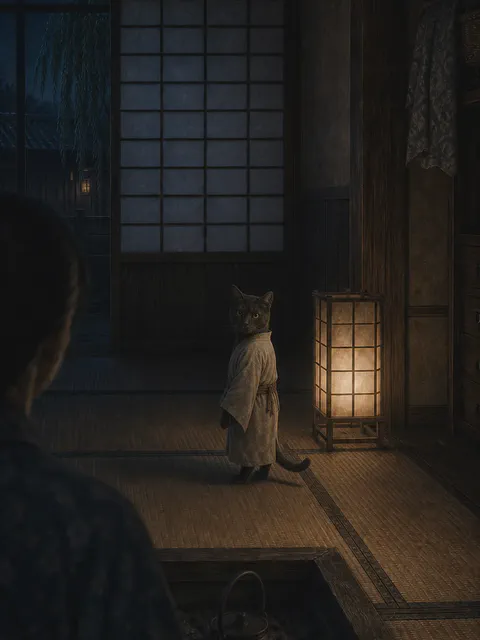
Japanese folklore never drew a clean line between the nekomata and the bakeneko, the “changed cat” that talks, wears a towel on its head and takes human form. Age and transformation turn up on both sides. For this series the split tail is the nekomata’s mark and the bakeneko keeps one tail, which is a way of telling two episodes apart, not a rule any village followed.
Weaknesses and countermeasures
Kagawa’s answer is a send-off rather than a fight: red-bean rice, a fish, a red towel, and the cat walks out and does not come back. Miyazaki’s answer is preventive, a measuring box for the kittens. The mountain nekomata of Tsurezuregusa has no remedy at all, and needs none, because it turns out to be a dog.
Documented tradition and later imagery
Documented tradition. An ageing household cat that becomes a nekomata, its tail dividing and its body rising to dance, sent away with red-bean rice, fish and a red towel (Marugame, Kagawa, 1931); a heavy cat that trains in the mountains on pine resin and sand and returns in one, two or seven years to threaten its household, with kittens boxed to keep them small (Shintomi, Miyazaki, 1992); the man-eating mountain nekomata of Tsurezuregusa that proves to be a dog (fourteenth century); and Sekien’s two-tailed cat of 1776.
Later imagery. Games, animation and fantasy art give the nekomata an enormous body, blue fire, human speech, costumes or a half-human form. Those are descendants of the tradition rather than pictures of it. The older cat is smaller and worse: the one that has been on the cushion for fifteen years, quietly getting ready.
Sources and further reading
- Fieldwork collection Nekomata account from Marugame, Kagawa, record 0640390 (external link) International Research Center for Japanese Studies The adopted 1931 account: an old cat becomes a nekomata, its tail divides in two, it dances upright, and a local food-and-red-towel response is recorded.
- Fieldwork collection Cat and nekomata account from Shintomi, Miyazaki, record C4510104-000 (external link) International Research Center for Japanese Studies Regional comparison for beliefs connecting old cats and nekomata.
- Library Gazu Hyakki Yagyō (画図百鬼夜行) (external link) National Diet Library Search Bibliographic record for the historical picture book associated with Sekien's kodama image.
- Museum Toriyama Sekien's Nekomata image (external link) International Research Center for Japanese Studies Historical two-tailed upright-cat image; not an illustration of the 1931 Kagawa record.
- Library Tsurezuregusa section 89 and the nekomata (external link) National Diet Library Discusses the older mountain-nekomata rumor and the story's mistaken-identity ending; it does not describe an old household cat or two tails.
Where it was recorded
- 1931
Marugame, Kagawa
Folklore record
Old cat's tail splits and it dances; sent away with red-bean rice and a red towel
- 1992
Shintomi, Koyu District, Miyazaki
Folklore record
Heavy cat trains in the mountains and returns as a nekomata
Places named in the records behind this article. Coordinates are approximate. View on the map
Records behind this article
On the timeline
In the glossary
In manga
- Hozuki's Coolheadedness 鬼灯の冷徹 Uses the names, reinvents the rest
- Inuyasha 犬夜叉 Uses the names, reinvents the rest
- Kemono Jihen 怪物事変 Uses the names, reinvents the rest
- Nura: Rise of the Yokai Clan ぬらりひょんの孫 Uses the names, reinvents the rest
- Otome Yōkai Zakuro おとめ妖怪 ざくろ Uses the names, reinvents the rest
- Yokai Doctor 妖怪のお医者さん Uses the names, reinvents the rest
- Yokai Rental Shop 妖飼兄さん Uses the names, reinvents the rest
Related yokai
Bakeneko
化け猫(ばけねこ)
Stories of old cats that speak, perform, dress like people or take human form—and the separate cat yokai they keep getting confused with.
Kasha
火車(かしゃ)
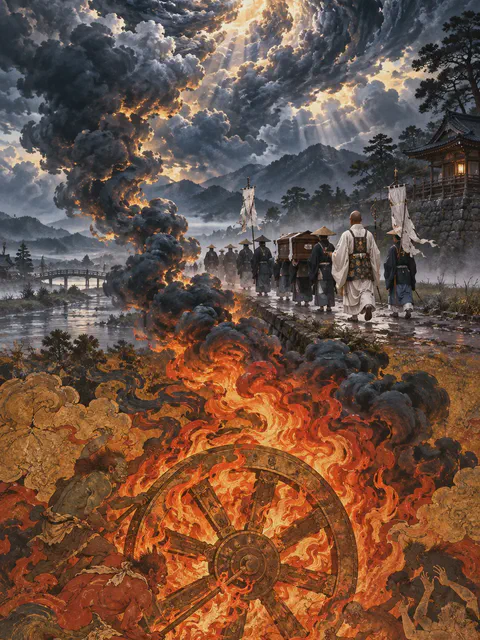
Kasha began as the Buddhist fire cart that came for sinners at the hour of death. By the late sixteenth century it was a thing in the thunderstorm that stole the dead from funerals, and only from about the late seventeenth century was it said to be a cat.
Kitsune
狐(きつね)
A 1930 account from Toyooka describes blurred blue or red foxfire moving restlessly from beyond the mountain to somewhere close by.