
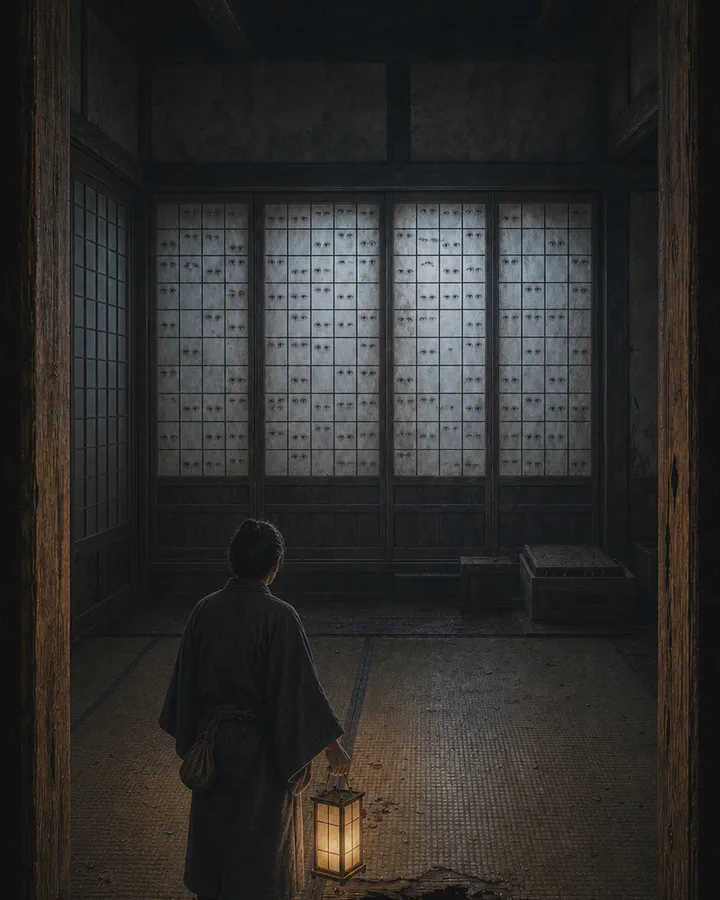
Mokumokuren (目目連): The Eyes in the Paper Screens
Sekien's many-eyed shoji, and the Go joke in its caption
目目連(もくもくれん) Mokumokuren ASCII: Mokumokuren
Also known as: 目目蓮, Mokumoku-ren
Pronunciation: moh-koo-moh-koo-ren
Mokumokuren (目目連, “many eyes connected”) is the yokai of a ruined house whose paper sliding screens are covered in eyes. It comes from Toriyama Sekien’s picture book of 1781: an empty room, worn shoji, and dozens of paired human eyes looking out of the paper. The caption is a joke — a house with this many “eyes” must have belonged to a player of Go, where enclosed spaces are called eyes. No attack, no victim, no remedy.
Quick Facts
- Habitat
- House
- Region
- Japan
- Recorded period
- Edo period
- Nature
- Unknown
- Danger rating
The danger rating is an editorial summary made for readability. It is not an objective measure found in folklore sources.
Watch the Short
What is Mokumokuren?
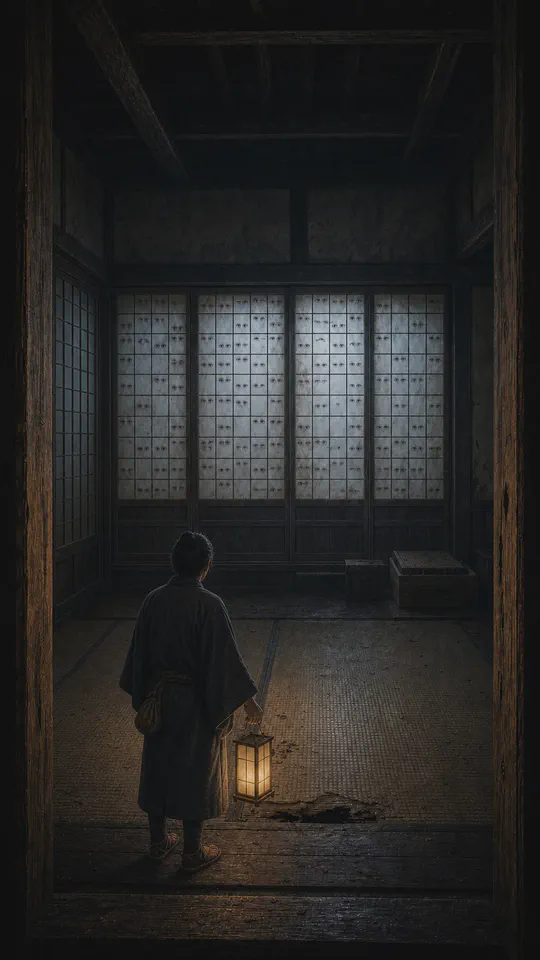
A ruined room. The tatami are gone and the paper of the sliding screens is torn and brown. Nobody has lived here in years. And across every panel of the shoji, in pairs, at the height of a face, there are eyes — dozens of them, human-sized, open, looking into the room.
That is the plate Toriyama Sekien published in 1781 in Konjaku Hyakki Shūi, and the caption under it is not a warning. It is a pun. A house with so many me — eyes — in it, Sekien suggests, must once have been the home of a Go player, because in Go the enclosed spaces that keep a group of stones alive are called eyes.
The result is a picture that watches you and a caption that winks.
What does mokumokuren mean?
The name is written 目目連: me, eye, twice, and ren, to connect or to string together — a connected multitude of eyes. Read in the Chinese manner the three characters come out moku-moku-ren. The name describes the picture and nothing else; there is no story behind it to describe.
Appearance
The mokumokuren has no head, no body, no hands and no feet. The yokai is the room, the paper and the eyes together. The eyes are human in scale and sit on the surface of the paper, not peering through holes in it; the shoji stay recognisable as shoji, which is what makes the detail land.
Our illustration follows that composition: a traveller with a lantern before four old panels as small paired eyes open across them. The traveller and the opening are film’s additions. Sekien drew a room.
Behavior and abilities
- The house has eyes. The visual premise is the whole creature.
- They are on the shoji. No separate thing is identified behind the paper.
- The caption makes a Go joke. The ruined house was a Go player’s.
Nothing in the plate steals eyes, bites, traps or follows anyone. Animation makes the eyes blink and track a person across the room; that extends a still picture, and the picture itself holds still.
A picture, not a village
Sekien’s late books are full of inventions — tool spirits, puns given bodies — and the mokumokuren is one of them. It has no province, no witness and no date other than the year it was printed. Calling it folklore in the broad modern sense is fair; what the record holds is an artist’s arrangement and a learned joke. It is also its own creature: not the one-eyed hitotsume-kozō, not the hundred-eyed dodomeki, not the tenome with eyes in its palms.
Weaknesses and countermeasures
None. Replacing the paper, cleaning the house, prying the eyes out and selling them to a doctor — all later retellings. The 1781 plate offers nothing to do about the eyes at all, and nothing that needs doing. Its effect is being watched in a room that should be empty.
Documented plate and later imagery
Documented plate. Toriyama Sekien, Konjaku Hyakki Shūi (1781): many pairs of eyes across the shoji of a ruined house, with a caption joking that the building must have belonged to a Go player because it holds so many “eyes.”
Later imagery. Later versions add a neglected house that grows eyes out of resentment, an attack, a method of banishment, eyeballs in torn holes, or a whole building that has come alive. All of it exceeds the caption. A deserted room, a dim lantern and a wall that looks back are enough.
Sources and further reading
- Primary text Mokumokuren in Hyakki Yagyō Shūi, lower volume, frame 6 (external link) National Diet Library Digital Collections Digitized 1805 printing containing Sekien's image and caption; the work was first published in 1781 and the caption makes a pun on the eyes of Go.
- Library Hyakki Yagyō, three volumes and three supplementary volumes (external link) National Diet Library Search Bibliographic record for the multi-volume publication containing the supplementary work.
- Museum Konjaku Hyakki Shūi (external link) Tokyo Museum Collection Museum record identifying Toriyama Sekien and dating the work to 1781.
- Library Hyakki Yagyō Shūi, three volumes (external link) CiNii Books Bibliographic record for editions and holdings of the three-volume supplementary work.
- Museum Toriyama Sekien's Mokumokuren (external link) Wikimedia Commons Public image reference for Sekien's composition; use the primary text for the caption.
Records behind this article
On the timeline
In the glossary
In manga
- GeGeGe no Kitarō ゲゲゲの鬼太郎 Keeps the traditional forms, invents the stories
- Kiitarō Shōnen no Yōkai Enikki 奇異太郎少年の妖怪絵日記 Keeps the traditional forms, invents the stories
Related yokai
Tenome
手の目(てのめ)
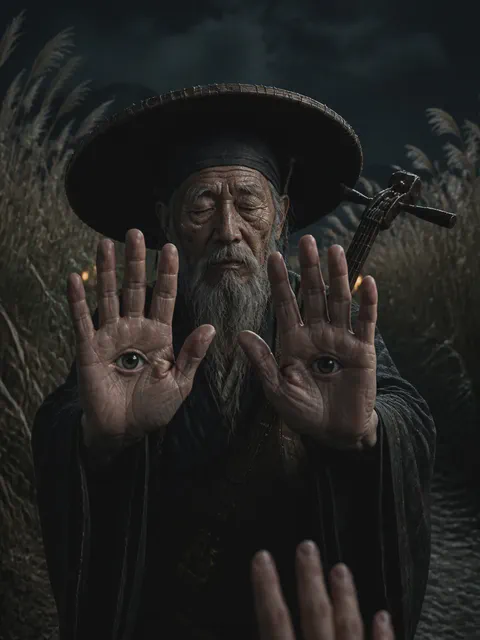
Sekien's 1776 plate shows an elderly blind figure with a biwa on his back, holding out two palms, each with an open eye. He gave it a name and nothing more; the story of a murdered man hunting his killer came later.

Karakasa-kozō
唐傘小僧(からかさこぞう)
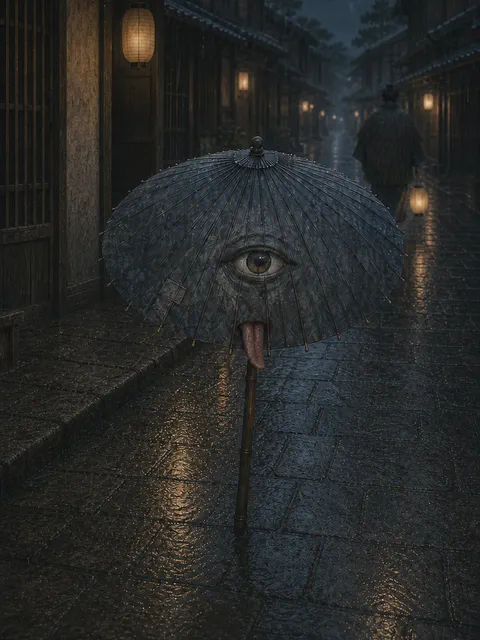
An 1857 Osaka print shows a kabuki actor playing a one-legged umbrella monster — the clearest history of a yokai known through pictures rather than encounters.