
Mikoshi-nyūdō (見越入道): The Giant That Grows as You Look Up
Japan's looming monk of the night road, and the words that cut it down to size
見越入道(みこしにゅうどう) Mikoshi-nyūdō ASCII: Mikoshi-nyudo
Also known as: 見越し入道, Mikoshi-nyudo
Pronunciation: mee-koh-shee nyoo-DOH
Mikoshi-nyūdō (見越入道, “the monk who looks over”) is the giant of Japanese night roads: a bald, monk-like figure that stands over a traveller and gets taller the further they look up. In Nagasaki it announces itself with bamboo rustling overhead, and if you walk on in silence the bamboo falls and kills you; you have to say aloud, Mikoshi-nyūdō, I’ve seen through you. In Yamagata the same words make the giant shrink until it is gone.
Quick Facts
- Habitat
- Road, Mountain
- Region
- Nagasaki, Kaminoyama (Yamagata), Tōei (Aichi)
- Recorded period
- 1932 folklore record, 1938 folklore record, modern folklore collections
- Nature
- Harmful
- Danger rating
- If you meet one
- Say, 'Mikoshi-nyūdō, mi-nuita,' I have seen through you. Pass in silence and the bamboo falls on you. In the article
The danger rating is an editorial summary made for readability. It is not an objective measure found in folklore sources.
Watch the Short
What is Mikoshi-nyūdō?
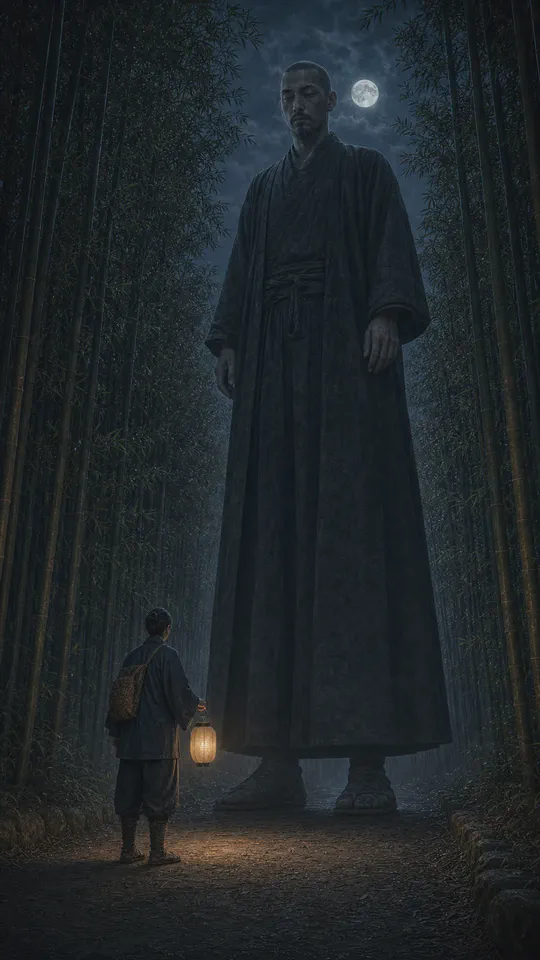
You are on a road at night in Nagasaki and the bamboo above your head begins to rustle — wara-wara, a dry whispering, with no wind to account for it. That is the mikoshi-nyūdō. If you keep your head down and walk past in silence, the bamboo comes down on you and you die. What you have to do is look up at the thing, and say to it: Mikoshi-nyūdō, mi-nuita — Mikoshi-nyūdō, I’ve seen through you.
That is the rule Yanagita Kunio recorded in 1938. In Kaminoyama, in Yamagata, the words were a little different — Mikoshi-nyūdō, mikoshita, “I’ve looked over you” — and the result was different too: the huge monk shrank as you watched, smaller and smaller, and was gone.
What does mikoshi-nyūdō mean?
The name is written 見越入道. Mikosu is to look over something, to see past or beyond it — and also to anticipate, to see through a trick. Nyūdō, “one who has entered the Way,” is a man who has taken Buddhist vows and shaved his head, and in yokai names it had come to mean any big, bald, monk-shaped apparition. The mikoshi-nyūdō is the monk who looks over you — and the monk you have to see through.
The whole encounter is in the name. It looms, and you outlook it.
Appearance
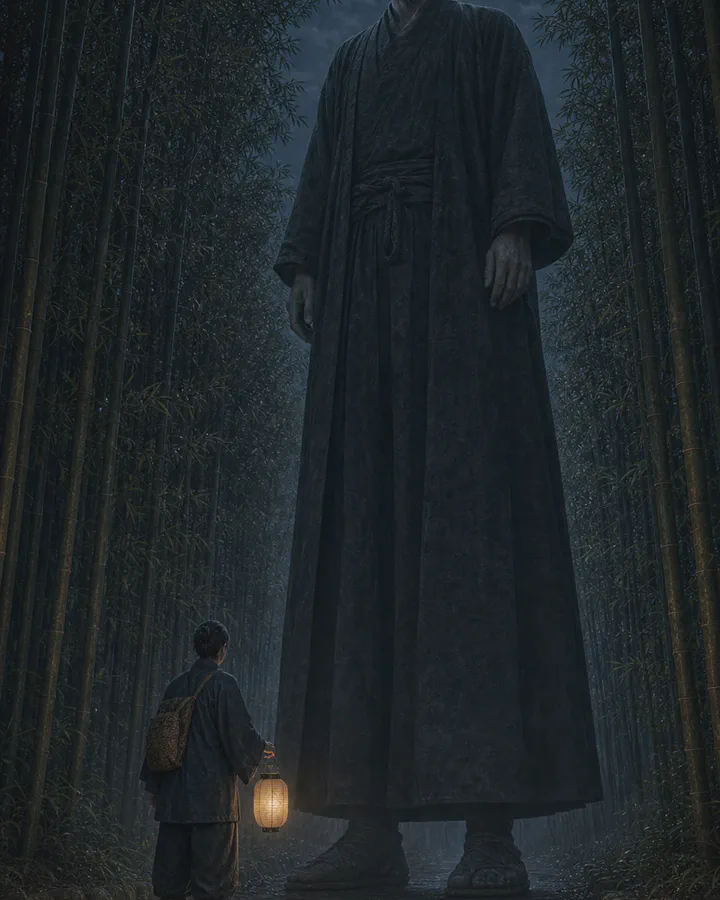
A tall, thin, man-shaped figure in a dark robe, with a shaven head. Our illustration keeps its feet on the road and its shoulders above the bamboo, with a small traveller and a lantern to give the scale, and the whole body stretched — not just the neck. The rokurokubi is the one whose neck grows; the mikoshi-nyūdō grows all over.
Pictures from the Edo period hand related figures a single eye, a long lolling tongue, or a hairy neck. Those are artists playing with a name and a silhouette. The Nagasaki road gives you a sound overhead and a shape too tall to see the top of.
Behavior and abilities
- It rustles. Bamboo or bamboo grass moving above the road with no wind.
- It grows. The further up you look, the taller it is.
- It punishes silence. In Nagasaki, walk past without a word and the bamboo falls on you.
- It shrinks when named. In Yamagata, the right words make it dwindle to nothing.
In Tōei, in Aichi, as recorded in 1932, there was simply a place where the mikoshi-nyūdō came out, and people feared it. Not every village kept the words; some only kept the dread.
Say it out loud
Most yokai are beaten by a thing — salt, a blade, a sutra, a stick swept low. The mikoshi-nyūdō is beaten by a sentence. The rule is not don’t look up. It is the opposite: look up, see it for what it is, and say so. Keeping your head down is what gets you killed. A thing that grows on being looked at, and dies on being named, is a fairly exact picture of fear on a dark road.
Weaknesses and countermeasures
The spoken formula, in the local wording. Nagasaki’s mi-nuita saves your life; Yamagata’s mikoshita makes the giant vanish. The words differ from valley to valley and the endings differ with them, which is how folklore travels. No weapon, charm or object appears in either record.
Documented tradition and later imagery
Documented tradition. Bamboo rustling over a night road, death by falling bamboo for those who pass in silence, and the phrase Mikoshi-nyūdō, I’ve seen through you (Nagasaki, in Yanagita’s Yōkai Meii, 1938); Mikoshi-nyūdō, I’ve looked over you, at which the giant shrinks and vanishes (Kaminoyama, Yamagata, 1990); and a feared place where it appeared (Tōei, Aichi, 1932). Edo pictures with one eye, a long tongue or a hairy neck.
Later imagery. Modern depictions pile every feature together — endless growth, a single eye, a long tongue, monk’s robes, spectacular attacks. The fear in the records is simpler: a sound in the bamboo, a shape that is taller every time you check, and the knowledge that your life depends on saying one sentence out loud to it.
Sources and further reading
- Fieldwork collection Mikoshi-nyūdō account from Nagasaki, record 2180788 (external link) International Research Center for Japanese Studies The adopted 1938 account: bamboo rustles above a night traveler, silence is dangerous, and the traveler must identify Mikoshi-nyūdō aloud.
- Fieldwork collection Mikoshi-nyūdō account from Kaminoyama, Yamagata, record 1140544 (external link) International Research Center for Japanese Studies A regional example in which a related spoken phrase makes the giant shrink and disappear.
- Fieldwork collection Mikoshi-nyūdō account from Tōei, Aichi, record 0900011 (external link) International Research Center for Japanese Studies A 1932 place-based record useful for showing the tradition's regional spread.
- Reliable secondary Yokai Hyakunin Isshu and Mikoshi-nyūdō (external link) National Diet Library Monthly Bulletin 770 National Diet Library discussion of historical Mikoshi-nyūdō imagery.
- Museum Mikoshi figure from Shinpan Yōkai Tobimawari Sugoroku (external link) International Research Center for Japanese Studies Historical popular-print example showing one visual treatment of a towering mikoshi figure.
- Museum One-eyed mikoshi image with a portable shrine (external link) International Research Center for Japanese Studies A distinct visual example; do not treat its one eye or shrine as universal Mikoshi-nyūdō features.
Where it was recorded
- 1938
Nagasaki, Nagasaki
Folklore record
Bamboo rustles overhead; say 'I've seen through you' or it falls on you
- 1990
Kaminoyama, Yamagata
Folklore record
'I've looked over you' makes the giant shrink and vanish
- 1932
Tōei, Kitashitara District, Aichi
Folklore record
A feared place where the mikoshi-nyūdō appeared
Places named in the records behind this article. Coordinates are approximate. View on the map
Records behind this article
On the timeline
In the glossary
In manga
- GeGeGe no Kitarō ゲゲゲの鬼太郎 Keeps the traditional forms, invents the stories
- Mokke もっけ Keeps the traditional forms, invents the stories
Related yokai
Rokurokubi
轆轤首(ろくろくび)
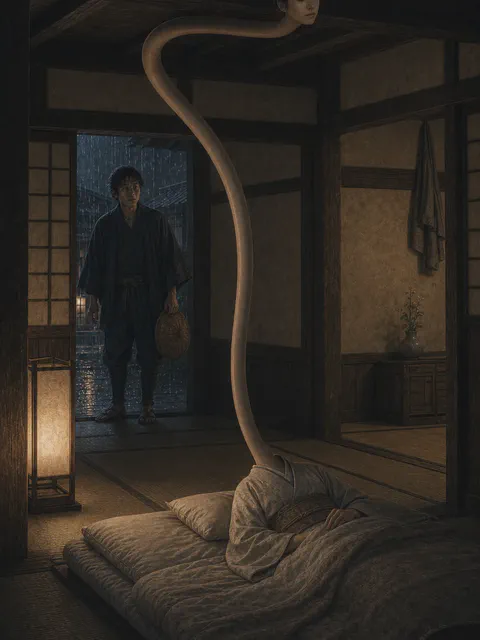
A seemingly human figure whose neck stretches at night—and one name that once covered more than one uncanny form.
Ao-bōzu
青坊主(あおぼうず)
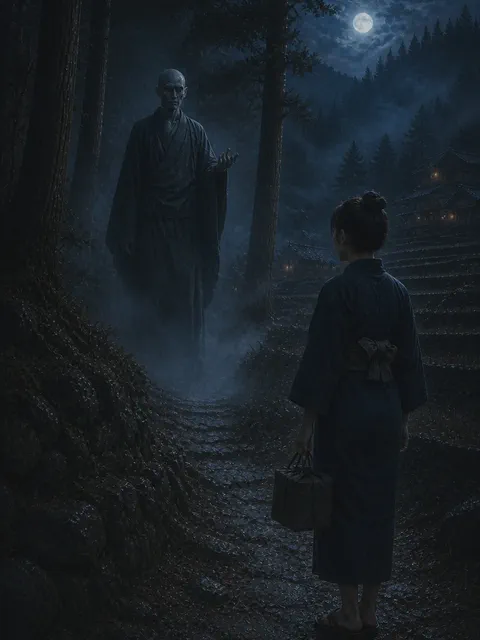
In a 1984 record from Miai in Kagawa, a girl carrying lunch to her family's mountain field met Ao-bōzu, the blue monk. He asked her one question. She said no, and he was gone.
Wanyūdō
輪入道(わにゅうどう)
In Toriyama Sekien's 1779 picture book, a single ox-cart wheel rolls through the night by itself — and anyone who sees it is said to lose their soul.