
Kyōrinrin (経凛々): The Yokai Made of Discarded Scriptures
Sekien's sutra-scroll creature, and the monk whose curse came home
経凛々(きょうりんりん) Kyōrinrin ASCII: Kyorinrin
Also known as: Kyorinrin
Pronunciation: KYOH-reen-reen
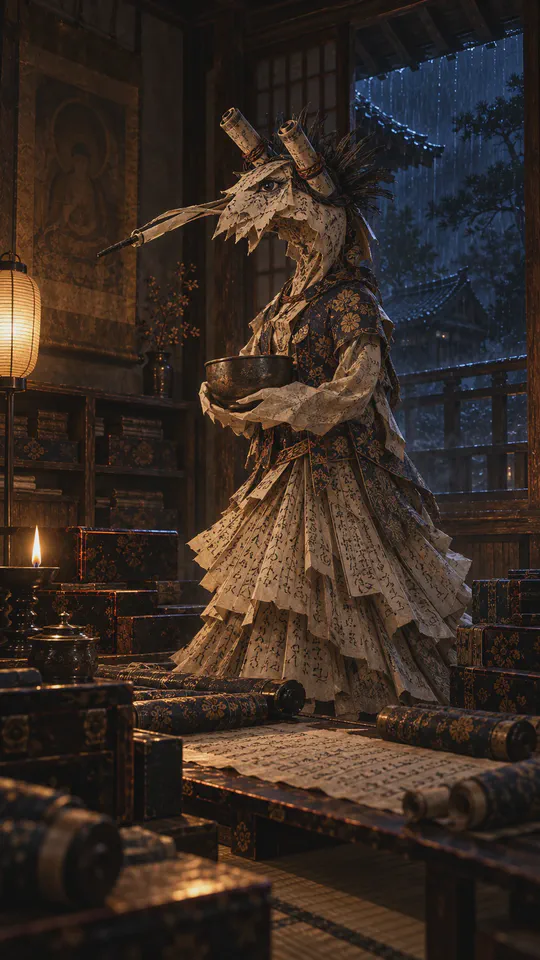
Kyōrinrin (経凛々, “the stern sutra”) is a creature built entirely of Buddhist scripture, from Toriyama Sekien’s picture book of 1784: rolled sutra scrolls for limbs, more scrolls bound upright on its head like a crown, folded scripture fanning out into a skirt, a face torn out of the paper itself, and a temple bowl-gong in its hands. Sekien’s caption wonders whether these are the sutras read and thrown away by the monk Shubin, whose curse against Kūkai turned back on himself.
Quick Facts
- Habitat
- Temple or shrine, House
- Region
- unspecified
- Recorded period
- Toriyama Sekien's Hyakki Tsurezure Bukuro (1784)
- Nature
- Unknown
- Danger rating
The danger rating is an editorial summary made for readability. It is not an objective measure found in folklore sources.
Watch the Short
What is Kyōrinrin?
In a temple library where scrolls and folded books and a sutra desk lie scattered across the floor, the scripture has stood up. Rolled sutra scrolls make its arms and legs. More scrolls are bound upright on its head with a cloth band, like a crown. Folded accordion-style scripture fans out below into something like a skirt. Its face is the torn paper itself, the rips forming eyes, a mouth and teeth, and in its hands it holds the copper bowl-gong that is struck during chanting, with a scroll’s wooden rod for a striker.
That is the plate in the middle volume of Hyakki Tsurezure Bukuro, Toriyama Sekien’s picture book of 1784, in a run of creatures built from the tools of Buddhist temples. Sekien opens his caption by asking how venerable scripture came to such a state, and his answer names a man.
What does kyōrinrin mean?
The name is written 経凛々. Kyō is a Buddhist sutra. Rinrin means stern, imposing, dignified — and it also sounds like the ringing of a small bell, rin-rin, which is what a bowl-gong does. The stern, ringing sutra. It is pronounced KYOH-reen-reen.
The caption and the monk
Perhaps, Sekien supposes — in a dream, as every entry in this book is supposed — these are sutras read and then discarded by Shubin, the monk upon whom “curses and poisons returned to the one who sent them.” The phrase comes from Buddhist scripture, and Sekien’s readers knew the story it points to. In the Taiheiki, the fourteenth-century war chronicle, Shubin is a court monk who loses face to Kūkai, Kōbō Daishi, in a contest of powers before the emperor. Out of resentment he traps the dragon gods of the land in a water jar to bring drought; one dragon escapes, and Kūkai’s prayers bring the rain. The two monks then turn their rituals on each other, and Shubin’s curse comes back on Shubin.
So the scrolls in the plate are not simply old books nobody read. In Sekien’s supposition they are holy words that were used to wish harm on someone, and then thrown away by the man that harm returned to.
Appearance
Our illustration follows the plate — the scroll crown, the fan of pages, the bowl-gong, the scattered library — and gives the torn face a sharp paper beak, which is our reading of the rips.
Behavior and abilities
- It is made of scripture. Every part of the body is sutra or folded text.
- It holds a bowl-gong. The instrument of chanting, with nobody to chant.
The caption records no action at all. It explains where the scrolls came from, not what they do.
Weaknesses and countermeasures
None are recorded. The closest thing to a rule in the caption is the one in the phrase it quotes: a curse returns to the one who sends it.
Documented plate and later imagery
Documented plate. Toriyama Sekien, Hyakki Tsurezure Bukuro (1784): a figure built from sutra scrolls and folded scripture, scrolls tied upright on its head, a torn-paper face, holding a bowl-gong, among scattered scriptures. The caption suggests these are sutras discarded by Shubin, on whom his own curse returned.
Later imagery. The kyōrinrin is now usually the spirit of scriptures that went unread — books left in storage, resentful at being ignored, rising up to demand study. That is a natural reading of a creature made of sutras, and it leaves out the one person the caption names. The plate’s own suggestion is darker than neglect. These words were used for something, and they remember what.
Sources and further reading
- Library Hyakki Tsurezure Bukuro, volume 2 (NDL scan) (external link) Wikimedia Commons; National Diet Library Full scan of the 1805 printing's middle volume, with the Kyōrinrin and Boroboroton plates and captions.
- Library Hyakki Tsurezure Bukuro (百鬼徒然袋), 3 volumes (external link) National Diet Library Search Bibliographic record for an 1805 printing; notes the original edition of 1784.
- Museum Hyakki Tsurezure Bukuro, middle volume (external link) Kawasaki City Museum Archive The middle volume, carrying Koto-furunushi and Biwa-bokuboku, Kyōrinrin, and Boroboroton with Hahakigami.
- Reliable secondary Kyōrinrin: caption and plate notes (external link) Yōkaidō (Sekien Hyakusekinyū) Transcribes and annotates the caption on scriptures discarded by Shubin, and the Taiheiki account of the rain contest with Kūkai and the curse that returned to its sender.
Records behind this article
On the timeline
In the glossary
Related yokai
Biwa-bokuboku
琵琶牧々(びわぼくぼく)
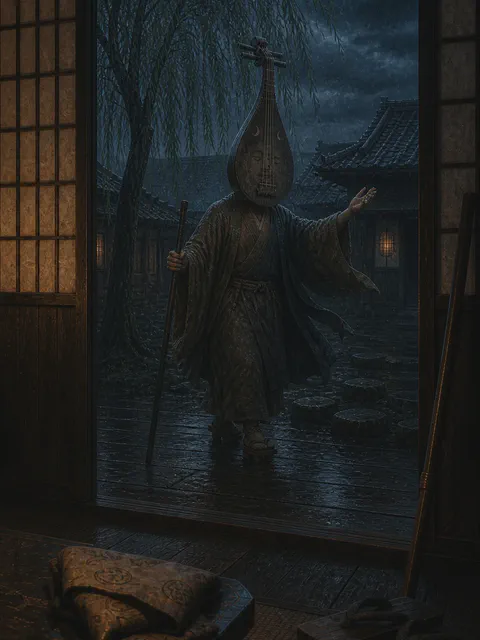
In 1784 Sekien drew a blind biwa priest with a biwa for a head, feeling his way under a willow. His caption names two legendary court lutes, Genjō and Bokuba, and builds the creature's name out of one of them.
Koto-furunushi
琴古主(ことふるぬし)
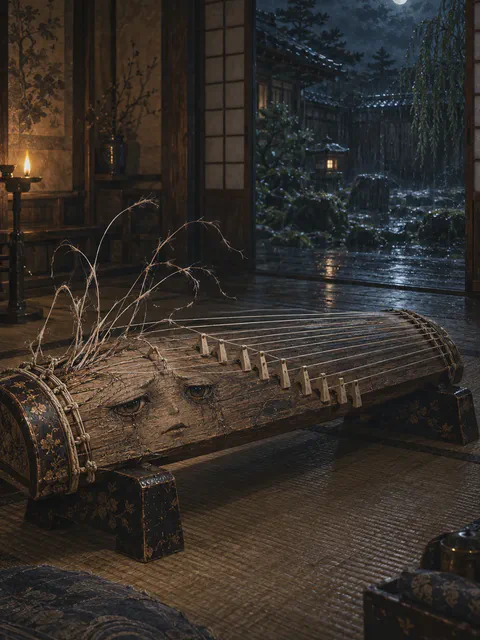
Sekien's 1784 Koto-furunushi is an old koto with a face and strings like wild hair. His caption says why it appeared: after Yatsuhashi changed the music, the old Tsukushi koto survived only as a name, and it came to make its grudge known.