
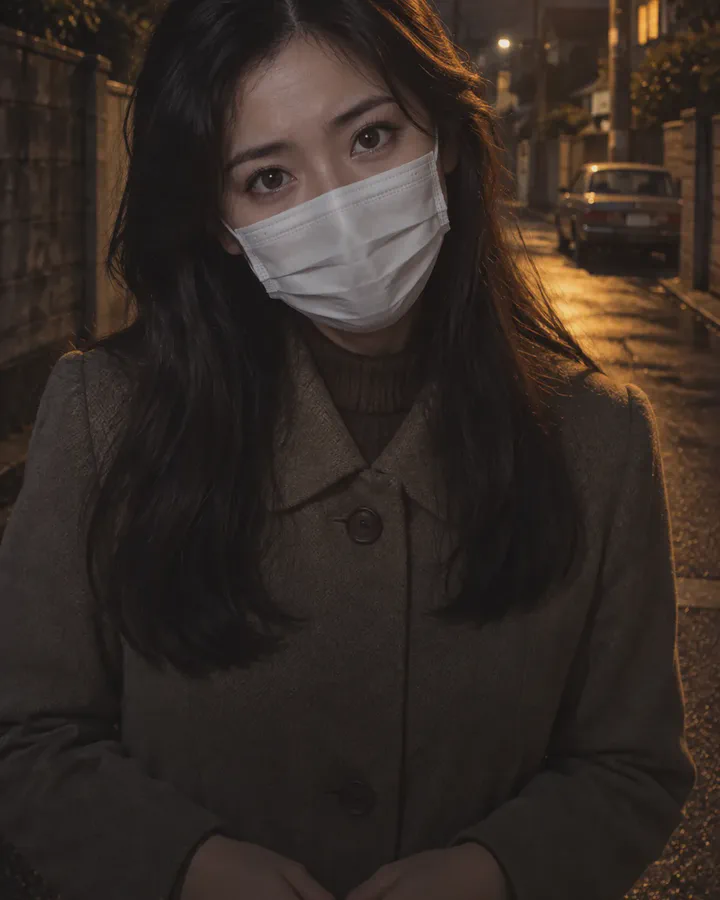
Kuchisake-onna (口裂け女): The Slit-Mouthed Woman of 1979
Japan's most famous urban legend — a masked woman, one question, and a country of schoolchildren
口裂け女(くちさけおんな) Kuchisake-onna ASCII: Kuchisake-onna
Also known as: Slit-Mouthed Woman
Pronunciation: koo-chee-SAH-keh OHN-nah
Kuchisake-onna (口裂け女, “the slit-mouthed woman”) is a modern Japanese urban legend, not an old yokai. In the spring and summer of 1979 a rumour swept through the country’s schools: a young woman with long hair and a large mask stops you in the street and asks, Am I pretty? — and under the mask her mouth is cut from ear to ear. Her age, her weapon, her speed, her story and the way to escape her changed from one school to the next, and newspapers and television carried every version.
Quick Facts
- Habitat
- Street, Road
- Region
- Japan
- Recorded period
- 1978–79 rumour, 1980s–90s folklore records
- Nature
- Harmful
- Danger rating
- If you meet one
- Tell her she is average, or say pomade three times. In the article
The danger rating is an editorial summary made for readability. It is not an objective measure found in folklore sources.
Watch the Short
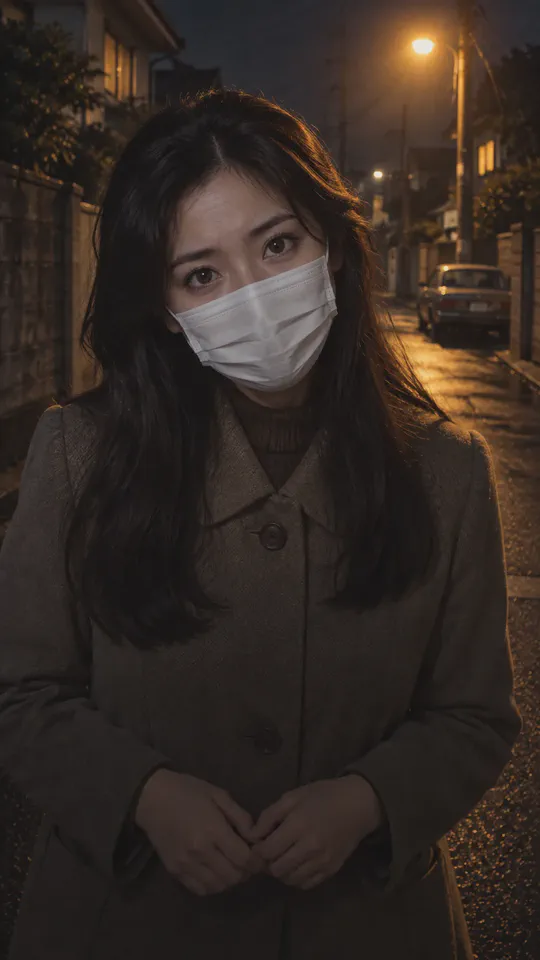
Who is Kuchisake-onna?
You are walking home after dark, in a town in Japan, in 1979. A woman is standing under the streetlight. She is young, her hair is long, and the lower half of her face is hidden by a large white mask — nothing unusual; half the country wears one in cold season. She steps toward you and asks, Watashi, kirei? Am I pretty?
What happens next depended on which school you went to. That is the kuchisake-onna, and she is not an old yokai. She is a rumour, and in the spring and summer of 1979 she spread through Japan’s elementary and middle schools so fast that the newspapers, the magazines and the broadcasters ended up covering the panic itself.
What does kuchisake-onna mean?
The name is written 口裂け女: kuchi, mouth; sakeru, to split or tear; onna, woman. The woman with the split mouth. It is pronounced koo-chee-SAH-keh OHN-nah. The name tells you what is under the mask, which is the one thing the story never shows you until it is too late.
The core, and everything else
Every version shares the scene: long hair, a big mask, the question. Beyond that, more than twenty versions collected across the country in the 1980s and 1990s disagree about nearly everything.
In Sendai she is a patient escaped from a particular hospital, who frightens people in the street. In Kitakata, in Fukushima, she is a beautiful woman in her twenties whose cosmetic surgery went wrong, and the only thing to do is run. In Kagoshima she killed herself after a rejection. In Iwate she carries a sickle and runs too fast to escape; in Tokyo a knife, or a kitchen knife if there are three of her. Other tellings give her sisters, a horror of pomade, a weakness for a particular sweet, a fixed distance she can cover in so many seconds. Each version spread because it was new, and each contradicted the last.
How old is she?
The versions that give an age make her young — in her twenties in the Kitakata telling, a young woman in most of the others — a figure of the present, not a ghost from the past. Retellings that make her an Edo-period spirit or the wife of a jealous samurai are later additions. In 1979 she was somebody who might have been standing at the bus stop.
How it spread
The rumour travelled first by word of mouth between children — in the classroom, on the way home, from older brothers and sisters. A study of a questionnaire given to schoolchildren that year suggests that part of the pleasure was being frightened and passing the fright on. Then local papers, radio, magazines and television picked it up, and the coverage sent every local version everywhere at once. NHK’s broadcasting research institute still cites it as the textbook case of an urban legend exploding among schoolchildren.
Appearance
A woman, usually young, with long hair and a large surgical mask — a common sight in Japan, which is part of why it worked. Our illustration keeps her masked throughout, on an ordinary street at dusk.
Behavior and abilities
- She asks a question. The one element that never changes.
- Everything else varies. Weapon, speed, motive, and what she does with your answer.
Weaknesses and countermeasures
Every school had an answer and the answers cancel out: tell her she is average; offer her a particular hard candy; say pomade three times; run in a particular direction. None is the original, because there was no original.
Documented rumour and later imagery
Documented rumour. A nationwide rumour among Japanese schoolchildren in 1978–79, at its height in the spring and summer of 1979, with a stable core — a masked woman asking “Am I pretty?” — and dozens of mutually contradictory versions recorded in folklore journals in the 1980s and 1990s.
Later imagery. Kuchisake-onna is now a fixture of horror films, manga and international lists of Japanese urban legends, often given an Edo-period origin or a single fixed backstory. The record is more interesting than any one story. Nobody wrote her. A country’s schoolchildren built her together in a few months, and each of them added one more detail before passing her on.
Sources and further reading
- Library Finding magazine articles on the Kuchisake-onna rumour of spring–summer 1979 (external link) National Diet Library Search (Kagawa Prefectural Library) Reference record dating the nationwide spread of the rumour to spring and summer 1979.
- Database Ikai no mori, no. 32: Kuchisake-onna (external link) International Research Center for Japanese Studies A rumour that arose in the late 1970s and spread nationwide in many variants.
- Fieldwork collection Kuchisake-onna, related records from 0210016 (external link) International Research Center for Japanese Studies Twenty-one records whose details disagree — a patient escaped from a Sendai hospital, a failed cosmetic operation, a jilted woman's suicide, a knife or a sickle, chasing or not.
- Academic paper Misinformation in the SNS era and mass-media corrections (external link) NHK Broadcasting Culture Research Institute; Hōsō Kenkyū to Chōsa 68/11 Cites Kuchisake-onna as the classic urban legend that spread explosively among schoolchildren in 1978–79.
- Academic paper Factors in rumour transmission by mode of transmission (external link) Japan Association for Social Informatics Uses a 1979 questionnaire to suggest the rumour was passed on partly as a game of wanting to be scared.
Where it was recorded
- 1979
Gifu, Gifu
Modern rumour
Where the 1979 school rumour is first reported to have spread
- 1979
Sendai, Miyagi
Modern rumour
Escaped hospital patient version
- 1979
Kitakata, Fukushima
Modern rumour
Woman in her twenties whose surgery went wrong; run
- 1979
Kagoshima, Kagoshima
Modern rumour
Suicide after rejection version
- 1979
Iwate, Iwate
Modern rumour
Carries a sickle; too fast to outrun
Places named in the records behind this article. Coordinates are approximate. View on the map
Records behind this article
On the timeline
In the glossary
In manga
- Dandadan ダンダダン Yokai-adjacent: urban legends and mixed lore
- Jujutsu Kaisen 呪術廻戦 Yokai-adjacent: urban legends and mixed lore
Related yokai
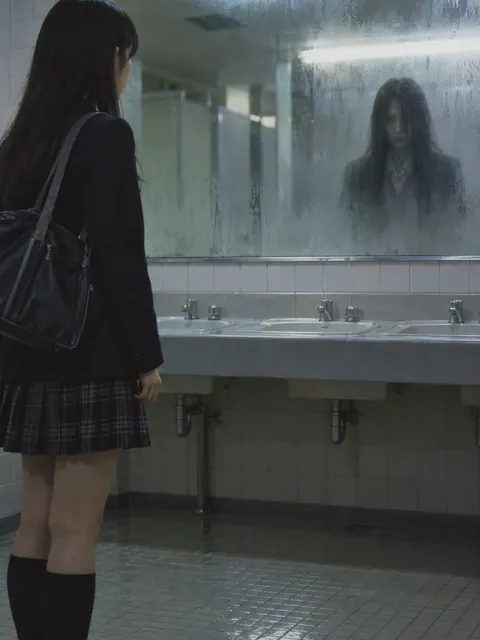
Teke Teke
テケテケ
Teke Teke is a modern school ghost story, best known as the upper half of a woman who drags herself along on her elbows. Its origin cannot be traced, and one recorded version from a Kobe high school puts it in a mirror instead.
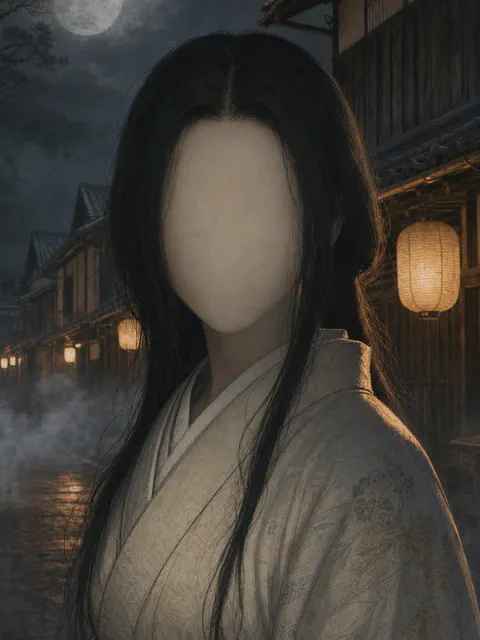
Futakuchi-onna
二口女(ふたくちおんな)
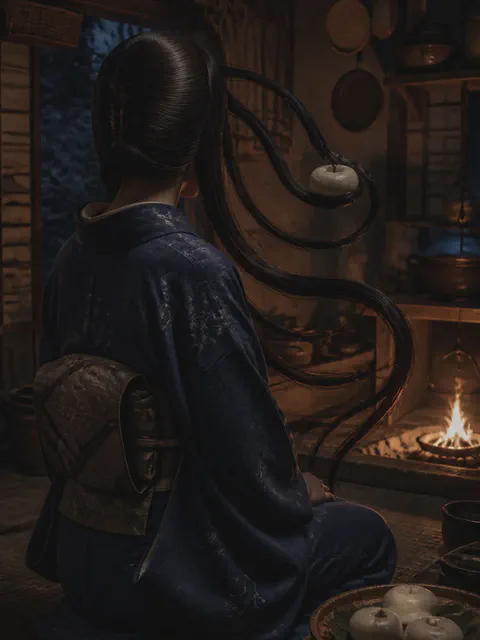
The 1841 Ehon Hyaku Monogatari made Futakuchi-onna a stepmother punished with a mouth at the back of her head. Folktales of the wife who eats nothing, recorded in the twentieth century, give the same hidden mouth to brides who turn out to be snakes, spiders, and oni.