
Koto-furunushi (琴古主): The Old Koto With a Grudge
Sekien's instrument yokai, and the forgotten music inside it
琴古主(ことふるぬし) Koto-furunushi ASCII: Koto-furunushi
Also known as: Kotofurunushi
Pronunciation: KOH-toh foo-roo-NOO-shee
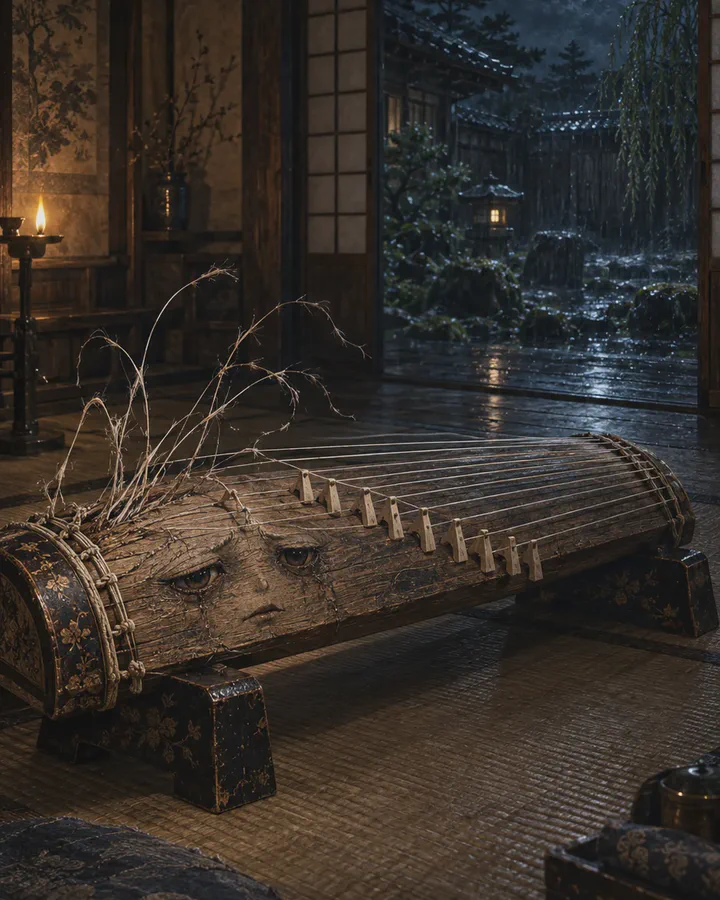
Koto-furunushi (琴古主, “old master of the koto”) is an old thirteen-stringed koto that has become a creature, from Toriyama Sekien’s picture book of 1784: a face at the head of the instrument, the finger-picks standing up like horns, the snapped strings rising like wild hair, a torn book of music under one foot. Sekien’s caption says why it appeared. After the blind master Yatsuhashi changed the way the koto was played, the old Tsukushi music survived in name only, and it took this shape to make its grudge known.
Quick Facts
- Habitat
- House
- Region
- unspecified
- Recorded period
- Toriyama Sekien's Hyakki Tsurezure Bukuro (1784)
- Nature
- Unknown
- Danger rating
The danger rating is an editorial summary made for readability. It is not an objective measure found in folklore sources.
Watch the Short
What is Koto-furunushi?
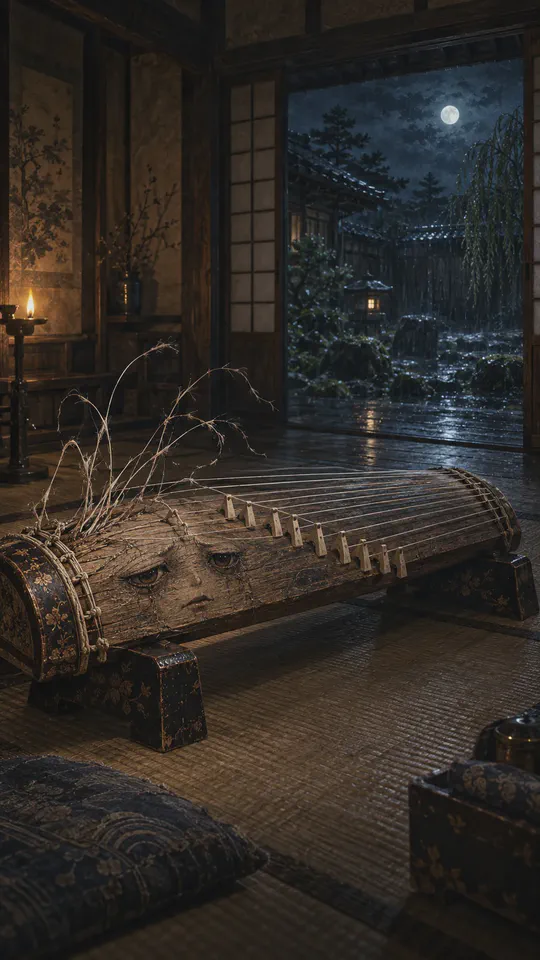
In the last of Toriyama Sekien’s four yokai picture books, Hyakki Tsurezure Bukuro of 1784, there is a koto on the floor of a dim room, and it is looking at you. The end of the instrument where the strings are tied off has become a face. The ivory picks a player wears on the fingers stand up from it like horns. The strings, loosened and snapped, rise in a tangle like a head of wild hair. The body is cracked and holed, and under one foot lies a torn book of music.
Look for the kotoji, the movable bridges that hold each string up and set its pitch. There are none. Without them a koto cannot be tuned at all.
What does koto-furunushi mean?
The name is written 琴古主. The koto is the long zither, thirteen strings on a hollow body of paulownia wood, laid on the floor and played with picks. Furu is old. Nushi is a master or owner — and also the word for the spirit that has made its home in a place or a thing, the nushi of a pond or a mountain. Koto-furunushi is the old master of the koto, or the koto that has been around long enough to have a master living in it. It is pronounced KOH-toh foo-roo-NOO-shee.
The caption
Sekien’s text is short and specific. Since a blind musician named Yatsuhashi changed the tunings and the playing, he writes, the Tsukushi koto has remained in name only, and the people who know its sound have become rare — and so, perhaps, it took this shape to make its grudge known.
Yatsuhashi Kengyō was a real musician of the seventeenth century, a blind master who trained in Tsukushi-goto, the koto music handed down in the temples of northern Kyushu, and then built new tunings and a new repertoire of his own. His style spread, carried the instrument’s name with it, and became the koto music most people knew. The older tradition did not vanish, but by Sekien’s day it belonged to a few specialists.
Which side the caption is on is hard to tell. It can be read as sympathy for a venerable tradition pushed aside, or as a joke at the old style’s expense. Either way, the thing with the grudge is not a neglected instrument. It is a way of playing.
Appearance
Our illustration follows the plate: a long cracked koto on a low stand in a tatami room at night, a face at its end, picks like horns, strings standing up like hair, no bridges, and the torn music under it. Beyond the open doors, a moonlit garden.
Behavior and abilities
- It makes its grudge known. That is the only purpose the caption gives it.
- It holds a sound nobody hears. The complaint is that few can recognise the old music any more.
There is no attack and no victim. Nothing is done to anyone. Its companion in the same book is the biwa-bokuboku, a walking lute; in the medieval scrolls Sekien drew on, a koto creature and a biwa creature travel together.
Weaknesses and countermeasures
None are recorded. If a remedy is implied, it is the obvious one — listening — and Sekien leaves it unsaid.
Documented plate and later imagery
Documented plate. Toriyama Sekien, Hyakki Tsurezure Bukuro (1784): a battered koto with a face at one end, picks like horns, loose strings like hair and no bridges, standing on a torn music book, with a caption attributing its appearance to the grudge of the old Tsukushi koto whose sound became rare after Yatsuhashi changed the music.
Later imagery. Modern yokai books file the koto-furunushi as a tsukumogami, a household object come to life after long neglect — an old koto left unplayed and resentful in a storeroom. Sekien’s version is more particular and stranger. The instrument is not lonely. The music is. A melody that no living player knows has climbed into the wood and strings, and it is waiting to be recognised.
Sources and further reading
- Library Hyakki Tsurezure Bukuro (百鬼徒然袋), 3 volumes (external link) National Diet Library Search Bibliographic record for an 1805 printing; notes the original edition of 1784.
- Museum Hyakki Tsurezure Bukuro, middle volume (external link) Kawasaki City Museum Archive The middle volume, carrying Koto-furunushi and Biwa-bokuboku, Kyōrinrin, and Boroboroton with Hahakigami.
- Library Hyakki tsurezurebukuro digitized copy, volume 2 (external link) Smithsonian Libraries Digitized middle volume of Sekien's 1784 book of utensil yokai.
- Reliable secondary Koto-furunushi: caption and plate notes (external link) Yōkaidō (Sekien Hyakusekinyū) Transcribes and annotates the caption on Yatsuhashi Kengyō and the old Tsukushi-goto, and describes the plate's plectrum horns, string hair, missing bridges, and torn score. Notes that the caption can be read as siding with either the old or the new style.
Records behind this article
On the timeline
In the glossary
Related yokai
Biwa-bokuboku
琵琶牧々(びわぼくぼく)
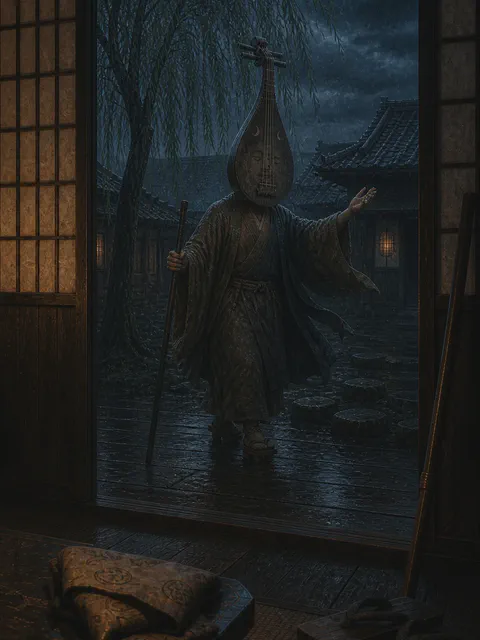
In 1784 Sekien drew a blind biwa priest with a biwa for a head, feeling his way under a willow. His caption names two legendary court lutes, Genjō and Bokuba, and builds the creature's name out of one of them.
Boroboroton
暮露暮露団(ぼろぼろとん)
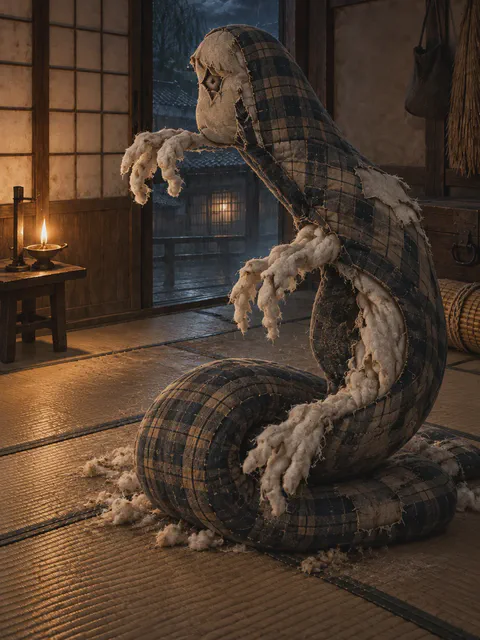
Sekien's 1784 Boroboroton is a worn, patched futon standing upright with cotton spilling out like hands. His caption gets there through wandering Zen mendicants, an old poetry contest, and one word that means both.
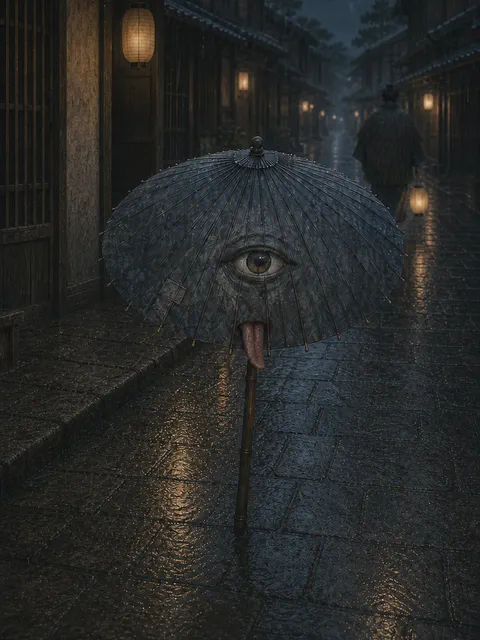
Karakasa-kozō
唐傘小僧(からかさこぞう)
An 1857 Osaka print shows a kabuki actor playing a one-legged umbrella monster — the clearest history of a yokai known through pictures rather than encounters.