Kitsune (狐) and Kitsunebi (狐火): The Foxfire That Never Stays Still
Japan's fox yokai, seen through one night of moving lights in Tajima
狐(きつね) Kitsune ASCII: Kitsune
Also known as: Kitsunebi, 狐火, 狐の火
Pronunciation: kit-soo-neh
Kitsune (狐) is the Japanese fox, and in folklore a whole family of strange foxes — shape-shifters, possessors, tricksters — and of kitsunebi (狐火, “foxfire”), the lights they are said to make. In Toyooka, in Hyōgo, the foxfire was blue or red, blurred at the edges, and never still: one moment flickering beyond the mountain, the next on this side of it. No fox was seen. Only the lights, moving.
Quick Facts
- Habitat
- Mountain, Forest, Road
- Region
- Toyooka (Hyōgo), Ōji (Edo)
- Recorded period
- 1930 folklore record, Edo-period art
- Nature
- Unknown
- Danger rating
The danger rating is an editorial summary made for readability. It is not an objective measure found in folklore sources.
Watch the Short
What is Kitsune?
In the hills around Toyooka, in the old province of Tajima on the Japan Sea side of Hyōgo, people saw the fox’s fire. It was blue, or it was red, and it was never quite in focus. You would see it flickering on the far side of the mountain — and then, before you had decided how far away it was, it was flickering on this side. It did not stop moving.
That is the record set down in 1930, and it is a fox story with no fox in it. Nobody saw an animal carrying a lantern. They saw lights where no lamp should be, and lights that would not stay where they were first seen, and they knew whose they were.
What do kitsune and kitsunebi mean?
Kitsune (狐) is simply the fox, the red fox that lives across Japan. In folklore the word stretches to cover everything the fox was believed able to do: take human shape, possess people, hold weddings in the rain, serve as the messenger of Inari, and grow, in a few famous cases, nine tails.
Kitsunebi (狐火) is kitsune plus hi, fire — the fox’s fire. It names the lights, not the animal. In Toyooka it was also called kitsune no hi, “the fire of the fox,” which says the same thing a little more slowly.
Appearance
The Toyooka foxfire has three qualities and no more. It may be blue or red. Its outline is soft — not a torch, not a sharp-edged ball. And its position changes continually, so that near and far stop meaning anything.
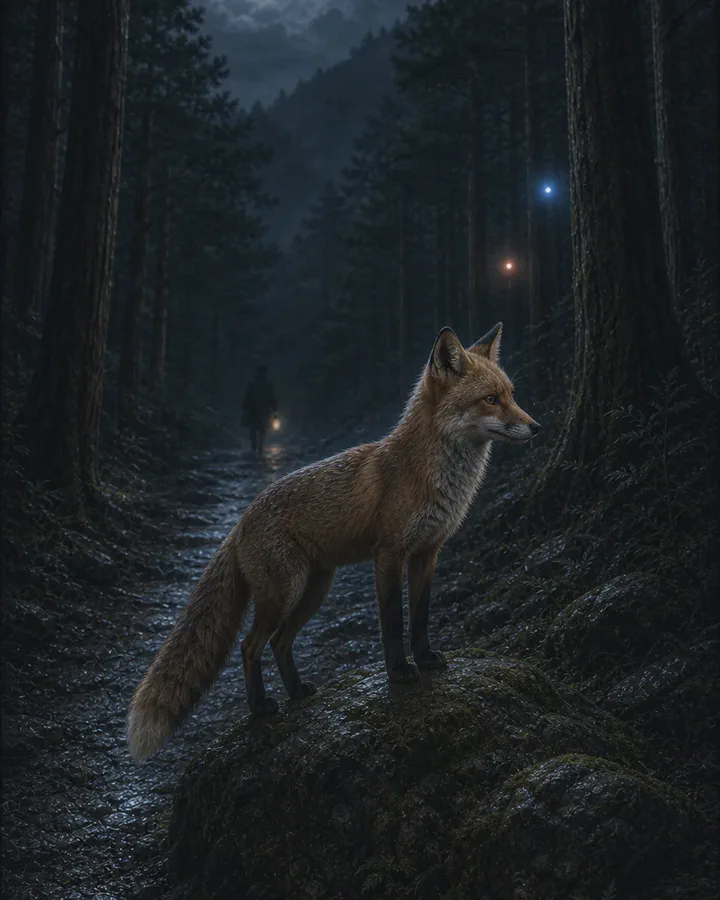
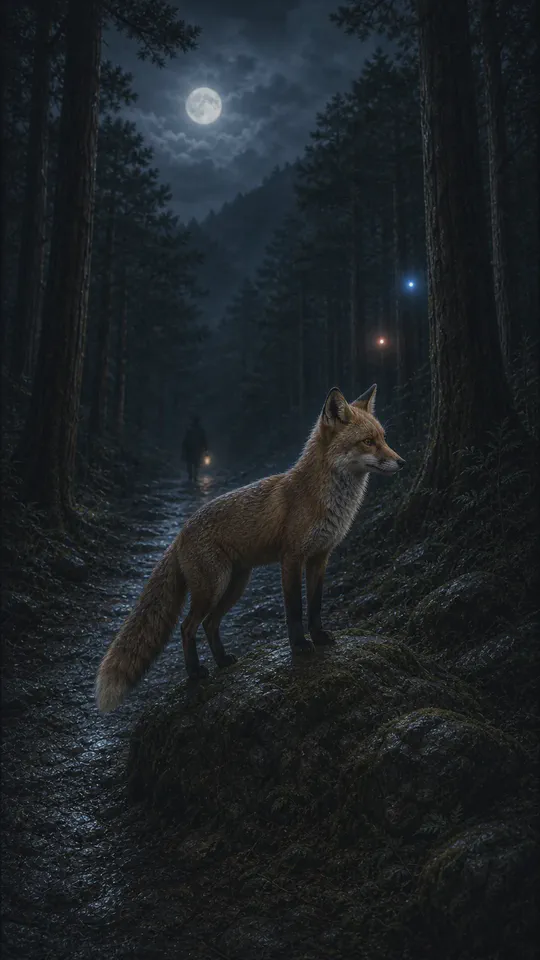
Our illustration separates what was seen from what was believed. The lights follow the record: two colours, blurred edges, scattered along a wet mountain road. The single red fox on the path is the belief, shown as an ordinary four-legged animal rather than a white shrine fox, a woman, or a nine-tailed monster. The 1930 account describes no fox at all.
Artists had put foxes and fire together long before. Toriyama Sekien drew kitsunebi in his yokai books in the 1770s, and Hiroshige’s print of Ōji, from around 1857, shows dozens of foxes gathered under a great tree on New Year’s Eve with flames hanging in the air above them.
Behavior and abilities
- The lights move. They never hold one place like a beacon.
- They confuse distance. A flicker beyond the ridge is suddenly on this side of it.
- Nothing is attacked. No one is burned, chased, led astray or possessed in the Toyooka record.
- No fox is seen. The animal is the explanation, not the sighting.
Our short turns this into a walk along a wet mountain road, with the lights changing position and a fox stepping out of the mist. The traveller and the visible fox are the film’s additions. The lights are the record.
Foxfire, Inari, and the rest of the fox
Foxes serve as the messengers of Inari, the rice deity, at shrines across Japan, and the Ōji foxes in Hiroshige’s print are on their way to pay their respects at Ōji Inari; farmers, it was said, counted the fires to forecast the harvest. That is one tradition in one place on one night of the year.
The Toyooka foxfire mentions no shrine, no New Year’s Eve and no harvest. It is lights on a mountain. The nine-tailed fox, fox possession, fox weddings, the fox wife who leaves when her true shape is seen — each of these has its own history and its own geography. They are all kitsune. None of them is needed to explain two colours of light that will not keep still.
Weaknesses and countermeasures
The Toyooka account offers none: no prayer, no iron, no dog, no salt, no spoken formula, because nothing in it attacks. Turning for home and not following the lights is good advice in a modern retelling, and the record has no need of it. The watcher watches, and the lights carry on moving.
Documented tradition and later imagery
Documented tradition. Foxfire at Toyooka in Tajima — blue or red, blurred, continually shifting between the far side of the mountain and somewhere closer, with no fox seen and no harm done (1930). Sekien’s kitsunebi in an Edo-period yokai book, and Hiroshige’s separate New Year’s Eve tradition of foxes gathering with fires at Ōji before visiting Inari.
Later imagery. Modern fiction gives the kitsune nine tails as standard, blue flame thrown from the paws, human form at will, and a fixed place in the Inari hierarchy. Each piece comes from somewhere. The Toyooka night had none of them — only a light that was never where you had last seen it.
Sources and further reading
- Fieldwork collection Kitsune no hi from Toyooka, Hyōgo, record 2260088 (external link) International Research Center for Japanese Studies The adopted 1930 account describes foxfire as blue or red, blurred, and continually moving between the far side of a mountain and somewhere closer.
- Library Kitsunebi in the National Diet Library's Toriyama Sekien image collection (external link) National Diet Library Image Bank Library exhibition index identifying Kitsunebi among the yokai illustrated by Toriyama Sekien.
- Museum New Year's Eve Foxfires at the Changing Tree, Ōji (external link) The Metropolitan Museum of Art Museum record for Hiroshige's circa-1857 print and its distinct Ōji tradition of foxes, foxfire, Inari worship and harvest prediction.
Where it was recorded
- 1930
Toyooka (Tajima), Hyōgo
Folklore record
Blue or red foxfire that never stays beyond the mountain
- 1857
Ōji, Tokyo
Print or picture
Hiroshige: foxes gather with fires on New Year's Eve before Ōji Inari
Places named in the records behind this article. Coordinates are approximate. View on the map
Records behind this article
On the timeline
In the glossary
In manga
- Demon Love Spell あやかし恋絵巻 Uses the names, reinvents the rest
- Dororo どろろ Uses the names, reinvents the rest
- GeGeGe no Kitarō ゲゲゲの鬼太郎 Keeps the traditional forms, invents the stories
- The Great Yokai War: Guardians 妖怪大戦争 ガーディアンズ Uses the names, reinvents the rest
- Hozuki's Coolheadedness 鬼灯の冷徹 Uses the names, reinvents the rest
- Hyakki Yakōshō 百鬼夜行抄 Keeps the traditional forms, invents the stories
- Inuyasha 犬夜叉 Uses the names, reinvents the rest
- Kakuriyo: Bed & Breakfast for Spirits かくりよの宿飯 Uses the names, reinvents the rest
- Kamisama Kiss 神様はじめました Uses the names, reinvents the rest
- Kekkaishi 結界師 Uses the names, reinvents the rest
- Kemono Jihen 怪物事変 Uses the names, reinvents the rest
- Kiitarō Shōnen no Yōkai Enikki 奇異太郎少年の妖怪絵日記 Keeps the traditional forms, invents the stories
- Mokke もっけ Keeps the traditional forms, invents the stories
- The Morose Mononokean 不機嫌なモノノケ庵 Uses the names, reinvents the rest
- Natsume's Book of Friends 夏目友人帳 Keeps the traditional forms, invents the stories
- Nura: Rise of the Yokai Clan ぬらりひょんの孫 Uses the names, reinvents the rest
- Ōedo Yōkai Kawaraban 大江戸妖怪かわら版 Uses the names, reinvents the rest
- Otome Yōkai Zakuro おとめ妖怪 ざくろ Uses the names, reinvents the rest
- Toilet-bound Hanako-kun 地縛少年花子くん Yokai-adjacent: urban legends and mixed lore
- Tono Monogatari 水木しげるの遠野物語 Keeps to the recorded tales
- Ushio and Tora うしおととら Uses the names, reinvents the rest
- xxxHOLiC ×××HOLiC Uses the names, reinvents the rest
- Yo-kai Watch 妖怪ウォッチ Uses the names, reinvents the rest
Where to see it
- Sesshōseki, the Killing Stone 殺生石 Site
- Ōji Fox Parade 王子 狐の行列 Festival
- Seimei Shrine and Ichijō Modoribashi 晴明神社・一条戻橋 Shrine or temple
- Abe Seimei Shrine, Osaka 安倍晴明神社(大阪) Shrine or temple
- Kuzunoha Inari Shrine, Shinoda Forest 信太森葛葉稲荷神社 Shrine or temple
Related yokai
Bake-danuki
化け狸(ばけだぬき)
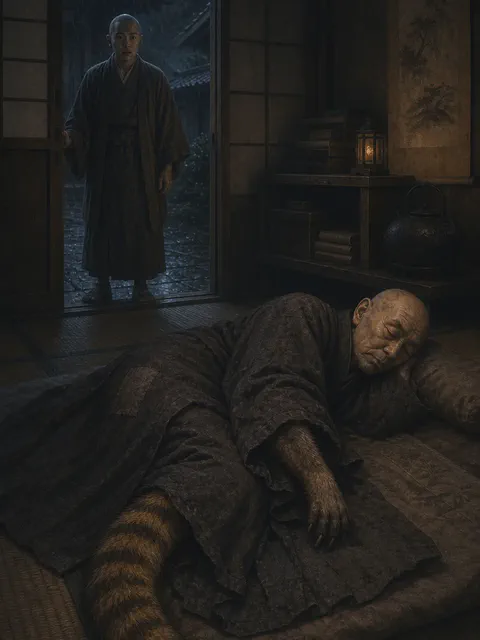
Morinji tradition tells of the monk Shukaku, an inexhaustible iron kettle, and the mujina or tanuki form revealed while he slept.
Tamamo-no-Mae
玉藻前(たまものまえ)
In the fifteenth-century tale, Tamamo-no-Mae is the most learned woman at the court of Retired Emperor Toba. He falls ill, divination names her as the cause, and she flees to Nasu as a fox. The killing stone came later.
Nekomata
猫又(ねこまた)
A 1931 Kagawa record describes an aging cat whose tail divides in two and that rises to dance on its hind legs.