
Karakasa-kozō (唐傘小僧, Kasa-obake): The Umbrella That Opens One Eye
Japan's one-legged umbrella yokai
唐傘小僧(からかさこぞう) Karakasa-kozō ASCII: Karakasa-kozo
Also known as: Kasa-obake, Kasa ippon ashi
Pronunciation: kah-rah-kah-sah koh-zoh
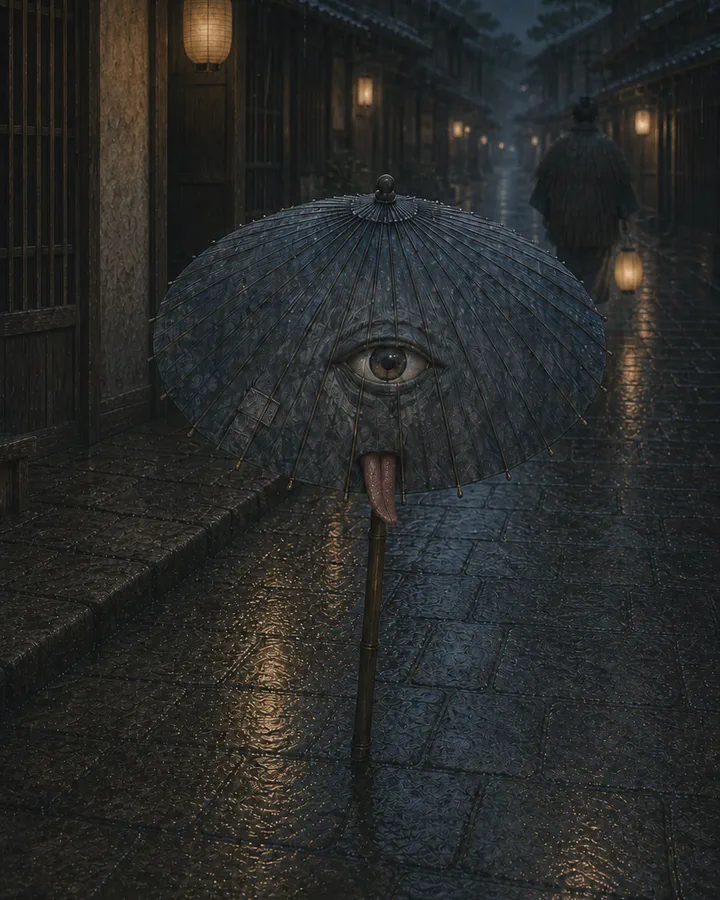
Karakasa-kozō (唐傘小僧, “umbrella boy”; also kasa-obake, “umbrella ghost”) is Japan’s umbrella yokai: an old oil-paper umbrella standing on one leg, with a single eye and a lolling tongue. It is one of the most recognisable yokai in the country and one of the hardest to pin to a place or a witness. Its clearest history is a stage role, printed in Osaka in 1857.
Quick Facts
- Habitat
- Street, Road, House
- Region
- Osaka
- Recorded period
- 1857 woodblock print, modern popular imagery
- Nature
- Mixed
- Danger rating
The danger rating is an editorial summary made for readability. It is not an objective measure found in folklore sources.
Watch the Short
What is Karakasa-kozō?
In 1857, in Osaka, the print artist Gosōtei Hirosada made a picture of a kabuki actor in a role called Kasa ippon ashi — “the one-legged umbrella.” The actor has one leg bound up behind him, and he is hopping on the other, playing an umbrella that has come to life.
That print, now in the Metropolitan Museum of Art, is the firmest ground the Karakasa-kozō has. Everyone in Japan can picture the creature: a battered paper umbrella standing on a single leg, one big eye in the canopy, a tongue hanging out. Almost nobody, in any century, claimed to have met one. It is a yokai made of pictures and performances, passed from scroll to print to stage, and it never needed a village to vouch for it.
What does karakasa-kozō mean?
Karakasa (唐傘) is the traditional oil-paper umbrella on a bamboo frame — the first character means “Chinese,” the mark of something once imported. Kozō (小僧) is a young boy, an apprentice, a temple boy. Karakasa-kozō is the umbrella boy. Its other name, kasa-obake, is plainer still: the umbrella ghost, an umbrella that has become something else.
The names tell you what it is: not a spirit that haunts umbrellas, but an umbrella that has become a spirit. It belongs to the family of tsukumogami, tools and household things that acquire life after long use.
Appearance
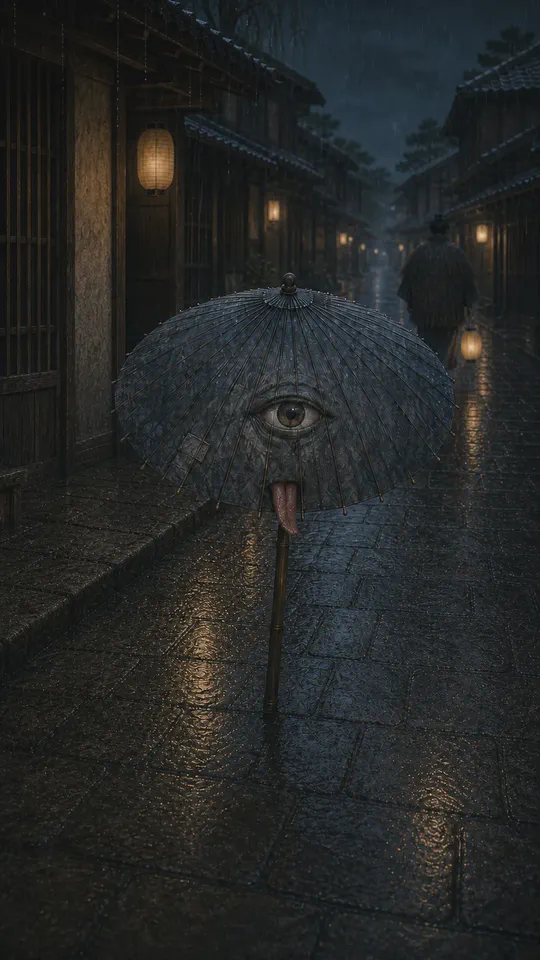
Our illustration keeps it in worn, real material: a faded blue-grey oiled-paper canopy with torn panels, water stains, and hand-sewn repairs; thick bamboo ribs; a wooden ferrule; and a single leg that is simply the handle, continued. One eye sits in the centre of the canopy. The tongue is thin and short and a dull greyish pink, not a red banner. It has no arms, no body, no clothes, and no wooden sandal.
The unease comes from an ordinary discarded object moving on its own, not from a cartoon face.
Behavior and abilities
- It hops. Irregularly, on one leg, closing the distance down a rainy street.
- It opens. The canopy spreads and the eye appears.
- It puts out its tongue. To startle whoever it has caught up with.
It does not kill, curse, carry anyone off, or eat them. It is one of the few yokai more likely to make you shout than run.
A yokai without a village
Most entries in these files have a place and a year: a road in Gunma, a slope in Tokyo, a pass in Kagawa. The Karakasa-kozō has pictures. It appears in parade scrolls of marching household objects, in games of a hundred ghost stories, in printed monster catalogues, and on the kabuki stage, and it spread through images and performances rather than through anyone’s story of what happened to them one night.
Popular retellings supply what is missing — a province, a haunted house, a reason for revenge — and a tidy rule that any tool turns into a yokai on its hundredth birthday. The umbrella arrived with none of that. It arrived hopping, on a stage, in 1857, already the thing everyone recognises.
Weaknesses and countermeasures
None. There is no charm, no salt, no sutra, and no ritual for destroying it, because nothing it does needs preventing.
Documented pictures and later imagery
Documented pictures. A tool-spirit known through pictures and performance: parade scrolls of animated household objects, printed collections, and an 1857 Osaka woodblock print by Gosōtei Hirosada of a kabuki actor playing the one-legged umbrella with one leg bound.
Later imagery. The single eye, the long red tongue, and the wooden sandal that later art often adds have become so fixed that the Karakasa-kozō now serves as the mascot of Japanese yokai in general — rounded, cheerful, printed on souvenirs. We keep the eye and the tongue because they are how the creature is known, without pretending the 1857 stage print is where every feature began.
The older strangeness is still available if you want it: something you threw away, upright in the rain, watching.
Sources and further reading
- Museum “One-Legged Umbrella Monster” (Kasa ippon ashi), 1857 (external link) Gosōtei Hirosada; The Metropolitan Museum of Art An Osaka woodblock print of a kabuki actor performing a one-legged umbrella monster with one leg bound. A theatrical role, not an encounter record.
- Database Database of Yokai Images (怪異・妖怪画像データベース) (external link) International Research Center for Japanese Studies Image database used to compare how a motif was depicted across artists and periods.
- Library The World of Yokai through Toriyama Sekien's Yokai Encyclopedias (external link) National Diet Library Image Bank Surveys rokurokubi images by multiple artists, including female and male examples.
Where it was recorded
- 1857
Osaka, Osaka
Print or picture
Hirosada print of a kabuki actor as the one-legged umbrella
Places named in the records behind this article. Coordinates are approximate. View on the map
Records behind this article
On the timeline
In the glossary
In manga
- GeGeGe no Kitarō ゲゲゲの鬼太郎 Keeps the traditional forms, invents the stories
- Kiitarō Shōnen no Yōkai Enikki 奇異太郎少年の妖怪絵日記 Keeps the traditional forms, invents the stories
- Malevolent Spirits: Mononogatari もののがたり Uses the names, reinvents the rest
- Mononoke モノノ怪 Uses the names, reinvents the rest
Where to see it
- Ichijō Yōkai Street and Daishōgun Hachi Shrine 一条妖怪ストリート(大将軍商店街)と大将軍八神社 Street
Related yokai
Mokumokuren
目目連(もくもくれん)
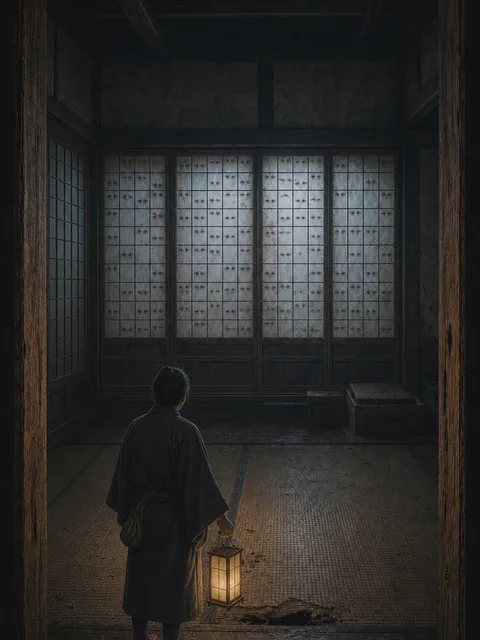
Rows of human eyes appear across old shoji in Toriyama Sekien's 1781 picture-book image.
Chōchin-obake
提灯お化け(ちょうちんおばけ)
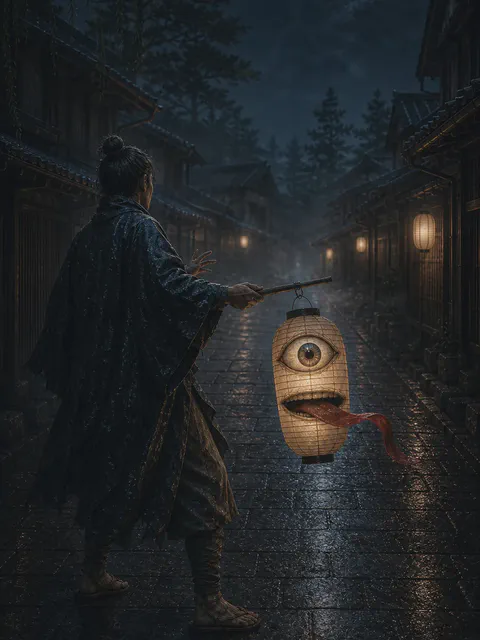
One of forty-eight monsters on Yoshimori's print Shinban Bakemono-zukushi is a paper lantern with an eye, a mouth, and something coming out of the mouth. That picture is the record — there is no story attached to it.
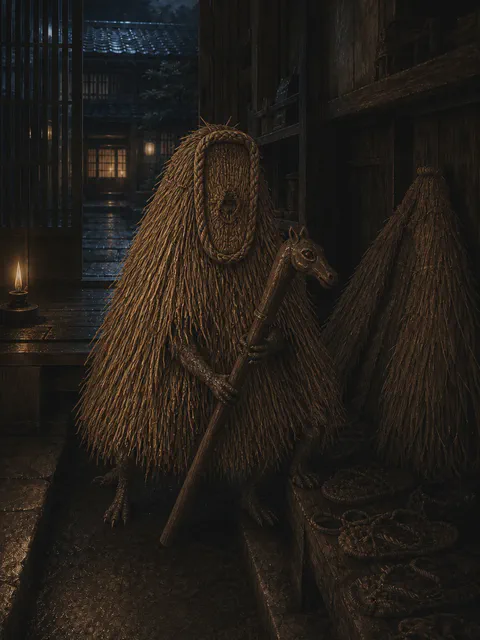
Bakezōri
化け草履(ばけぞうり)
A yokai scroll in the Nichibun collection shows a sandal monster covered in yellow straw, with a straw sandal for a face, riding a horse-head staff. It is stranger than the one-eyed singing sandal of modern books, and it comes with no story.