Hakutaku (白澤, Bai Ze): Meaning, Legend and the Charm
The knowledge beast of Chinese and Japanese folklore
白澤(はくたく) Hakutaku ASCII: Hakutaku
Also known as: 白沢, Bai Ze
Pronunciation: hah-koo-TAH-koo
Hakutaku (白澤, also written 白沢; Bai Ze in Chinese) is a legendary beast that understood human speech and taught the Yellow Emperor how to recognise and drive off every harmful being in the world. In Japan it was the picture, not the beast, that protected you: tucked into a traveler’s coat, hung on a wall, and in the cholera year of 1858 laid beside the pillow.
Quick Facts
- Habitat
- House, Road
- Region
- China (origin), Japan, Ryukyu
- Recorded period
- known to Japanese scholars by the Heian period, images circulated as charms through the Edo period, cholera epidemic of 1858
- Nature
- Helpful
- Danger rating
- If you meet one
- Borrow the hakutaku picture and hang it; at Hachiōji people came from all around to borrow one. In the article
The danger rating is an editorial summary made for readability. It is not an objective measure found in folklore sources.
Watch the Short
What is Hakutaku?
In the summer of 1858, cholera reached Edo, and a printed sheet went on sale with a title that was also an instruction: Hakutaku no zu, “the picture of Hakutaku.” The sheet was for the pillow. Sleep beside it and you would have no bad dreams. No bad dreams meant no evil spirits. And a thing that kept evil spirits away — the reasoning ran — must also keep away the cholera.
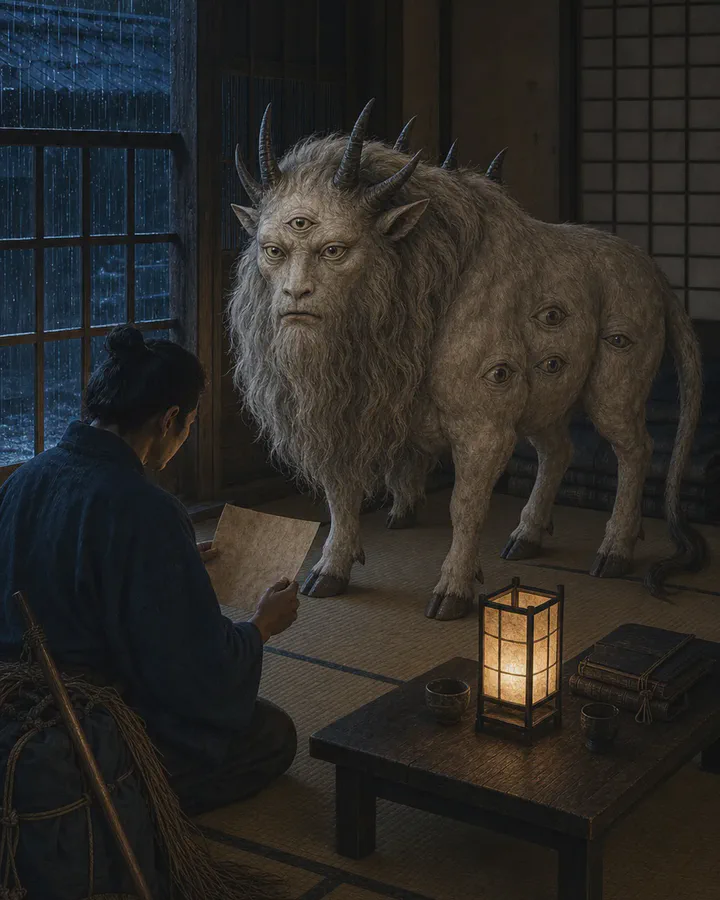
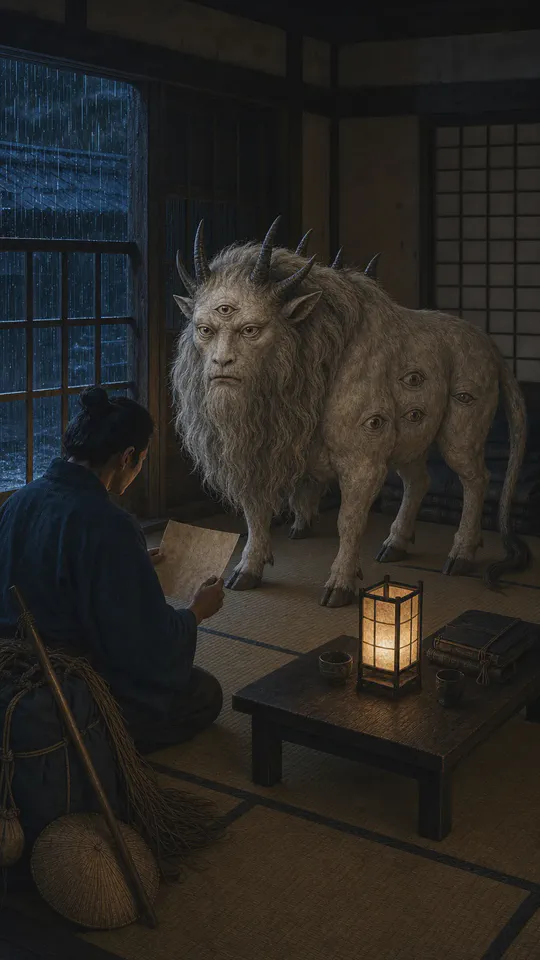
The creature on the sheet had a human face on a four-legged body, three eyes across its brow and three more down each flank, and six horns. Nobody had ever seen one. That was not the point. The point was what it knew.
Hakutaku begins in China, as Bai Ze. The Yellow Emperor met it on a mountain, and the beast — which understood human speech — told him about every harmful thing in the world and how to be rid of it. The emperor had it written down as the Baize tu, the Book of Bai Ze. The book is lost. The idea survived it: a picture of the one creature that knows every monster by name is as good as a guard who can see them coming.
What does hakutaku mean?
The name is written 白澤, or in simplified form 白沢: the first character is white, the second a marsh. Read in Japanese it is hakutaku; read in Chinese, Bai Ze.
For most of its history the name carried no nine-eyed body at all. In Chinese texts of the Han period, Bai Ze has a single horn on its forehead and nothing more. By the Heian period Japanese scholars knew it as a beast that speaks, knows all things, and appears only in the reign of a virtuous ruler. The eyes came much later.
Appearance
The nine eyes and six horns are a late-Edo Japanese invention, assembled from parts people already trusted. The body comes from the kudan, the human-faced ox of the broadsheets; the character — a beast that protects — from the baku, the eater of dreams. Hakutaku arrived in the Edo market already built from other creatures.
It was not the only Hakutaku. In the early seventeenth century, two hundred years before the Edo sheets, Jiryō — Gusukuma Seihō, the earliest painter known by name in the Ryukyu Kingdom, who is said to have been unable to hear or speak — painted a Hakutaku no zu that is now a designated cultural property of Okinawa. Lion-bodied and dragon-bodied versions exist in China and Korea. They share the name and little else.
Our illustration follows the late-Edo type. The pale coat is our choice for the screen.
Behavior and role
- It knows. Every strange and harmful thing in the world, by name.
- It speaks. The exchange with the Yellow Emperor happens in human language.
- It warns, and never fights. No account has it hunting, devouring other spirits, or being summoned against anything. What it gave the emperor was information, and information is what its picture went on selling.
The picture as the charm
Here is a hakutaku you can measure. A hanging scroll in Iwate, titled Hakutaku hikai zu — “the picture of Hakutaku that wards off strangeness” — is 90 centimetres tall and 28 wide, and is kept not as art but as a charm, alongside shrine talismans. It is printed on both sides. The back names the artist, “Shōtō Sanjin,” and three publishers: Kichimonjiya Ichiemon, Funaya Yasubei, and Kobayashi Shinbei. Below them is the promise. Carry this picture with you, it says, and foxes, tanuki, and evil spirits will not come near.
That is a charm, and it is also an advertisement. Three publishers put their names on it because it sold.
It sold to travelers first. A late-Edo travel manual, the Ryokō Yōjinshū, printed a Hakutaku for the reader to carry in the breast of the kimono against the dangers of mountain and sea and against illness on the road. Then, in 1858, it sold to everyone. A picture that protected against evil in general became a picture against the epidemic in particular, by way of the pillow and the bad dream.
Twelve years earlier, a different sea creature had made the same request from the other direction. The Amabie of 1846 asked people to copy its picture and show it around. Hakutaku never asked. Its picture was simply there to be bought.
Weaknesses and countermeasures
Nothing in the tradition opposes a hakutaku. There is no story in which someone has to get past one, and so there is nothing to get past. What the tradition does specify is the reverse: what you had to do for the picture to work. Carry it. Hang it. Put it by your head at night. The conditions are on the paper, not on the beast.
Documented tradition and later imagery
Documented tradition. A Chinese beast, single-horned in Han-period texts, that understood speech and taught the Yellow Emperor the names of all harmful things; known to Japanese scholars by the Heian period; painted in Ryukyu in the early seventeenth century; given a human face, nine eyes, and six horns in late-Edo Japan, with parts borrowed from the kudan and the baku; printed as a charm for travelers, and in 1858 as a sheet for the pillow against cholera.
Later imagery. Modern illustrated collections and games settle Hakutaku into one fixed design, usually a white lion or ox with a countable number of eyes, and treat it as what a hakutaku is.
The historical picture never held still, and did not need to. The scroll on the wall and the sheet by the pillow were not portraits of an animal anyone had seen. They were the protection itself — and a thing whose whole purpose is to be owned can afford to look like whatever the person selling it believed would sell.
Sources and further reading
- Museum Hanging scroll, Hakutaku hikai zu (白澤避怪図) (external link) Iwate Prefectural Museum A painted Hakutaku kept as a charm against misfortune, catalogued with the "warding off strangeness" title the images carried.
- Museum Hakutaku, the numinous beast — exhibition commentary (external link) Koga Historical Museum, Koga City Municipal museum account of the creature's Chinese origin, its meeting with the Yellow Emperor, and its use in Japan as a protective image.
- Museum Hakutaku no zu (白澤之図) (external link) Shurijo Castle Digital Museum A Ryukyuan version of the image, showing that the iconography travelled and changed outside the Japanese mainland.
- Museum Hakutaku hikai zu print (external link) British Museum A printed sheet of the charm, of the kind produced for household use.
- Academic paper Current state and problems in Hakutaku research (external link) Kansai University Academic Repository Survey of the scholarship, covering the transmission from China and the divergence of the surviving images.
Where it was recorded
- 1858
Edo, Tokyo
Print or picture
Hakutaku charm prints during the cholera epidemic
Places named in the records behind this article. Coordinates are approximate. View on the map
Records behind this article
On the timeline
In the glossary
In manga
- Hozuki's Coolheadedness 鬼灯の冷徹 Uses the names, reinvents the rest
- Kakuriyo: Bed & Breakfast for Spirits かくりよの宿飯 Uses the names, reinvents the rest
- Yokai Doctor 妖怪のお医者さん Uses the names, reinvents the rest
Related yokai
Kudan
件(くだん)
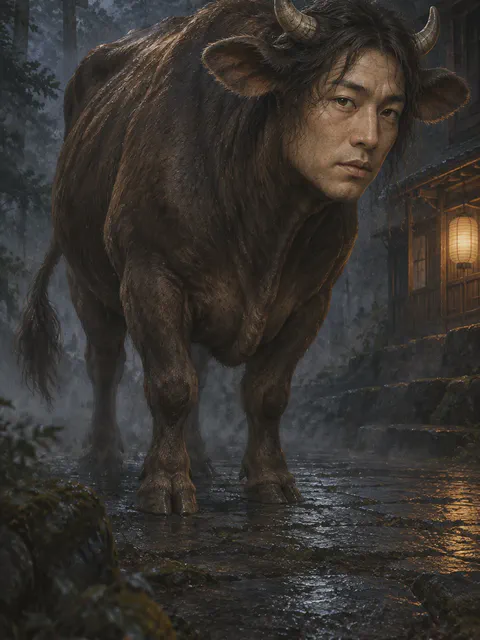
An 1836 broadsheet from Tango described a kudan — a cow's body with a human face — and promised that any house that put up its picture would prosper. Other kudan of the same century foretold disaster instead.
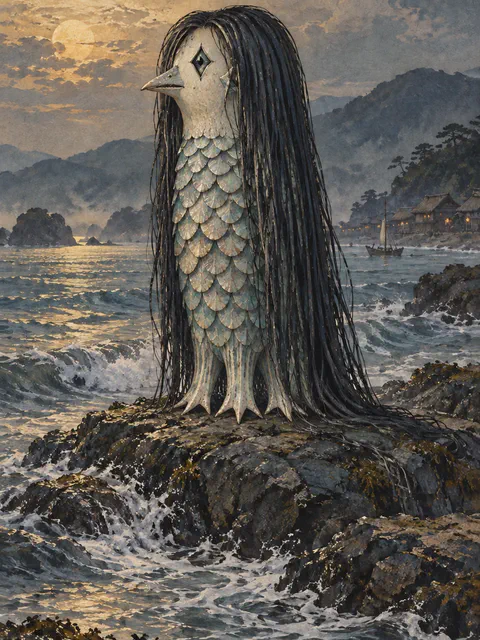
Amabie
アマビエ
A printed sheet dated 1846 tells of a creature with long hair and a beak that rose from the sea off Higo, foretold six years of good harvests and an epidemic, and asked people to copy its picture and show it around.
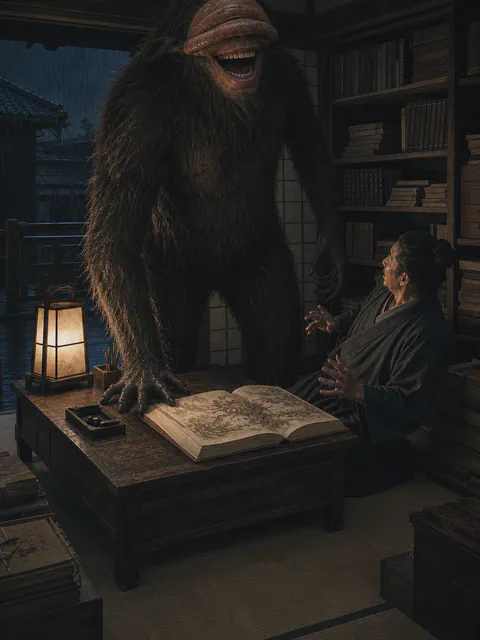
Hihi
狒々(ひひ)
A 1712 Japanese encyclopedia compiled older Chinese descriptions of a black-haired, long-lipped creature that laughs when it sees a person — and whose upper lip then rolls up over its own eyes.
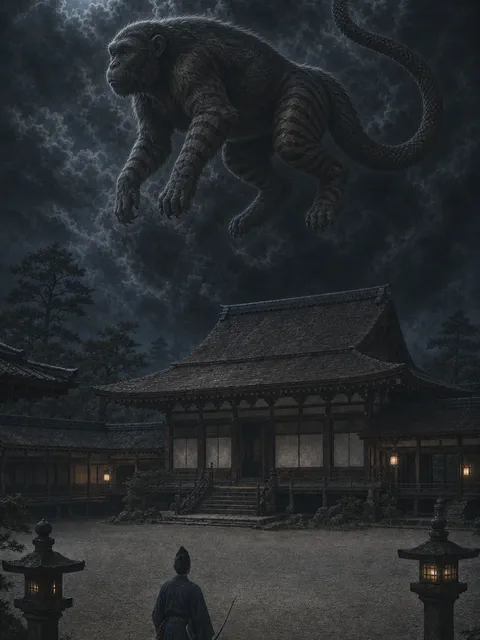
Nue
鵺(ぬえ)
In The Tale of the Heike, a black cloud and a bird's cry sicken the emperor until an archer shoots the creature down — and the versions disagree on what fell.