
Futakuchi-onna (二口女): The Woman With a Second Mouth
The two-mouthed woman of an 1841 picture book, and the brides who hid a mouth under their hair
二口女(ふたくちおんな) Futakuchi-onna ASCII: Futakuchi-onna
Also known as: Futakuchi onna, Kuwazu nyōbō
Pronunciation: foo-tah-KOO-chee OHN-nah
Futakuchi-onna (二口女, “two-mouthed woman”) is the Japanese yokai with a second mouth hidden at the back of her head. In the 1841 Ehon Hyaku Monogatari, she is a stepmother in Shimōsa who starved her husband’s child to death; forty-nine days later a wound opens at the back of her skull, becomes a mouth, and must be fed, her hair lifting the food to it like hands. In the folktales of the wife who eats nothing, the hidden mouth belongs to a bride who turns out to be a snake, a spider or an oni.
Quick Facts
- Habitat
- House
- Region
- Shimōsa (Ehon Hyaku Monogatari), Niigata, Iwate, Kanagawa
- Recorded period
- Ehon Hyaku Monogatari (1841), 20th-century folktale records
- Nature
- Harmful
- Danger rating
- If you meet one
- Run into a stand of iris and mugwort. The man of Iwate escaped there. In the article
The danger rating is an editorial summary made for readability. It is not an objective measure found in folklore sources.
Watch the Short
What is Futakuchi-onna?
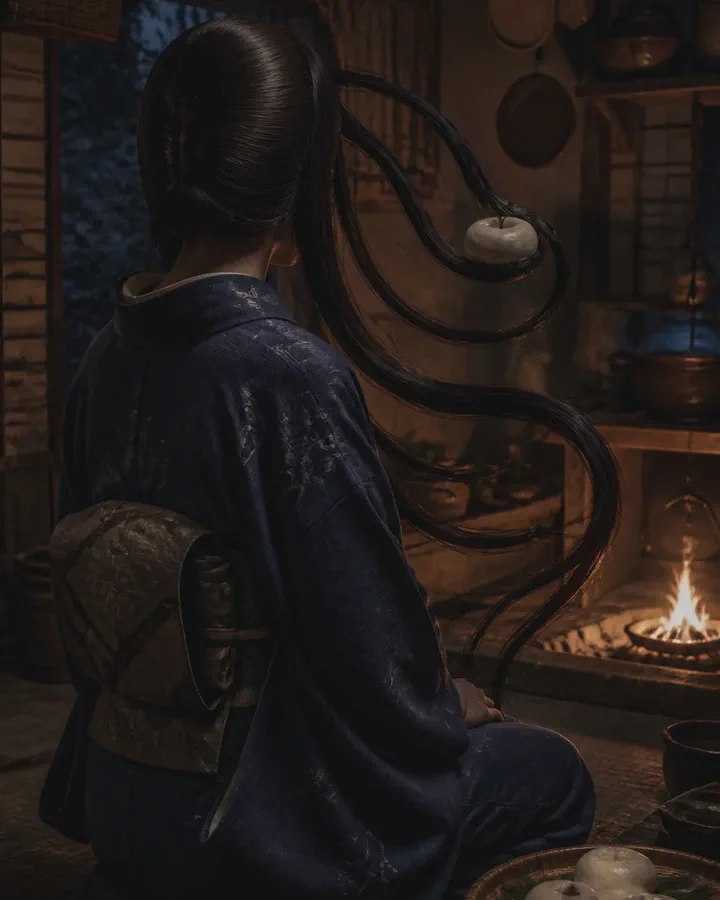
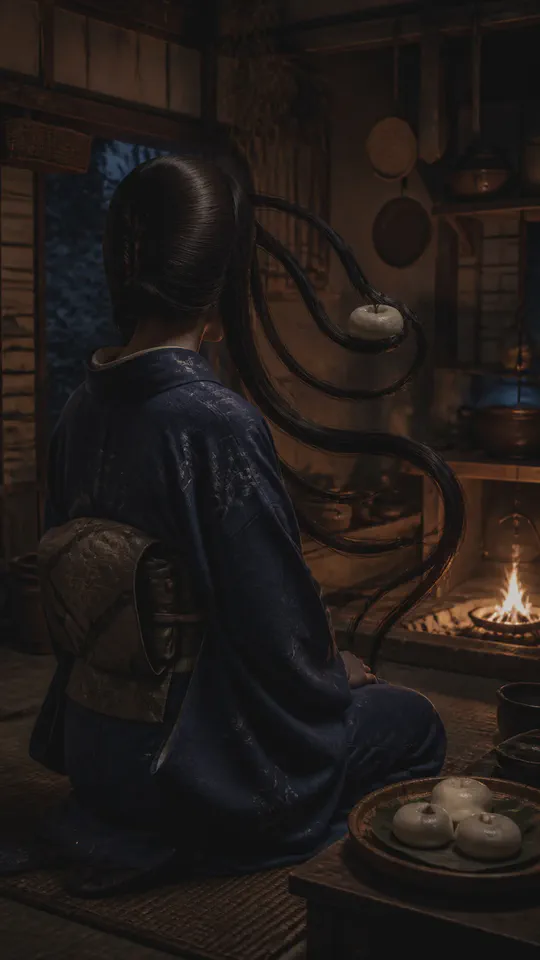
In Shimōsa, east of Edo, a man’s second wife fed her own child and gave nothing to his child from the first marriage, and the stepchild starved to death. Forty-nine days later — the day the Buddhist mourning period ends — the woman was struck at the back of the head, and the wound did not heal. It grew lips. It grew teeth. It hurt her unbearably unless it was fed, and when it was hungry her hair rose up of its own accord, like two thin arms, and carried rice to it.
That is the futakuchi-onna of Ehon Hyaku Monogatari, the “Picture Book of a Hundred Stories” written by Tōsanjin and illustrated by Takehara Shunsen in 1841. It is a punishment, and the book says so. A woman who withheld food becomes a mouth that can never be refused.
What does futakuchi-onna mean?
The name is written 二口女: futa, two; kuchi, mouth; onna, woman. The woman with two mouths — one in the usual place, and one under the hair at the back of her head. It is pronounced foo-tah-KOO-chee OHN-nah.
The name describes the body. It leaves open the question the two traditions answer differently: whose body, and why.
The wife who eats nothing
Across Japan, folklorists recorded a different story under names like kuwazu nyōbō, “the wife who eats nothing.” A stingy man says he wants a wife who will not eat. One arrives. She never touches a grain in front of him — and his rice keeps vanishing. He hides in the rafters and watches.
In Iwafune, in Niigata, as told in 1948, a cooper watches his wife undo her hair and tip a whole bale of rice into a mouth at the back of her head. She is a snake. He tries to throw her out; she stuffs him in a tub and carries him off; he slips away, and leaves in the tub a gourd and rice grains threaded on needles. She feeds the rice to her young and eats some herself, and the needles kill them all.
In Nishiiwai, in Iwate (1939), the mouthless bride has her mouth on the top of her head; found out, she turns into an oni and chases the man, and he saves himself by diving into a stand of iris and mugwort. In Kanagawa (1977) the bride is a spider, and the neighbours have to be called to get him back.
These women are not being punished for anything. They are something else wearing a wife’s shape, and the hidden mouth is how you find out.
Appearance
An ordinary woman from the front; a mouth where no mouth belongs. The 1841 illustration gives it hair that works like hands. The folktales put it on the crown or the back of the head and leave the rest to the listener. Our short keeps the body unreal, shows her from behind, and lets the hair do the work.
Behavior and abilities
- The second mouth must eat. In the 1841 tale it demands food and tortures her when refused; in the folktales it eats in secret and enormously.
- The hair serves it. In the picture book, strands of hair lift the food.
- It is hidden. Every version turns on the moment someone sees what they were never meant to see.
Is the futakuchi-onna evil?
It depends which one. The 1841 woman did a terrible thing and the mouth is her sentence; she is a sinner, not a monster. The brides of the folktales did nothing except be hungry and not be human; they are monsters, and the story treats the husband’s escape as the happy ending. Both tales judge a woman by what she eats and whether she hides it. Which mouth is the evil one depends on who is telling the story.
Weaknesses and countermeasures
The 1841 woman has no escape; the mouth is the consequence, and the book offers no cure. The husbands do better. Iris and mugwort — the plants hung from the eaves at the Boys’ Festival to keep evil out — save the man in Iwate. Rice threaded on needles kills the snake wife in Niigata. Shouting for the neighbours works in Kanagawa.
Documented tradition and later imagery
Documented tradition. Ehon Hyaku Monogatari (1841): a Shimōsa stepmother who starved a child is given a second mouth at the back of her head, fed by her hair. Separately, twentieth-century records of the wife who eats nothing: a snake wife and the needles in the rice (Iwafune, Niigata, 1948); a bride with a mouth on her crown who becomes an oni and is escaped through iris and mugwort (Nishiiwai, Iwate, 1939); a spider bride (Kanagawa, 1977).
Later imagery. The modern futakuchi-onna merges the two — a wife who eats nothing at the table, with the 1841 mouth and the moving hair — into one creature with one origin, which she never had. The picture book punishes a woman for not feeding a child; the folktales unmask one for feeding herself.
Sources and further reading
- Library Ehon Hyaku Monogatari (絵本百物語), 1841 (external link) National Diet Library Search The illustrated collection carrying the Isonade account of a shark-like creature in the western sea that attacks with its tail.
- Fieldwork collection The wife who eats nothing, record 2181901 (external link) International Research Center for Japanese Studies Minkan Denshō (1948), Iwafune district, Niigata. A cooper's wife eats a bale of rice through a mouth at the back of her head; she is a snake.
- Fieldwork collection The wife who eats nothing, record 1231019 (external link) International Research Center for Japanese Studies Tabi to Densetsu (1939), Nishiiwai district, Iwate. A mouthless bride has a mouth in her head, turns into an oni, and loses the man in iris and mugwort.
- Fieldwork collection The wife who eats nothing, record C1450092-000 (external link) International Research Center for Japanese Studies Kanagawa Kenshi, Minzoku (1977). The bride who eats nothing is a spider.
Where it was recorded
- 1841
Shimōsa Province, Chiba
Legend or tale
Stepmother punished with a second mouth (Ehon Hyaku Monogatari)
- 1948
Iwafune District (Murakami), Niigata
Folklore record
Snake wife who ate a bale of rice through the back of her head
- 1939
Nishiiwai District, Iwate
Folklore record
Bride with a mouth on her crown who became an oni
- 1977
Kanagawa, Kanagawa
Folklore record
Spider bride; neighbours called to rescue the husband
Places named in the records behind this article. Coordinates are approximate. View on the map
Records behind this article
On the timeline
In the glossary
In manga
- Kiitarō Shōnen no Yōkai Enikki 奇異太郎少年の妖怪絵日記 Keeps the traditional forms, invents the stories
- Yokai Doctor 妖怪のお医者さん Uses the names, reinvents the rest
Related yokai
Yamauba
山姥(やまうば)
A man carries a woven object home from the hills, and that night a woman's voice demands the return of her ashinaka.
Rokurokubi
轆轤首(ろくろくび)
A seemingly human figure whose neck stretches at night—and one name that once covered more than one uncanny form.
Jorōgumo
絡新婦(じょろうぐも)
At a waterfall in Shizuoka, a spider winds one fine thread around a man's foot—and reveals enough strength to tear a mulberry stump from the earth.