Chōchin-obake (提灯お化け): The Paper Lantern That Looked Back
Japan's lantern yokai, in the one print that records it
提灯お化け(ちょうちんおばけ) Chōchin-obake ASCII: Chochin-obake
Also known as: Chōchin no obake, Chochin obake
Pronunciation: CHOH-cheen oh-BAH-keh
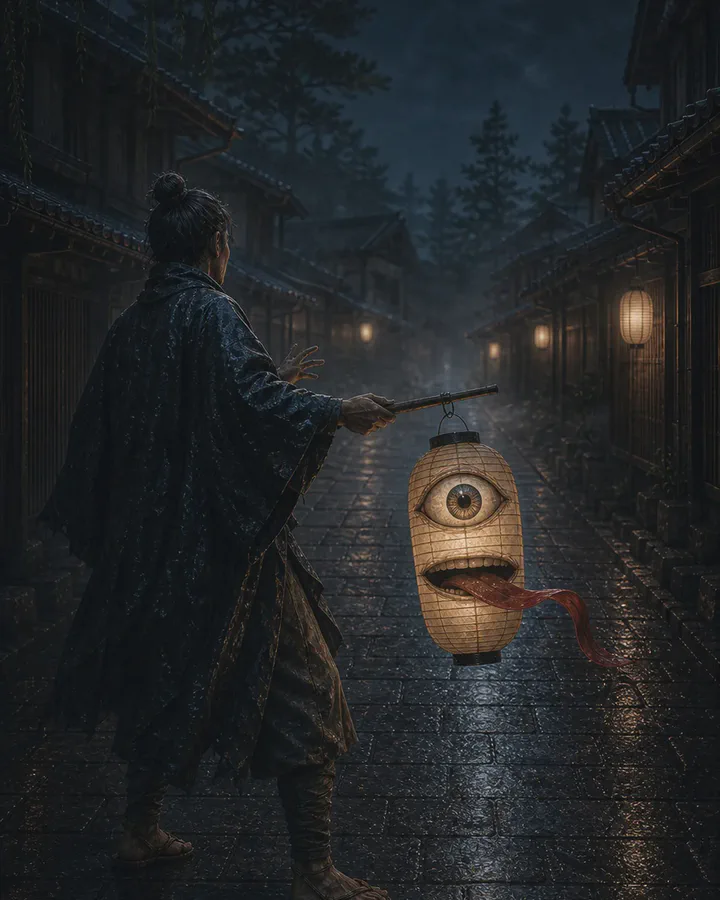
Chōchin-obake (提灯お化け, “lantern ghost”) is the Japanese paper-lantern yokai: a chōchin, the collapsible paper lantern carried on a pole at night, that has split open into a mouth and grown an eye. Its record is one small figure among forty-eight monsters on a nineteenth-century print by Yoshimori — a lantern with an eye and a mouth, and something coming out of the mouth. No story, no victim, no origin. The grinning tongue-lolling character everyone knows was built on that.
Quick Facts
- Habitat
- Road, House
- Region
- unspecified
- Recorded period
- Yoshimori's Shinban Bakemono-zukushi, modern popular imagery
- Nature
- Unknown
- Danger rating
The danger rating is an editorial summary made for readability. It is not an objective measure found in folklore sources.
Watch the Short
What is Chōchin-obake?
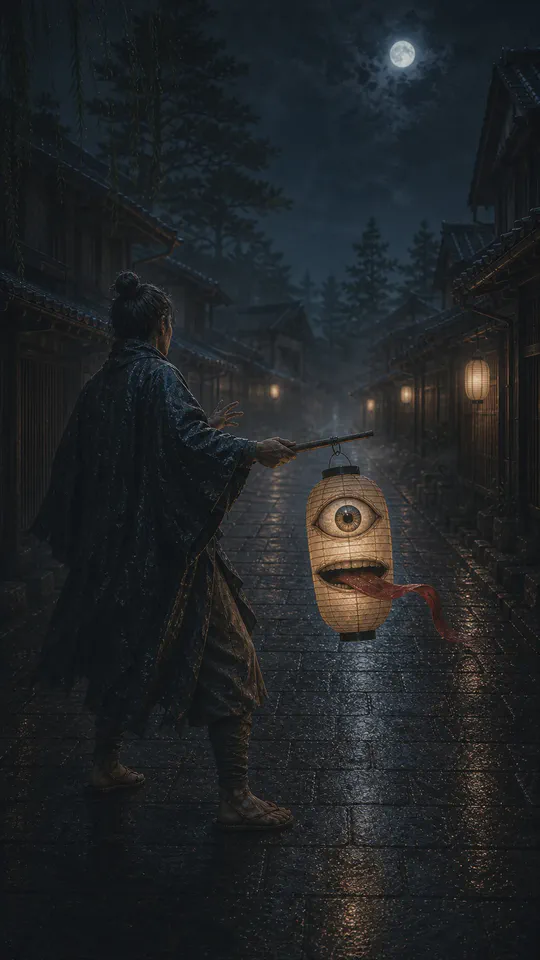
You are walking a wet street at night with a paper lantern held out on a pole to light the way, and the lantern opens an eye. Below the eye, the paper splits into a mouth, and something comes out of it.
That is the chōchin-obake, one of the most recognisable yokai in Japan and one of the thinnest in the record. It is a single figure on a single sheet: Yoshimori’s Shinban Bakemono-zukushi, “A New Edition: All Kinds of Monsters,” a popular print of forty-eight creatures. The catalogue entry for the figure labelled chōchin no obake says three things. It is a lantern monster. The lantern has an eye and a mouth. Something appears to be coming out of the mouth.
What does chōchin-obake mean?
The name is written 提灯お化け. A chōchin is a paper lantern — a cylinder of paper on a collapsible bamboo frame, with a candle inside, carried on a pole or hung at a door. An obake is a thing that has changed, a shape-shifter, a ghost. The chōchin-obake is the lantern that has become something else. It is pronounced CHOH-cheen oh-BAH-keh.
Appearance
A paper lantern with an eye and a mouth, and something issuing from the mouth; the catalogue does not name the something. Our illustration reads it as a long paper strip hanging like a tongue and gives the lantern one large eye. Both are our reading. The lantern is being carried on a pole along a wet night street, because that is what lanterns are for.
Behavior and abilities
- It looks. The eye is the first thing the catalogue mentions.
- Something comes out of its mouth. The second.
There is no third. The print records no flight, no attack, no laughter and no victim.
A face on a thing you carry
The chōchin-obake belongs with the karakasa-kozō, the one-legged umbrella, and the bakezōri, the running sandal: household objects given faces in the parade scrolls and monster prints of the Edo period, where they were comic as often as frightening. Modern retellings explain all of them as tsukumogami, tools that come alive after a hundred years of use. That idea has a history of its own, and it is not on Yoshimori’s sheet. The sheet has a lantern with a face in a crowd of forty-seven other monsters, drawn to be enjoyed.
Weaknesses and countermeasures
None are recorded, because no threat is. A picture of a lantern with a face has no encounter in it to defend against.
Documented print and later imagery
Documented print. Yoshimori, Shinban Bakemono-zukushi, a sheet of forty-eight monsters: the figure chōchin no obake, a lantern with an eye and a mouth and something apparently coming out of the mouth. No narrative is given.
Later imagery. The modern chōchin-obake is a finished character — a torn lantern split into a grin, a long tongue, one or two eyes, often floating on its own, and often supplied with a ghost story. What the print keeps is a small, sharp reversal. The thing you carry to see by has started to see you. If your lantern blinked tonight, you would still need it to get home.
Sources and further reading
- Database Chōchin no obake (ちうちんのおばけ), U426_nichibunken_0073_0021_0000 (external link) International Research Center for Japanese Studies A lantern with an eye and a mouth, something appearing to come out of the mouth. One figure on Yoshimori's sheet Shinban Bakemono-zukushi.
- Database Shinban Bakemono-zukushi (しん板化物尽し), U426_nichibunken_0073 (external link) International Research Center for Japanese Studies Parent record; the sheet shows forty-eight different monsters.
- Library Shinban Bakemono-zukushi (しん板化物尽し), library catalogue record TW92076297 (external link) International Research Center for Japanese Studies Library One colour woodblock sheet, 34.8 by 22.7 cm, drawn by Utagawa Yoshimori, with the mark of the publisher Yamajin. Place of publication unknown; date given only as [18--].
- Database Database of Yokai Images (怪異・妖怪画像データベース) (external link) International Research Center for Japanese Studies Image database used to compare how a motif was depicted across artists and periods.
Records behind this article
In the glossary
In manga
- Ayakashi Triangle あやかしトライアングル Uses the names, reinvents the rest
- Kiitarō Shōnen no Yōkai Enikki 奇異太郎少年の妖怪絵日記 Keeps the traditional forms, invents the stories
Where to see it
- Ichijō Yōkai Street and Daishōgun Hachi Shrine 一条妖怪ストリート(大将軍商店街)と大将軍八神社 Street
Related yokai
Karakasa-kozō
唐傘小僧(からかさこぞう)
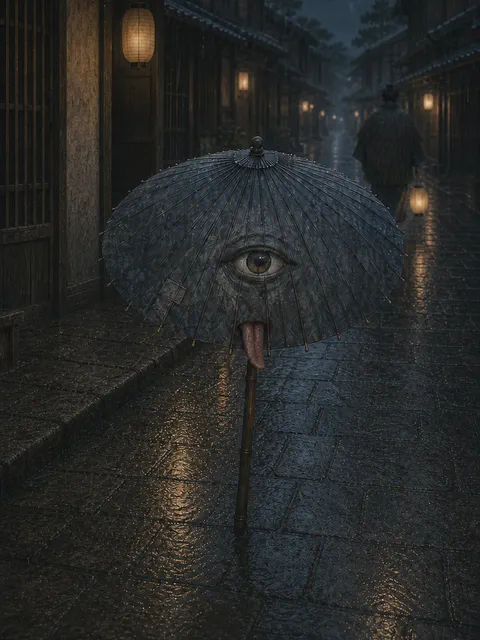
An 1857 Osaka print shows a kabuki actor playing a one-legged umbrella monster — the clearest history of a yokai known through pictures rather than encounters.
Bakezōri
化け草履(ばけぞうり)
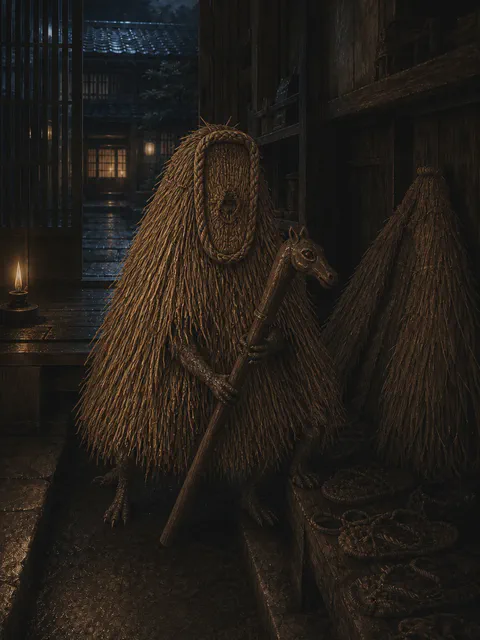
A yokai scroll in the Nichibun collection shows a sandal monster covered in yellow straw, with a straw sandal for a face, riding a horse-head staff. It is stranger than the one-eyed singing sandal of modern books, and it comes with no story.
Ittan-momen
一反木綿(いったんもめん)
A white bolt of cloth that flutters across a rural night road, dazzles a traveler and attacks.