
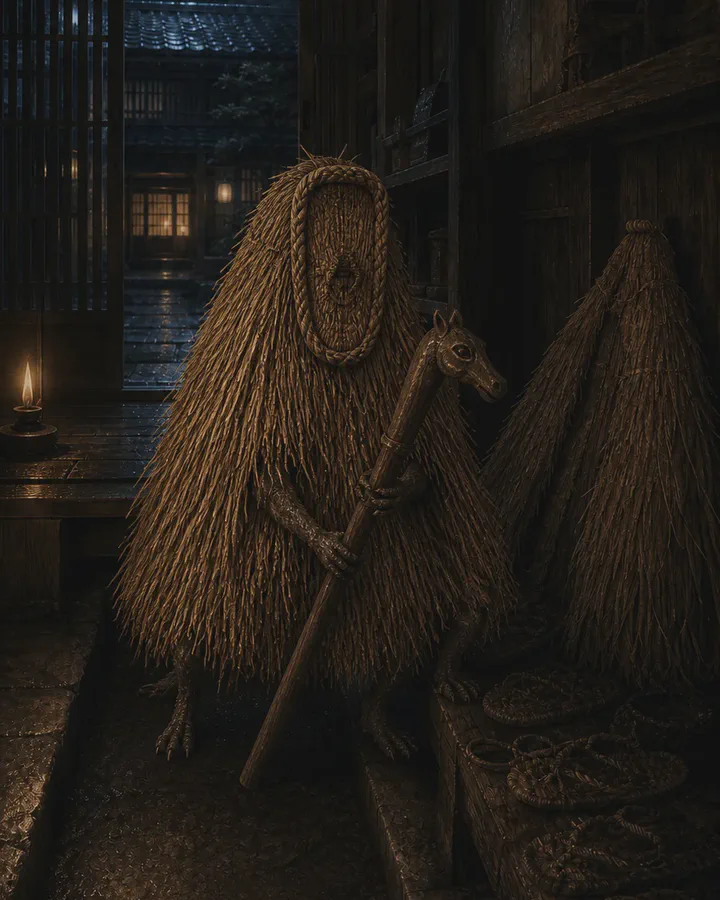
Bakezōri (化け草履): The Sandal Monster in a Straw Cloak
Japan's sandal yokai, as a parade scroll drew it
化け草履(ばけぞうり) Bakezōri ASCII: Bakezori
Also known as: Bake-zōri, Bakezouri
Pronunciation: bah-keh-ZOH-ree
Bakezōri (化け草履, “changed sandal”) is the straw-sandal yokai of Japanese folklore. In a yokai parade scroll in the Nichibun collection it is a figure cloaked from head to foot in yellow straw, with a woven sandal for a face, riding a staff carved with a horse’s head, animal limbs showing under its hem. The one-eyed sandal that runs round the house at night singing is a modern design; the scroll’s creature comes with no song, no story and no explanation.
Quick Facts
- Habitat
- House, Road
- Region
- unspecified
- Recorded period
- Yōkai Emaki (Nichibun collection), modern popular imagery
- Nature
- Unknown
- Danger rating
The danger rating is an editorial summary made for readability. It is not an objective measure found in folklore sources.
Watch the Short
What is Bakezōri?
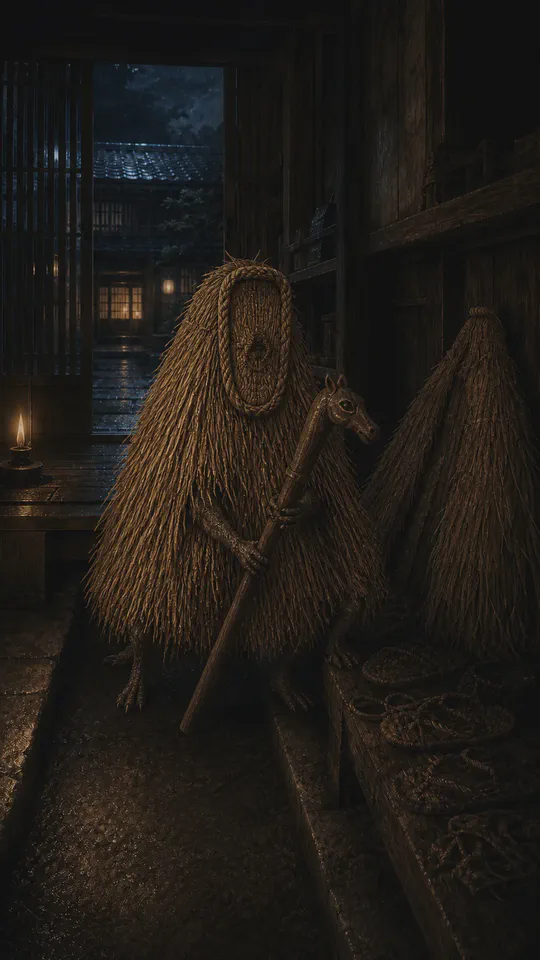
In a scroll of yokai marching in procession — animals and household things in a long line — one figure is cloaked from head to foot in yellow straw. Where its face should be there is a waraji, a tied straw sandal. It sits astride a staff with a horse’s head carved on the end, like a child’s hobby-horse, and from under the hem of the straw, arms and legs like an animal’s are showing.
That is the bakezōri of the Yōkai Emaki in the Nichibun collection, and the catalogue description above is very nearly the whole record. The scroll has no text; a signature of Hanabusa Itchō stands at its end, and nothing dates it. The figure is in a parade, and that is its only recorded activity.
What does bakezōri mean?
The name is written 化け草履: bakeru, to change form, and zōri, a sandal — in old usage the flat woven straw kind, cousin of the waraji worn for the road. The changed sandal, the sandal that has become something else. It is pronounced bah-keh-ZOH-ree.
Appearance
Less a sandal with a face than a creature wearing one. The yellow straw hangs like a mino, the straw raincoat of farmers and travellers, to the ground; where the face should be is a sandal; below, something with animal limbs is holding the whole costume up and riding a toy horse. Our illustration follows the catalogue — the straw cloak, the sandal face, the staff — and sets it on a threshold at night.
Behavior and abilities
- It is in a procession. It belongs to a scroll of animals and objects on the move.
- It rides. The horse-head staff is the one gesture it makes.
The scroll gives no song, no chase, no voice and no reason.
Weaknesses and countermeasures
None are recorded. A figure in a parade has nothing to be defended against.
A separate explanation, collected by the Mizuki Shigeru Memorial Museum, ties a bakezōri to a household in Ise that treated its footwear carelessly, and to a creature that went into the storehouse at night. That is a different tradition with its own logic of neglect and consequence, and it is not the scroll figure. Its cousins are the other household things of the parade scrolls — the karakasa-kozō umbrella, the chōchin-obake lantern — drawn to be enjoyed rather than feared.
Documented scroll and later imagery
Documented scroll. A Yōkai Emaki in the Nichibun collection: a sandal monster covered in yellow straw, with a waraji face, riding a horse-head staff, animal-like arms and legs beneath its hem. No story is given.
Later imagery. The standard modern bakezōri is a single sandal with one eye, two arms and two legs, running through the house at night and singing a song about three eyes and two teeth — a lesson about looking after worn-out things. It is tidy and a little comic, and it is a separate image from the scroll. The scroll’s version is harder to explain. Something is wearing straw, wearing a sandal as a face, and riding a toy horse through the dark, and it is not telling anyone why.
Sources and further reading
- Database Sandal and straw-cloak waraji, U426_nichibunken_0154_0078_0000 (external link) International Research Center for Japanese Studies A sandal monster covered in yellow straw, with a waraji for a face, astride a horse-head staff, animal-like limbs showing below the hem.
- Database Yōkai Emaki (妖怪絵巻), U426_nichibunken_0154 (external link) International Research Center for Japanese Studies Parent record; a scroll of animal and utensil monsters parading.
- Library Yōkai Emaki (妖怪絵巻), library catalogue record BB10059786 (external link) International Research Center for Japanese Studies Library One painted scroll, 30 by 1109 cm, colour on paper. Title supplied by the cataloguer; place, maker and date of making unknown ([1---]). A signature of Hanabusa Itchō at the end of the scroll; the attribution is given in brackets.
- Museum Yokai that live in the house, no. 149: Bakezōri Mizuki Shigeru Memorial Museum A separate Ise explanation tied to a household careless with footwear; not the same tradition as the Nichibun scroll figure.
Records behind this article
In the glossary
Related yokai
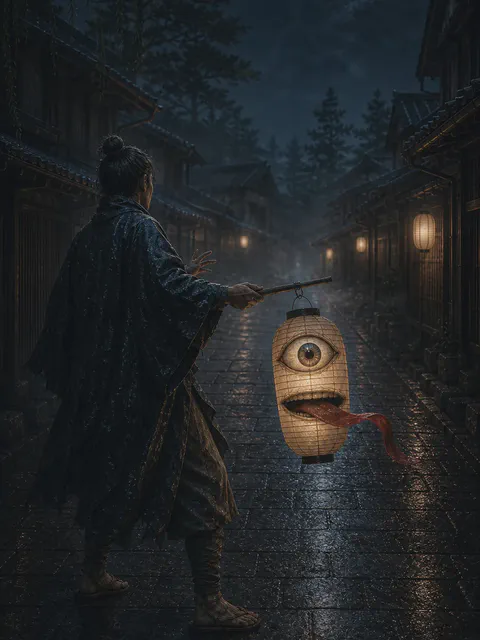
Chōchin-obake
提灯お化け(ちょうちんおばけ)
One of forty-eight monsters on Yoshimori's print Shinban Bakemono-zukushi is a paper lantern with an eye, a mouth, and something coming out of the mouth. That picture is the record — there is no story attached to it.
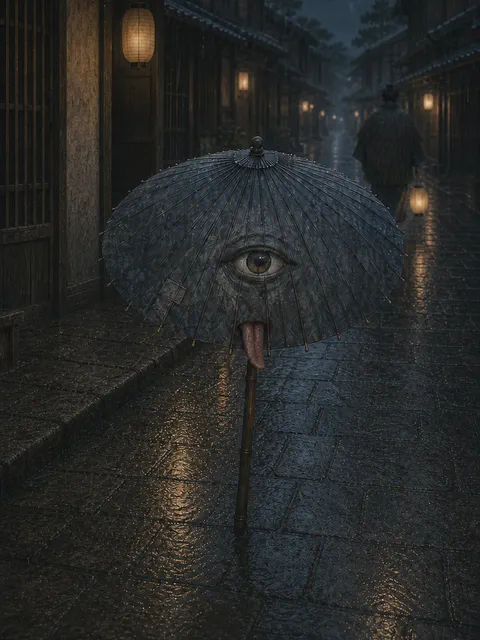
Karakasa-kozō
唐傘小僧(からかさこぞう)
An 1857 Osaka print shows a kabuki actor playing a one-legged umbrella monster — the clearest history of a yokai known through pictures rather than encounters.
Ittan-momen
一反木綿(いったんもめん)
A white bolt of cloth that flutters across a rural night road, dazzles a traveler and attacks.