
Azuki-arai (小豆洗い, Azuki-togi): The Bean-Washing Sound by the Water
Japan's unseen yokai of streams and bridges — heard everywhere, almost never seen
小豆洗い(あずきあらい) Azuki-arai ASCII: Azuki-arai
Also known as: Azuki-togi, 小豆とぎ
Pronunciation: ah-zoo-kee ah-rye
Azuki-arai (小豆洗い, “azuki-bean washer”; also azuki-togi) is the Japanese yokai you hear and do not see: beside a stream or under a bridge at night comes the dry shoki-shoki of red beans being washed in a basket, and nobody is there. In Suwa an old man met a boy on the road, spoke to him, and watched him vanish — and on the way home heard the beans at the same spot. In Ehime the sound under the bridge seemed to be counting: one shō, five gō, shaari-shari.
Quick Facts
- Habitat
- River, Mountain
- Region
- Kitasaku (Nagano), Suwa (Nagano), Ehime, Ōita
- Recorded period
- 1938 folklore record, 1943 folklore records, modern folklore collections
- Nature
- Unknown
- Danger rating
The danger rating is an editorial summary made for readability. It is not an objective measure found in folklore sources.
Watch the Short
What is Azuki-arai?
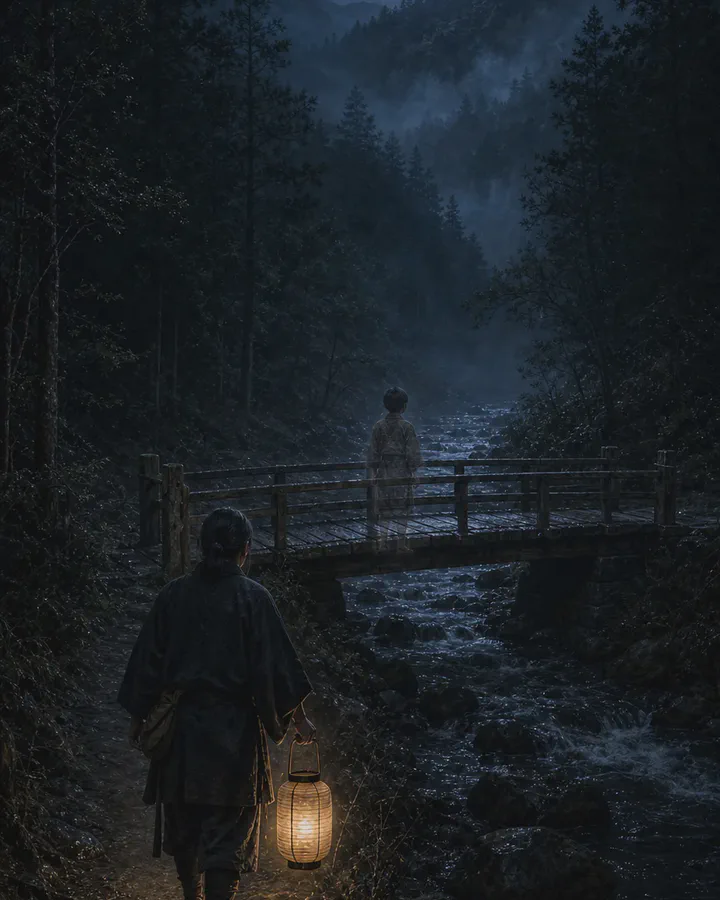
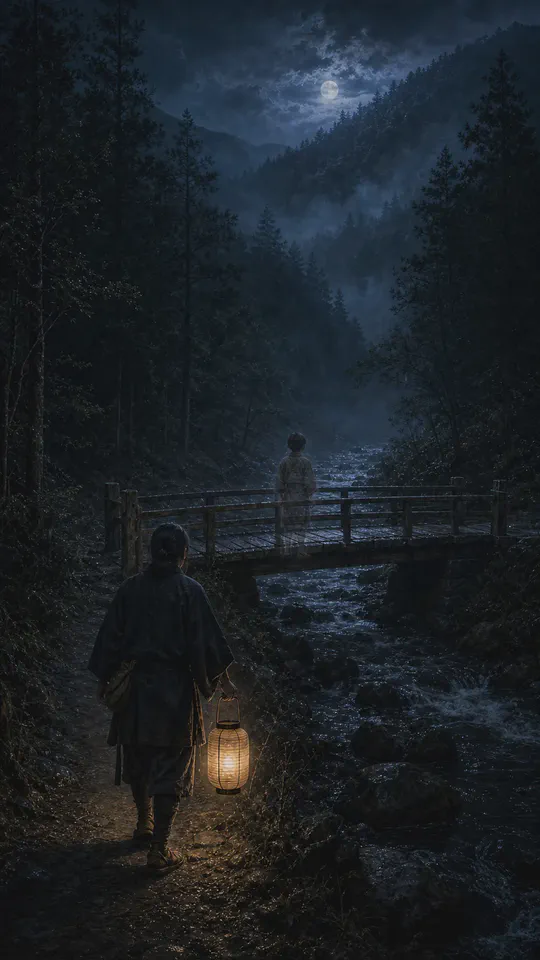
An old man in Suwa, in Nagano, went into town one evening and passed a boy on the road — a young lad in a kimono whose pattern he could make out clearly even in the dark. He went up to say something to him. The boy vanished, all at once, like a bubble. On the way home the old man came back along the same road, and at the place where the boy had stood he heard it: shoki-shoki, shoki-shoki, the sound of azuki beans being washed.
That was told in 1943, and it is the azuki-arai with a face, which is unusual. In Kitasaku, in the same prefecture, in 1938, there was only the sound — beans being rinsed at the water’s edge, and the belief that a bakemono was making it.
What does azuki-arai mean?
The name is written 小豆洗い: azuki, the small red bean, and arau, to wash. The bean-washer. Before cooking, azuki are rinsed and rubbed together in a basket, and they make a distinctive dry rattle; everyone in old Japan knew the sound from their own kitchen. Azuki-togi, “bean-polisher,” is the same creature under the verb for scrubbing rice.
The name is a sound, displaced. A kitchen noise, outdoors, at night, by water, with nobody doing the work.
Appearance
Mostly none. The Kitasaku record describes a sound and a belief. In Higashichikuma, in Nagano, as recorded in 1943, the azuki-arai comes out to the mountain stream with a black hand-towel over its head and washes its beans. In Suwa it is a boy who disappears when spoken to.
Our illustration follows Suwa — a boy in a faded patterned robe on a wooden bridge, dissolving into the stream mist as a lantern is raised toward him — and treats him as one valley’s image, not everyone’s.
Behavior and abilities
- It makes the sound. A repeated dry rattle of beans in a basket, beside water, in the dark.
- It is not found. Approaching the water does not reveal who is washing.
- It vanishes when addressed. In Suwa, the boy was gone the moment the old man spoke.
- It counts. Under a bridge in Tōon, in Ehime, as told in 1978, the sound on rainy nights seemed to say isshō gongō, shaari-shari — “one measure and a half, shaari-shari” — and people were afraid of it. Other bridges nearby had their own.
In Kunisaki, in Ōita, as recorded in 1986, they had an answer. The sound by the wells and pools was a weasel, chattering its teeth.
Weaknesses and countermeasures
None in any of the records. There is no charm, phrase or offering, and no attack for one to prevent. The Suwa boy vanished when spoken to, and the sound carried on behind the old man’s back anyway. The useful advice is the ordinary kind for any dark riverbank: an unexplained noise is a poor reason to step toward deep water.
Documented tradition and later imagery
Documented tradition. A bean-washing sound at the water’s edge, laid to a bakemono (Kitasaku, Nagano, 1938); a boy who vanished when spoken to, with the sound heard afterward at the same spot (Suwa, Nagano, 1943); a washer with a black towel over its head at the stream (Higashichikuma, Nagano, 1943); a counting sound under a bridge on rainy nights (Tōon, Ehime, 1978); and a weasel chattering its teeth (Kunisaki, Ōita, 1986).
Later imagery. Pictures and games make the azuki-arai a single character — a grinning old man with a basket of red beans, sometimes with a song about whether to wash beans or catch a person to eat. Those songs and faces have sources of their own in other regions. The records above have almost nothing to show, which is the point: dark water, a kitchen sound, and the feeling that someone just beyond the lantern has stopped work to listen to you.
Sources and further reading
- Fieldwork collection Azuki-togi and Azuki-arai account from Kitasaku, Nagano, record 2180714 (external link) International Research Center for Japanese Studies The adopted 1938 account: a sound like azuki beans being washed comes from the water's edge, where people say a strange being makes it.
- Fieldwork collection Azuki-arai and a vanishing boy from Suwa, Nagano, record 2181773 (external link) International Research Center for Japanese Studies A distinct account published in 1943: an old man meets a boy whose patterned clothing is visible in darkness; the boy disappears when addressed, and the bean-washing sound is heard on the return journey.
- Fieldwork collection Azuki-arai wearing a black head cloth, Nagano, record 2181770 (external link) International Research Center for Japanese Studies A visible regional form published in 1943; not the appearance given in the sound-only Kitasaku record.
- Fieldwork collection Azuki-washing sound beneath a bridge in Ehime, record 0200280 (external link) International Research Center for Japanese Studies A regional account published in 1978 that places the sound under a bridge on a rainy night.
- Fieldwork collection Unseen Azuki-arai account from Ōita, record C4410037-000 (external link) International Research Center for Japanese Studies A regional account published in 1986 in which the source of the bean-washing sound cannot be seen.
- Reliable secondary The origin of Azuki-arai — why does it wash azuki beans? (external link) National Diet Library Search Bibliographic record for a scholarly discussion of the bean-washing motif and its origins.
Where it was recorded
- 1938
Kitasaku District, Nagano
Folklore record
Bean-washing sound at the water's edge
- 1943
Suwa, Nagano
Folklore record
Boy who vanished when spoken to; beans heard at the same spot
- 1943
Higashichikuma District, Nagano
Folklore record
Washer with a black towel over its head at the stream
- 1978
Tōon, Ehime
Folklore record
Counting sound under a bridge on rainy nights
- 1986
Kunisaki, Ōita
Folklore record
Sound by wells and pools, explained as a weasel
Places named in the records behind this article. Coordinates are approximate. View on the map
Records behind this article
On the timeline
In the glossary
In manga
- Kiitarō Shōnen no Yōkai Enikki 奇異太郎少年の妖怪絵日記 Keeps the traditional forms, invents the stories
Where to see it
- Mizuki Shigeru Road 水木しげるロード Street
Related yokai
Yamabiko
山彦(やまびこ)
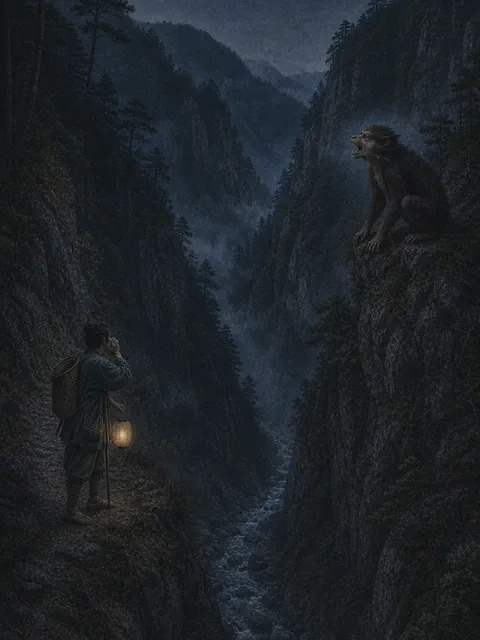
The echo in a Japanese valley was heard as an answer before anyone drew the thing answering — and when painters finally gave it a body, they produced a small animal that is neither quite a dog nor quite a monkey.

Kawa-akago
川赤子(かわあかご)
Toriyama Sekien drew an infant-shaped creature rising from the water plants of a mountain river in 1779, watching a man on a raft — and admitted in the caption that he was guessing about what it was.
Kodama
木霊(こだま)
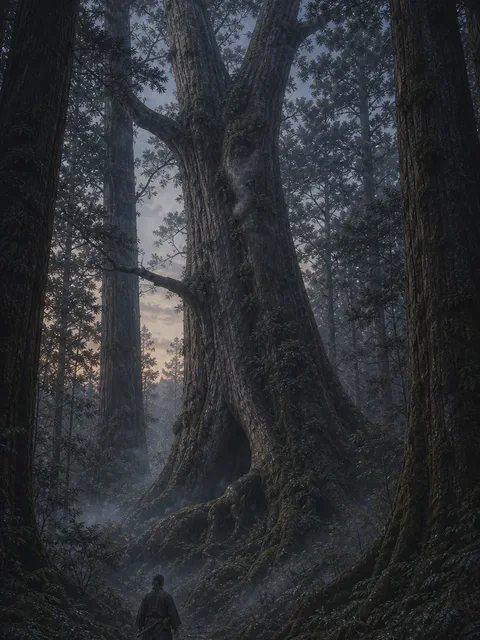
Kodama can mean both a presence within an old tree and the echo that returns from a mountain — but Japanese tradition gives it no single fixed body.